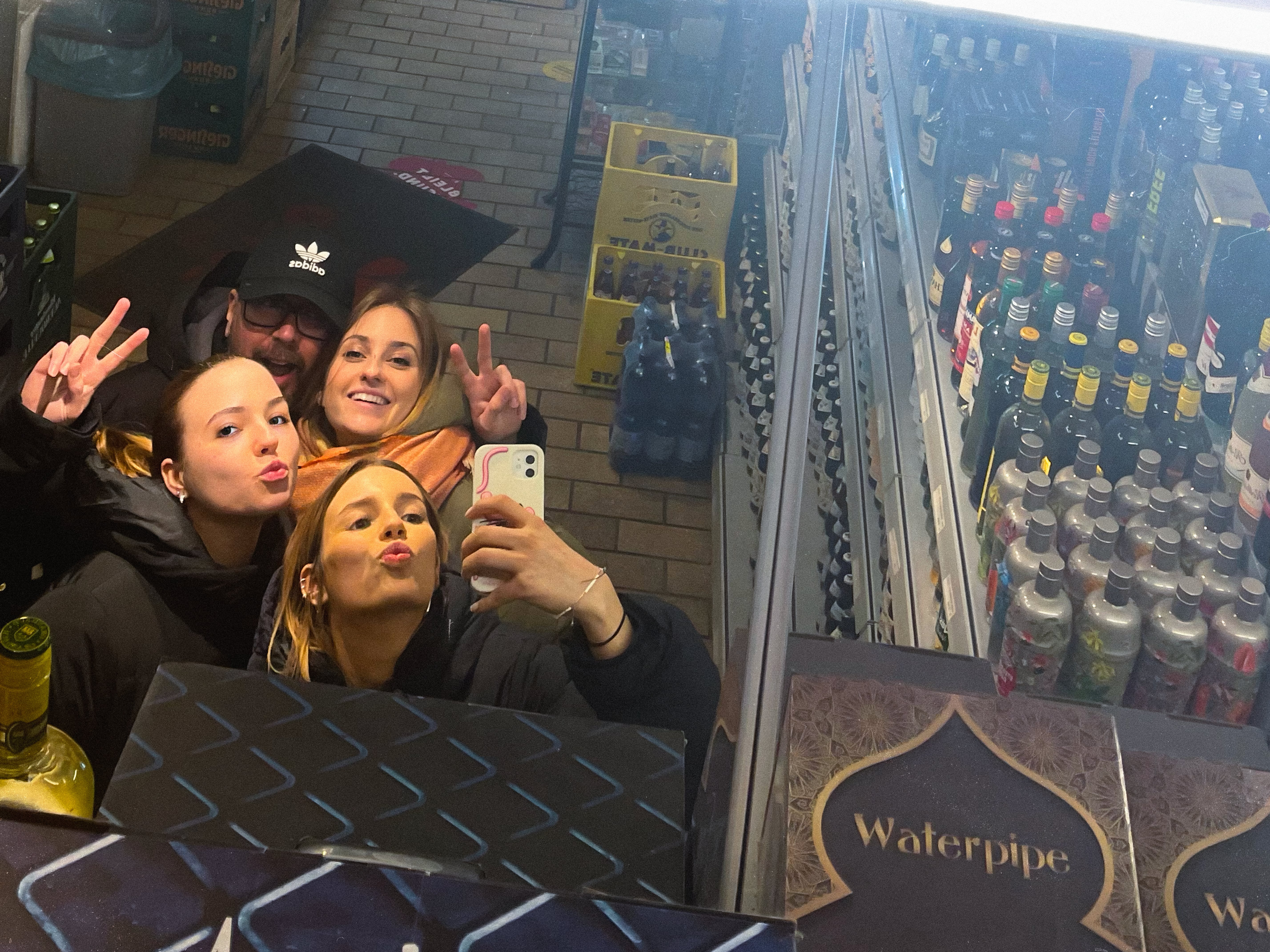
The second semester of my studies in Interactive Media has just said goodbye to me. Officially it doesn’t end until the end of September but with the semester break starting in the next few days, I can justifiably say that my first year at college is now over.
It has been a year full of new people, experiences, and joy of life. I have learned, designed, and programmed. We made our own movies, build machines, and create animations, tried our hand at programming languages, and almost single-handedly destroyed the university’s beverage budget in the form of beer, beer, and more beer.
I joined the design student council and a Dungeons & Dragons club, helped out at events in front of and behind the scenes, and spent some nights at the campus because I missed the last train home more than once.
While a few months ago, I was still convinced that I wanted to devote myself entirely to visual wonders and thus pursue a Bachelor of Arts, in recent weeks I have come to the decision that I would like to try my hand at the Bachelor of Science after all and thus prove myself in the world of bits and bytes.
The good thing about this plan is that if it fails, I can still crawl back into the art world the following semester. Possibly because the physics-soaked math has taken the fun out of it for me. I would then only have to make up a few missing modules.
In the next semester, we will have to try out various elective modules in the areas of design, computer science, and gaming and decide in which country we would like to spend our semester abroad.
I’m currently leaning towards Japan, Finland, or Estonia, but I still have little a bit of time to think about it in peace. Besides, I have to be accepted there first, and this decision is, sadly, not mine alone. But let’s see in which part of the world I’ll end up in the coming winter.
My versatile studies have given me, and I’m not exaggerating, a sense of life again. A reason to get up early in the morning. To come to campus with joy, smile at familiar faces, and experience new adventures with people I already know or just met for the first time. And for that, I want to thank everyone who has shared this journey with me so far.
I’m really glad I decided to apply at Technical University of Applied Sciences in Augsburg last year for being able to have this opportunity and excited to see what challenges await me next semester.
Of course I can’t always have what I want. That would be far too easy anyway. My own happiness sometimes collides with the dreams and wishes of others. And I have no right to hurt them just because I hold the questionable belief that I absolutely must be the main character in every single story that is told.
Every now and then I have to admit to myself that, in a play, I only occupy a supporting role and that the spotlight is directed at someone else. No matter how hard that may be on my own ego. Sometimes I am neither Romeo nor Juliet, but simply some random fruit vendor who suffers dutifully in the background.
If the slim, black-clad girl I like—with her white sneakers marked by life, who grins shamelessly at just the right moments—the girl I want to spend time with, experience adventures with, forge memories with, and face the perils of the world alongside, already has someone like that by her side, who—surprise—is not me, then the only correct path I should be capable of taking is the one that leads away.
Away from this captivating girl, away from her supposedly radiant happiness, away from the creeping pain I have grown accustomed to in recent times out of sheer ignorance toward myself and perhaps a touch of masochism.
Above all, away from the inner urge to perhaps still obtain—through some random, completely logic-defying miracle of this universe—the chance to become part of this slowly dissolving hope.
Before I cause irreparable damage. To myself and to the girl I actually wanted to win over. Because all I could achieve with this desperate plan is hatred, anger, and an almost unimaginable loneliness. And I certainly don’t want that. Unless I am already lost. But then everything is too late anyway.
So while she’s lying in bed with her boyfriend late at night, having watched a show, he was allowed to dive into her, and now, without sparing a single thought for me, has fallen asleep tightly cuddled up to him, I stand after a mediocre party in the rain, with two cold, rancid McDonald’s cheeseburgers in a bag, at the main station, waiting for the last train home—only to indulge in the one pastime I desperately wanted to prevent: thinking about her.
These embarrassing and pitiful emotional scars could be avoided if I followed the advice that emerged from a boozy round of others. That I should distract myself. That I should talk to the nice but uninteresting faces about more than just a few irrelevant sentences. That I might thereby find someone who could burn themselves into my emotional world just as deeply as the person whose attention I am trying to draw to myself by every conceivable means.
But of course I don’t want that. Because everyone else is just empty shells compared to this one girl. And even though I know perfectly well that this isn’t true, it’s far easier to regard this both subjective and objective lie as an established truth and thus dissolve undisturbed in my own self-pity. After all, heartbreak is much more fun when I abandon all hope.
Perhaps because this way of dealing with sorrow is also much easier than having to face the uncomfortable reality that I may not actually be infatuated with the girl herself, but with the false expectations I pumped into her from the very beginning.
Because what do I really know about this girl, beyond the scattered stories she so graciously shared with me, and the connections I had to piece together myself—otherwise I would have been staring at a patchwork of other people’s memories? Exactly: nothing. I know absolutely nothing. And realizing this fact is the first step out of my own broken head and into the real world.
On top of that, as could hardly be otherwise, I’m a good person. Of course I am. At least that’s what I tell myself so I don’t go completely insane. I don’t want to barge into someone else’s romance, no matter how broken and certainly miserable I might imagine it to be. Such a devious attack would not be my place and would also be deeply misanthropic. And probably very stupid.
Besides—and this is the most important point—it would get me nothing. I wouldn’t be the brave hero rescuing the helpless princess from the clutches of a painful relationship. No, I would simply be some random asshole who got too caught up in his own movie and, from whatever psychopathic abyss, decided that his only chance at happiness was to destroy that of others.
And no one wants anything to do with someone like that. Ever. Least of all the girl far removed from my own crumbling world, whose grin I see before me when I close my eyes. Her happiness should be untouchable. Even if she has decided that I myself may not be a part of it.
So I am left with nothing else but to scrape together the last remnants of my own sanity, my own reason, and perhaps a bit of my own pride, and arrive at the only right decision that is worth pursuing.
Namely, that I must tear down, burn, and blow up these bridges built in the wrong direction as quickly as possible, turn around, and finally walk once more along the ridge of mental health. Before it is possibly too late.
Maybe the other nice faces aren’t just empty shells after all. Maybe one of them can evoke the same feelings in me as the slim, black-clad girl with the white sneakers marked by life. Maybe one of them is just as pretty, smart, and cheeky—if only I allow for that potential instead of dismissing it with irritation from the outset. And if everything goes well, I might even forget why I was so fascinated by that one shamelessly grinning person in the first place.
As she sets off for home, I call after her with the first stupid remark that happens to come to mind. The slender girl dressed in black, wearing white sneakers marked by life, turns around one more time, grins, calls back, and raises her hand. I wave too, and then she steadily becomes a little smaller—smaller still than she already is.
The smoke from her cigarette dances in the otherwise so clear air. I only watch her go for a brief moment; I can’t bear the sight—and the cold that gradually embraces me—any longer. I open the heavy glass door and step once more into the building bursting with other people’s dreams, which over the past months has turned into our refuge from the usually loud, chaotic world outside, seemingly abandoned by all good spirits.
I deliberately want to miss the moment when she disappears completely behind the walls. Maybe because deep down I really am a coward, and this way it takes longer to sink in that without her, here in these light-flooded halls, it’s quite lonely.
There is no worse feeling than being in love with a girl I shouldn’t be in love with—for various reasons. Perhaps because there are simply too many differences between myself and the one on the other side. Because the girl of my affection already has someone who occupies the position I’d like to hold myself. Or because the girl I keep thinking about, at the most impossible times—maybe even constantly—simply doesn’t share the same emotions I so vulnerably hold out to her. And if things go really badly, then all of these points apply at once and hit me all the harder.
One almost insurmountable truth seems certain: this love makes no sense, has no future, and therefore no value. And there’s nothing I can do to change that, no matter how much I turn it over in my mind or wish it were otherwise.
With all my might, I try to find objective arguments for why it would be far more logical if I didn’t feel any affection for the shamelessly grinning person opposite me. But no matter how meticulously I search for them, they simply don’t exist—anywhere.
The lists, tables, and diagrams of negative reasons remain empty again today—as always. Because there’s absolutely nothing that argues against wanting to immerse myself in this body that seems almost ready to burst with different talents.
How could one possibly resist the sober, disarming, and sharp-witted charm of this girl? She’s pretty, she’s smart, she’s cheeky. She always has a stupid quip at the ready, either glows with energy or sinks apathetically into her thoughts, and every time I talk to her she opens up like a human incarnation of a lucky bag full of interesting stories.
Her manner flows seamlessly from brazen brat to motivating muse, without entirely dispensing with rules, guidelines, and socially relevant conventions. At heart, she’s one of the good ones—no matter how much she sometimes tries to conceal that with her abrasive ways and loose tongue.
I collect every new detail of her life like puzzle pieces scattered all over the globe, which, piece by piece, assemble into a lovingly decorated and partially scarred treasure map I can use to orient myself as I discover still more adventures, memories, and inspirations.
Then I sit there, listen, marvel, and travel back with her once more to those fateful moments that made her the—quite literally—wonderful personality she is today.
And no matter how great, meaningful, or varied I may consider my own existence, it’s nothing compared to the plays unfolding before my mind’s eye. I watch, transfixed, and can only gape in astonishment.
This pointless love is not a shock, not a jolt, not an earthquake. It gnaws at me, always a little—sometimes more, sometimes less. Usually in situations when I least expect it, or when I catch sight again of a certain smile shaped by the experiences of a young but exciting life. For a brief moment I am happy, only to remember shortly afterward that there was a reason my heart would soon feel a little heavier again.
Yet contrary to appearances, this pointless love is not an ominous feeling—quite the opposite. Far more bleak would be to deny myself this emotion from the outset. For the fact that I can feel this pointless love anywhere at all in my stunted, empathy-stripped soul is proof that I haven’t completely closed myself off from the world, that I’m not yet dead inside, that there’s still hope I won’t someday drown irretrievably in my minimalist melancholy.
As she sets off for home, I call after her with the first stupid remark that comes to mind. There are no lies hidden in my words, no mockery, and no false expectations. I am fully aware of the position from which I’m almost shouting after her, and that her small world is already fully occupied by figures I can neither replace nor wish to.
The slender girl dressed in black, wearing white sneakers marked by life, turns around one more time, grins, calls back, and raises her hand. I wave too, and then she steadily becomes a little smaller—smaller still than she already is.
The only hope rests on a future in which I may continue to follow that pretty face and listen to its stories. After all, our time together is limited. But the psychologically perhaps not entirely sound fact that other people bore me or even get on my nerves after the shortest time, while this girl does not, is sometimes so new, so rare, so unusual that I simply can’t help staying close to her and waiting with curiosity to see what might still come.
Of course, I have to be careful not to fall into the same traps so many others have fallen into before me. Because unrequited affection can tip over in the blink of an eye, leaving me not only with the sad certainty of an unfulfilled romance but also standing amid the ruins of a friendship turned to dust and ash. And I should obviously avoid that at all costs; otherwise this depressing journey will end not only empty-handed, but with a wounded soul as well.
There’s no worse feeling than being in love with a girl I shouldn’t be in love with—for various reasons. And yet, secretly, I’m a little glad about it. Because it also says a great deal about me and the path I have taken so far.
After all, this emotion, classified as negative from the very beginning, can—with a different perspective—transform in no time into a veritable treasure trove of consciousness-expanding ideas. I just have to draw the right conclusions from it and must not act according to outdated patterns of thought.
This pointless love is a bittersweet gift from which I can draw insights, gather inspiration, and gain a lesson or two about myself and others. It gives me the opportunity to enrich my own life with the experiences of the girl, which she shares so trustingly.
I should by no means close myself off to this chance—on the contrary, I should face it as open-heartedly as possible. Even if, or perhaps precisely because, I will probably never reach the actual goal: becoming a part of the world of the one to whom this pointless love is directed.
But hope—no matter how small, feeble, or unrealistic it may be—is known to die last. And sometimes that’s all I need to keep going in this usually so loud, chaotic world abandoned by all good spirits that waits for me out there, beyond these light-flooded halls.
To live up to my rediscovered campaign of unconditional openness, I of course don’t want to withhold how my first semester in the Interactive Media program at Augsburg University of Applied Sciences went. After all, we’ve just received the grades for our exams. And let’s put it this way: it went better than expected. Really.
It borders on an organizational miracle that I survived the scientific area so unscathed. Maybe the evening group prayers with my fellow students via one or two text messages actually did help after all. And that despite having learned that you should never demand anything from God, only ask politely. And also: if you only turn to God in a crisis but don’t think of him when things are going well, then he’s first busy forgiving you before he helps you. But apparently God is more laid-back than one might think. So, in that sense: thx. And: lots of love.
Of course, I didn’t miss out on a clichéd bit of fun: trying to crash the university’s online administration server with one reload after another until the grades finally became visible. But it didn’t work. Probably I should have reloaded not every five minutes, but every five seconds. Oh well—now I know for next time.
My lawyer, by the way, advises me to make it clear at this point that I will not attempt to crash the university’s server—or any other server, or anything else in this world—in any way whatsoever. Neither intentionally nor accidentally. These days, you can never be too careful. Many thanks to Mr. Goldberg of the law firm Goldberg and Partners. Props where props are due.
I’m quite satisfied with the results of my first semester, but I’m also aware that I’ll only manage the coming years if I cram the material into my head more consistently, more regularly, and with far more commitment. With the right mix of Anki, repetition, and the Pomodoro technique. At least those are the three strategies I plan to focus on. Probably. Maybe. Hopefully. What do I know about proper studying anyway.
I’ve also realized something else—something I hadn’t definitively decided at the beginning of my studies: which degree I want to pursue. Bachelor of Arts or Bachelor of Science. We have to know by the third semester.
But if the computer science exam offers even a small glimpse of what’s still to come, then I will cling to the Bachelor of Arts with all my might. Because otherwise I might end up standing there empty-handed. After all, good and bad art can always somehow be argued for—but computer science is like a killer robot gone out of control. It knows no mercy, only zeros and ones. Pass or fail. Life or death. And I know which side I’d be on.
Apart from that, I can say that the Interactive Media program at Augsburg University of Applied Sciences is a lot of fun, very varied, and should be interesting for anyone who feels reasonably at home in both the artistic and the technical worlds.
A large part of the entertainment value also comes, of course, from the fellow students with whom you battle through lectures, practicals, and exams—but that’s probably the case in any degree program. And in that respect, I’ve been really lucky. Shout-outs to Group C, which a perhaps slightly too clever person rightly described as those who always sat in the back row at school.
Unfortunately, I can no longer claim to be a freshman. This very time-limited term, in combination with my not-quite-so-dewy person, had always caused wide eyes and the occasional stammer in people standing opposite me.
In any case, I’m curious to see what new adventures await us in the second semester, and I’ll be spending the next few weeks reviewing the fundamentals of programming so that I can also pass the postponed exam successfully. Hopefully. But at least I’m not the only one who hasn’t yet managed to get this topic behind them—for whatever reasons.
And with that, we close another chapter of my rediscovered campaign of unconditional openness. I hope you’ll join me again next time as the more or less exciting journey of Marcel Winatschek as a student continues.
Will he crash a certain server? Will he be the first person to be awarded a master’s degree in the second semester because he is finally recognized as the global genius he always claimed to be? So handsome, so smart, and yet so modest. Or will he be exmatriculated because the glass buildings of the university simply aren’t fireproof enough for him and his—let’s call them—accidents? Stay tuned; we’ll know more soon. Hooray.
When I started my studies, my biggest concern wasn’t the course material, the professors, or fears about what the hell I would do with my degree once I had it in my pocket, but rather how the other students would react to me. After all, at the end of my 30s, I was twice their age. Most of them could have been my children. Maybe they were. One or two faces did look familiar…
During the introductory week, my suspicion that I was the oldest person there was confirmed. By a long shot. Not just in my degree program, but generally within a 500-meter radius. Even the janitor was probably younger than me. And he was about to retire.
Should that have given me pause? Yes, perhaps. But now that I was here, I had to make the best of it. In any case, I was mentally preparing myself to spend the next few years in isolation at the senior citizens’ table, slurping porridge and philosophizing with myself about the good old days.
When MySpace was still the measure of all things. When I still had to rewind VHS tapes before returning them to the video store. When the song of the year was a techno remix of the Smurfs. Every Smurf loves to listen to the radio, full blast anyway. The rhythm crashes into every leg—that’s how dance music for Smurfs should be!
While the university president gave his third welcome speech of the day, and seemed just as enthusiastic as he had been during his first, the campus was packed with young people who were equally confused and nervous, scurrying back and forth.
Their T-shirts were decorated with more-or-less creative graduation slogans: 12 Years of Walk of Fame – The Stars Leave, the Fans Stay. And: Graduate Today, Captain Tomorrow. Or even: With Their High School Diplomas in Hand, Heroes Become Legends.
With so much concentrated youthfulness, I felt like throwing up. However, I had of course expected this sight beforehand. Because I’m extremely clever. What else could I have expected? Exactly. After all, these people were the norm here—not me. They were the crowd; I was the outsider.
Between the tours of the building, the city, and the room where the beer fridge was located, I got into conversation with my fellow students. Little by little, the uniform mass of more or less fashionably dressed bodies transformed into interesting characters with names, pasts, and humor.
I quickly realized that they were just normal people, each with their own fears, hopes, and dreams. And they were all as excited as I was—if not more so—just for different reasons.
A week full of get-to-know-you tours, various house parties, and a boozy study trip to the Bavarian Forest later, I no longer felt any fear of not being able to fit in because of my advanced age. When I entered the cafeteria the following Monday, the first familiar faces were already beaming at me. Hey, Marcel! I heard someone call cheerfully from one of the tables.
I grinned back, followed the lively crowd, and sat down in a free seat among my new companions. Of course, I’m still the old fart. Just like Jenny is the pothead, Tim is the farting guy, and Fiona is the one who got plowed in a fire truck. I’m not the only one who gets stupid looks from strange students—no, everyone has their own baggage to carry, in one way or another.
The key to happiness in this case is unconditional openness and a positive attitude—no matter how difficult that may be at times. Being part of a group means being aware of my possibly not-so-glorious shortcomings and taking it with humor when they are in the spotlight. The important thing is to have a good line ready to keep the wheel turning and shift the focus to the next person. It’s a game I only lose if I don’t participate.
Since that fateful first week, hundreds of encounters have blossomed into friendships that have taken me all over the city—to various apartments, clubs, and bars. No matter where I go, I see familiar faces everywhere. Not only from my degree program, the student council, and the courses I took, but also from friends, roommates, and acquaintances who didn’t shy away from me because of my differences but, on the contrary, invited me into their lives.
Of course, I still have to listen to the occasional stupid comment. But that’s part of it. Today, it’s completely normal for me to walk the streets with them, exchange stories, create memories, and delay the morning a little longer. I’m happy to learn more about those who confide in me, to support them with advice, action, and some jokes, and to help them solve one problem or another conscientiously—provided they want that at all.
If you think you hate people, that you don’t need anyone but yourself, that you’re better off closing yourself off from everything and everyone, then you need to pack your bags, set your old life on fire, and go somewhere else. With new people, new opportunities, and new adventures. And as quickly as possible.
Of course, these relationships are not permanent either. I will soon forget many names, faces, and encounters. And they will forget me. Because they have moved on. Or because I have taken a different path. And that’s perfectly fine. Because new people will come into my life again, over and over, as long as I make it possible, in whatever way I can. Some of them will stay—for longer, maybe even forever.
But these opportunities only arise if you don’t nip every conceivable contact in the bud just because you’ve convinced yourself at some point that you’re happier alone. Out of fear, out of pain, out of feeling overwhelmed. Because no matter how strong you think you are in this matter, at some point you will break down. And then it will be too late.
As we stumble out of Iveta’s apartment door, shouting loudly and smelling of tequila, wine, and popcorn schnapps, to grab a few more beers to go, I glance briefly down the brightly lit street. New people are streaming through it, and in the buildings people are laughing, singing, and dancing.
Right now, at this moment, I am part of this backdrop, this ensemble, these stories. Because I took a chance and didn’t close myself off to the unknown, even though that would have been so much easier. Because one thing is certain: I can have alone time when I’m dead.
In the most unexpected situations, I encounter girls whose sheer existence fascinates me so much that I can hardly comprehend it. It’s not as if I’m overwhelmed by love, hate, or pity, because the tentative affection I feel for the girl on the other side doesn’t fit into the emotional templates into which I’ve almost instinctively pressed all my previous encounters.
It’s not love, because I’m not consumed by jealousy, desire, or grief. It’s not hate, because I finally feel a touch of empathy again. I’m happy when the girl is happy, and sad when the girl is sad. And it’s not pity, because any supposed fragility I see in the girl is merely a reflection of my own inadequacies.
The more interesting I find a girl, the more I naturally want to learn about her. Even the smallest banalities that no one else is aware of—perhaps not even the girl in the spotlight—become significant, important, even overrated.
What kind of music does she listen to? What clothes does she wear? How exactly did she become the collection of ideas, ideals, and identities that she is today? And what would I even do with the answers to these questions? The incomprehensibility of otherness can drive me mad if I’m not careful.
Not only can I find no definition for my own feelings, I can’t even manage to pigeonhole the girl into neat categories. Every encounter brings new insights, and I feel compelled to shatter the theories I carved in stone the day before.
Then the floor, littered with dust and debris, bears witness to the fact that the irrefutable knowledge of human nature—which I had been convinced of all these years—was worth about as much as the time I wasted trying to find answers to questions that may not even exist. After all, not even the girl in whom I suspect this enlightenment knows of its existence.
Perhaps I project too much onto the girl. Perhaps there’s nothing there. Perhaps she’s just a normal girl who simply wants to come to terms with herself and the world around her and already has enough to deal with.
Maybe I’m just imagining that I’m a little infatuated with her and her supposed secrets because it allows me to ignore the complexity of my own life for a short time. After all, I can only receive my own happiness once I’ve figured out how the girl defines happiness. Reality can wait for me until then.
I rack my brains trying to figure out exactly what feeling I’m experiencing. Because if I could come up with a name for it—a definition—it would be easier to find a way to deal with it, to put it behind me, to come to terms with it. I’m not even sure if what’s buzzing around in my head is a real feeling at all, or if it’s just my imagination because I have too much time to think again.
The feeling without a name is too strong to ignore but too weak to fully engage with. So I carry it around with me out of slowly creeping habit and wait almost anxiously for the moment when it knocks on the door of my chaotic world of thoughts again—usually when the mischievously smiling face that first led me down this strange path, in the truest sense of the word, enters the room.
But perhaps this gap in my own emotional spectrum is also sad proof that I’ve lived my life so far in a predetermined manner, in which even my feelings were copies of copies of copies—from television, from books, from the lies of society. Their names are rules—no, almost laws—for how I should behave when I stumble into one of these feelings.
Do I feel love? Then I despise the relationship the girl is in, burst with jealousy when she even looks at someone else, and cry alone at night, masturbating into my pillow, because I will never be part of her colorful world.
Do I feel hatred? Then I turn the girl’s life into a hell on earth, set fire to her pet, her family, and her entire apartment building, spin the threads of manipulation so skillfully that she ends up collapsing in the street, screaming, because life no longer has any meaning.
Do I feel pity? Then I turn myself into a more or less invisible guardian angel who will do anything to ensure that the victim of my favor never, ever suffers harm again—and I make sure to feel really good and great and important about myself while I’m doing it, because otherwise it all makes no sense.
In the end, it’s all about me and no one else. Just like always. What’s the point of helping someone else if I can’t reap the rewards? Exactly. The worst thing about this nameless feeling is that I may not even have a right to it.
After all, there are far more important people in the life of the girl I want to impose my worn-out template on. I’m nothing more than a fleeting minor character whose stage appearance is so brief that I’m not even explicitly mentioned in the script—at most, perhaps, as a passerby, spectator, or guy no. 5.
But perhaps this insight is enough to make peace with the nameless feeling. Maybe it makes no sense to find meaning in it, because it’s not permanent and can disappear as quickly as it came—at the latest when the girl whose accessible gaze triggered it in the first place has moved on.
On to new scenes, people, stories. While I myself linger in the backdrop that has just been abandoned by the spotlight and is about to dissolve, watching the silhouette that once smiled so disarmingly, only to forget shortly afterwards that the nameless feeling ever existed.
After the more or less sudden end of AMY&PINK, I felt lost. For fifteen years, I had put all my energy into a project that was full of fun, passion, and hope at the beginning, but by the end had become nothing more than a slowly fading burden. When the bright lettering finally disappeared, I didn’t know what to do with myself.
I sank into idleness, the days just passing me by. Was today Tuesday or already Friday? February or September? What year was it anyway? I couldn’t bring myself to do anything productive anymore and spent days, weeks, and months going for walks, watching TV shows, and going through depressive phases where I just lay there, switching between scrolling through Reddit, YouTube, and Pornhub. From sunrise to sunset. And vice versa.
In my late 30s, my life seemed to be over. What else was there to look forward to? Except maybe a heart attack caused by too many frozen pizzas and too little exercise. The only things that kept me alive were the voice messages from my good friend Hannah, who probably knew me better than I knew myself at that point; the programming course I was forced to take by the employment office so that I would at least be busy with something; and the fact that I was far too lazy to commit suicide.
On a much too hot summer day in June, I took the cheap ticket to nearby Munich to run around in circles and listen to a few podcasts. After all, I knew the streets of my hometown so well that they were getting on my nerves. At least there was life in Munich, even if there was none left inside me.
After buying a picture book about Japanese pop culture in a bookstore—because that was the only topic that still interested me even remotely—I sat down on a free bench on my way back to the city center to leaf through it a little and, at the same time, press the ice-cold can of Diet Coke I had bought at the nearby supermarket to my mouth. Its contents had been my main source of nutrition for several weeks—after all, I didn’t want to get any fatter.
When I looked up, I noticed that the bench I was sitting on was in front of the city university. Young people were buzzing all over the grounds, chatting and laughing. Some were in a hurry; others were sitting on the grass. There was a lively atmosphere. The large buildings watched over the small, mostly hectic figures whose futures would be shaped within them.
The setting reminded me of TV shows such as Gilmore Girls, Community, and Greek, and I found it a little sad that I had never had the opportunity to lead what was surely a pretty exciting student life.
My secondary school diploma wasn’t good enough for that, and after completing my training as a media designer, I had simply ignored the option of being allowed to study. After all, I wanted to earn money. With AMY&PINK. And that would undoubtedly live forever and soon become an international media empire. Like Vice. Or the New York Times. Or Russia Today, for that matter. Who needed a degree?
So there I was, in my late 30s, sitting on this bench with nothing but a book and a can of Diet Coke to my name, feeling sorry for myself. Two young women had taken a seat next to me. The blonde proudly told me that her little sister had just registered in time for the entrance exam for the coming winter semester. The brunette was a little overly surprised. I hope she gets accepted!She definitely will!
When I got home, I became interested in what I could have studied with the qualifications I had gained through my vocational training. Communication Design was listed. Graphic Design. Interactive Media.
I was a little annoyed that I hadn’t taken advantage of this opportunity, but had instead been so stubborn as to consistently ignore any path that led me away from my very own trip. At the time, I was even proud of that stubbornness.
While lethargically clicking around on the internet, I came across the website of the Augsburg University of Applied Sciences, which had been offering a combination of design and computer science in its Interactive Media program for several years and advertised it with flowery words.
The program sounded like a colorful grab bag of everything I enjoyed. Designing. Programming. I would even learn how to create video games. It was pure madness.
Before I could sink back into self-pity over never having taken advantage of this opportunity, a date caught my eye. There was still one week left to apply for the program. The admission requirements stated that not only a high school diploma but also a vocational qualification would be sufficient—provided that I passed the necessary entrance exam.
I took a sip from my seventh can of Diet Coke that day, thought for a moment, and filled out the linked application form. I can give it a try, became my motto from that day on. After that, everything happened very quickly.
I was invited to take the entrance exam, which I passed. I was invited to an interview, which I passed. I was sent the application for enrollment, which I submitted on time. At the beginning of October, I entered the campus of Augsburg University of Applied Sciences, sat down in a lecture hall for the first time, and suddenly I was a student.
Just a few weeks earlier, I had thought that my life would be over by the time I reached my late 30s—that there was nothing more to come, that all my dreams had been dreamed and all my hopes buried. Suddenly, I found myself in a completely new story, with new goals, new tasks, and new people. An unexpected adventure had begun—after all, I’m a student for life.
Yusuke looks out of the window. Accompanied by the voice of his deceased wife, houses, trees, and the sea fly past him. He doesn’t notice that there is another person sitting in the red Saab 900 Turbo in front of him as he fills in the gaps in the sentences with his own words. Misaki will soon drive him to a place where he can finally find himself.
Last night, I saw Ryusuke Hamaguchi’s Drive My Car for the second time. The Oscar-winning Best International Feature Film is based on the short story of the same name from Haruki Murakami’s 2014 book Men Without Women and tells the story of two people whose fateful encounter no one could have foreseen—least of all themselves.
Yusuke is a successful stage actor and director who is married to the mysterious Oto, a beautiful playwright with whom he shares a peaceful life despite a painful past. When Oto suddenly dies, Yusuke is left with unanswered questions and the regret that he could not really understand her—nor did he want to.
Two years later, still struggling with Oto’s death, Yusuke accepts an offer to direct a production of Uncle Vanya in Hiroshima. He drives his beloved fire-red Saab 900 Turbo to the big city in the west, where, upon arrival, he learns to his surprise and disappointment that, for legal reasons, he is forced to let Misaki, a young chauffeur who hides her own traumatic past, drive his car.
Rehearsals progress, and eventually Yusuke and Misaki develop a routine, with the Saab increasingly becoming an unexpected confessional for both driver and passenger. Less pleasant for Yusuke, however, is the decision to cast Koji, a handsome young television actor with an unwanted connection to his late wife, in the lead role.
As the premiere approaches, tensions between the cast and crew grow, and Yusuke’s increasingly intimate conversations with Misaki force him to face uncomfortable truths and uncover haunting secrets left behind by his wife.
I’m glad I’ve now seen Drive My Car for the second time, because with each new encounter I have different expectations of the characters, whose thoughts and actions seem to reflect my understanding of human interaction.
The character of Misaki, for example, now vaguely reminds me of someone I met recently. Her sober, disarming, and astute manner invites me to want to learn more about her. What does she think? Why does she think that way? And who—or what—made her who she is today?
The flowing conversations in Drive My Car are like intimate dances whose intention is to build bridges to the other person—brick by brick, meter by meter. With each new day that dawns in Hiroshima, there is a chance that two people will open up a little more to each other, only to be rewarded with new insights, no matter how painful they may be. And these insights apply not only to the other person, but often to myself as well.
Only those who have not even attempted to understand Drive My Car would describe it as calm. Every scene is seething with tension: Yusuke, who cannot forgive himself for his wife’s death and searches for answers that may not even exist; Misaki, whose observations only become words of trust when she assesses the chances of further hurt as low; and Koji, whose search for meaning can only save others, but not himself.
Eiko Ishibashi’s selectively used music dispels the absolute silence at just the right moments, which is otherwise interrupted only by glances, touches, and conversations. Extensive tracking shots across the autumnal Japanese backdrop make the characters appear as if in a diorama, their desires, hopes, and dreams seeming small and lonely.
A meta-level runs through the entire film: the story of Uncle Vanya, who is confronted with his life and his missteps in Anton Chekhov’s world-famous play. The character of Vanya represents someone who has spent his life working toward something that never came to fruition. It is a reflection on time and emotions wasted—a theme that both Yusuke and Misaki grapple with throughout the film, as both deeply regret their past relationships.
Drive My Car is mature in the truest sense of the word. Its characters have shed all childishness, all banality—indeed, all traces of joie de vivre—and try, with their last ounce of strength, to maneuver safely through the thicket of painful memories, only to have to admit in the end that they cannot drive away from the past, not even in a red Saab 900 Turbo.
Even today, people I don’t really know still ask me—by email, letter, and by shouting through open windows—what actually happened to AMY&PINK. The portal of good cheer. The party ship of Berlin’s newcomers. The voice of a generation that never wanted to grow up, partied for three days straight at Berghain, and woke up one morning in the ruins of their own denial of reality.
The reflexive answer to the highly individual question of why AMY&PINK no longer exists is: No idea. And that wouldn’t even be a lie. Because I really don’t know. Maybe it just happened that way at some point. Maybe there was no longer any place for it in today’s media world. Maybe things just have to end at some point before they are kept alive artificially (even longer) for reasons that are incomprehensible.
AMY&PINK saw the light of day in 2007 as the successor to my private blog, Tokyopunk, just as I was on my way to Berlin to begin my training as a designer in the field of conception and visualization at a digital new media agency. Everything was new, everything was exciting, everything in my life suddenly revolved around the German capital and the colorful people who bustled around in it.
I filled my new project with personal stories, finds from the internet, and the occasional fresh music video, and found passionate writers such as Hannah, Caro, Ines, Misha, Wenke, Sara, Meltem, Jana, Daniela, and Leni to take the site to the next level. AMY&PINK transformed from a small blog into one of the nation’s most widely read online magazines.
In the early years of the new decade, AMY&PINK was the digital go-to for young rebels, hipsters, and avant-gardists—and those who wanted to be just that, or at least know what these chaotic guys were up to and spouting nonsense about.
We were invited by brands such as Mercedes, Microsoft, and Deutsche Telekom to events throughout Germany and around the world: New York, Toronto, London. Rome, Shenzhen, Los Angeles. Lisbon, Monaco, Las Vegas. To get drunk there with Kendrick Lamar, Tokio Hotel, and Frank Ocean. And all because we wrote strange things on the internet, constantly used swear words, and there were people who wanted to read exactly that.
And every now and then there were bare breasts to be seen. Or girls throwing up. Or swastikas made of cocaine. The more provocative, the better. The press loved and hated us at the same time—much like our readers.
Unfortunately, the problem was that I continuously maneuvered AMY&PINK into a spiral of what the fucks from which I soon couldn’t get the site out. At first, everything was funny, ironic, and over the top, but at some point a completely far-fetched professionalization of the content took hold. On the one hand, we had to be even more outrageous than everyone else to keep readers interested; on the other hand, advertisers demanded fewer exposed genitals on the homepage.
On top of that, the Wild West days of the internet were over by the mid-2010s. Any visual content that wasn’t contractually approved by the copyright holder, rights manager, and preferably three to twelve additional lawyers couldn’t be published. The site lost its visual punch because everything consisted of official press photos, the texts became increasingly absurd and unrealistic, and AMY&PINK transformed from a radiant rock star into a washed-up madman who drunkenly assured strangers on the street that he was still cool—really now, you, burp, stupid cunts!
With the departure of important AMY&PINK authors, the diversity of voices that had long ensured balance in the site’s content also disappeared. Before the decline, every photo series about fucking teenagers was accompanied by an intimate text about heartbreak, every LSD-soaked music video by an amusing travelogue, every bizarre triviality by a story about the small and big experiences of those who had chosen AMY&PINK as the medium to realize themselves digitally. After all, they could have published their texts in Vice, Huck, or the local newspaper.
But at some point, there were only empty shock articles left—attracting attention at any cost, when no one had been interested for a long time. I tried to save AMY&PINK. Really. God is not my witness, but my friend Hannah is—without whom I might have drowned in my own madness long ago. The poor thing had to listen to the drama every day, for years on end. You have to be able to make something out of this!That can’t be all there is!Maybe try again in another language?
I was caught in an endless cycle of brooding, doubting, and trying things out. If I were even a fraction as cool as I always pretended to be in my countless articles, I would have poured gasoline on AMY&PINK years ago, lit it on fire, and let it explode behind me in cinematic slow motion while I walked toward the camera with a crazy smile on my face. But I’m not cool. And I can’t just let go that easily.
After all, visitor numbers were still quite good, the content we had built up over the years was being clicked on diligently, and any SEO expert would have been happy with such metrics. But in the end, I spent far too much time trying to save AMY&PINK—time that I should have invested in more important things. Finding a real job, for example. Having children, planting trees, building houses, whatever.
Only to admit to myself at some point that AMY&PINK wasn’t going to work out. Not because the website itself wasn’t working anymore, but because I had outgrown the whole thing and it was finally time to say goodbye. AMY&PINK had been fun at one point, but now it wasn’t anymore. And no number of clicks in the world could change that feeling.
So one fine morning, I sat down in front of my laptop with a hot coffee, made a backup of the site, and then deleted it from the server. And I felt nothing. Nothing at all. I was simply done with the whole thing. AMY&PINK was dead. And I didn’t care. I finished my coffee, got up, and went for a walk.
Even today, people I don’t really know still ask me—by email, letter, and shouting through open windows—what actually happened to AMY&PINK. The portal of good cheer. The party ship of Berlin’s newcomers. The voice of a generation that never wanted to grow up, partied for three days at Berghain, and woke up one morning in the ruins of their own denial of reality.
The reflexive answer to the highly individual question of why AMY&PINK no longer exists is: Because I wasn’t enjoying it anymore. And it took me a long time to admit to myself that this reason alone was enough to end it, even though logic said otherwise.
Instead, I now have my own little blog again, which I can fill with content that really interests me, and where it doesn’t matter if I’m the only one who reads it or likes it. Here, it doesn’t matter if I write about my current favorite Japanese band or publish a short story about a city at the end of the world. I can even rescue some articles from AMY&PINK and post them here if I think they would fit in well. Why not? I can now (once again) do what I want. Hurray.
I learned a lot from AMY&PINK and the people who had anything to do with it. But now it’s time to let the subject rest and start something new. The world out there is huge, and the possibilities for finding happiness are limitless. You just have to have the courage to let go, reach out to the unknown, and let it lead you to new adventures—before it’s too late.
When I finally got my driver’s license in my early 20s and raced through the streets of my uptight hometown in my mother’s bright red Seat Ibiza, criss-crossing back and forth, there was no hip hop, no techno, and no Britney Spears shouting from my speakers. No. It was the then-new single by a Japanese pop musician. Her name was Kumi Koda. The song was Butterfly.
My girlfriend at the time, who was sitting huddled in the passenger seat, was mortified as we sped past the local ice cream parlor, the school, and the outdoor pool. With Butterfly blaring at full volume. The fact that she let me back in her life after that is probably one of the most mysterious wonders of the world in human history.
Of course, it makes absolutely no sense for me to listen to Japanese music. I’m not Japanese and I don’t speak Japanese. No matter how much I sometimes wish I did and no matter how many Japanese courses I’ve endured. And believe me, there have been quite a few.
My teachers are utterly desperate with me. Greetings go out to Mr. Hasegawa, Ms. Takeda, and Mr. Sugimoto. To Ms. Ikeda, Ms. Takahashi, and Ms. Watanabe. To Mr. Fujiwara, Mr. Noguchi, and Ms. Yokoyama. To Ms. Ota, Ms. Sato, and Mr. Suzuki. And to Ms. Weatherby-Harrington.
After about 20 years and countless Japanese lessons, on a good day I can count to seven, distinguish between こころ for heart and こども for children, and shout はじめまして、わたしはマセルです! for Hello, my name is Marcel! That’s it. Really.
You’d think that after all the Japanese anime, comics, series, films, concerts, books, dramas, video games, and what feels like hundreds of thousands of songs, I’d be able to do a little more. But no. Even for my great love, Japanese pop culture, I’m still too lazy to seriously learn Japanese.
But maybe that’s not such a bad thing. I’ve met enough Japanese students in my life who wanted to turn their hobby into a career, and with every new word they learned, they became less and less interested in consuming anything Japanese. Perhaps because that’s when you really realize that Japan is just a normal country with problems, boredom, and a relatively average entertainment industry. Like Germany. Or America. Or Romania.
Hundreds of Japanese people wouldn’t throw themselves off strategically well-placed bridges, skyscrapers, and train stations every year if the nation in the far, far East were as great as it is portrayed in K-On!. And that’s despite the fact that the show is virtually an all-around credible documentary about the everyday school life of young adolescents in the Land of the Rising Sun.
But due to my complete mental block, I can’t even begin to comprehend any further meaning of a Japanese word. To me, everything Japanese sounds great. Everything is wonderful. Everything has something magical about it. If you get wet when Jacques from some Parisian suburb asks you for directions to the nearest public toilet in the worst French accent, then Japanese has the same effect on me. What are you saying, little Japanese girl? Your dog has warts on its balls? Kawaii!
I’m that typical, fat, run-of-the-mill nerd who’s always one step away from his first heart attack, who considers Japan to be the Mecca of evolutionary creativity and celebrates everything with even a single Japanese character on it, even though he couldn’t tell it apart from Chinese, with a completely unnatural level of obsession.
Soon I’ll be buying cuddly pillows with childlike, half-clothed waifus on them, who are of course actually thousand-year-old vampire queens. I’ll only eat rice drizzled with sake. And I’ll officially change my name to Marcel-san.
When musical gods like Hikaru Utada, Scandal, or Asian Kung-Fu Generation pound on the keys, strings, and microphones, roaring, screaming, and strumming, I don’t hear hackneyed lyrics about love, pain, and freedom. I hear the pulse of Tokyo. The vibration of Osaka. The voice of Kyoto. And sometimes even the fart of Los Angeles.
With songs like First Love, Secret Base, or Rewrite, I can piece together my own stories in my head. Imagine my own personal credits. Fantasize about my life on the other side of the world.
J-pop exudes the same kind of magic you had as a child when you heard English-language songs on the radio and didn’t yet have to understand what nonsense was being sung about. Can you blow my whistle baby, whistle baby? Uh, no thanks, I’d rather not.
Of course, I could look up the translations of these songs on the internet. But that would be very stupid. Then I would know that my creative heroes, whom I’ve been listening to ever since there was a Japanese song on some Sailor Moon soundtrack CD that forever changed my taste to, let’s say, alternative, so that now I have no friends left, spout the same pop-rock-backed brain shit as Taylor Swift, The Weeknd, and Adele. Only in Japanese. And then I might as well hang myself.
Nevertheless, I would argue at this point that J-pop is the best music genre humanity has ever produced. Jazz is dead. Hip hop is murky. Even the otherwise universally celebrated K-pop is nothing more than colorful.
Japanese pop music, on the other hand, is melodic, emotional, and captivating with an incredible power that you otherwise only experience when you accidentally find yourself at an anime convention surrounded by sweaty weebs armed with two to seven Canon SLR cameras and a sixteen-year-old dressed as Rem from Re:Zero.
Because when you don’t have to pay attention to the lyrics, but only to the musical performance as a whole, you realize the sophistication, skill, and sonic perfection that many Japanese artists put into their completely authentic work. And I can rightly claim, notice, and evaluate this. After all, I studied music history for 63 years. At the Moon University.
Maybe J-pop just broke me. Because in their four-minute songs, they like to mix eight different music genres, three orchestras, and a singer screaming at the top of her lungs, stir it all up, and turn the epic switch up to 11. So that you might think the universe is about to explode while God dies and the Keio Girls Senior High School choir cries in the background.
J-pop is the anthem of my own little messed-up world. The Japanese music industry doesn’t care whether I listen to the songs or not. Whether I worship the stars or not. Whether I watch the music videos or not. They’re not marketed to me through TV commercials, radio slots, and newsletters. I don’t exist for them.
I can figure out their meaning for myself. I know nothing about their scandals or problems or rumors. J-pop is a huge, personal playlist. Just for me. Because everyone else thinks the songs are crap.
Its emotional range has something for every situation in my life. For dancing. For laughing. For crying. Whether they remind me of sad anime episodes or the stirring background music in video games or heartbreak or my first minutes at Narita Airport, when I stepped through the Welcome to Japan banner into a world full of cultural, technological, and human wonders. J-pop is always there for me and fills the void of wanderlust in my small, constantly annoyed and bored heart.
Of course, J-pop isn’t cool. Even Japanese people don’t think J-pop is cool. When I once mentioned at a picnic in Yoyogi Park AKB48, I was allowed to spend the rest of my trip to Japan alone.
Apparently, a report about me was repeated every hour on state television, warning the population about me and saying that it was better to stay away from me. A gaijin who likes AKB48 and admits it publicly? If you see this walking hentai, drop everything! Including your children and pets. And run for your bare life!
Cool Japanese people like Swedish indie bands, American rappers, and British DJs. But definitely not a bunch of plastered Yukis from next door who have been thrown together into a so-called band by sleazy pimp managers and now have to jump up and down and back and forth to pop dance music until something inside them breaks.
They realize that only overweight, middle-aged office workers want to celebrate them and have sex with them at the same time. And then, after their identity crisis, often accompanied by shaving their heads and crying in front of TV cameras, they are replaced by younger models. On the other hand, this is probably the case throughout the entertainment industry. Everywhere. All over the world.
And when you watch interviews with Japanese bands and musicians, there is no pride in what they have created. No arrogance. Not even a hint of self-confidence. Rather, the exact opposite. A collective apology for being responsible for such noise, which is falsely labeled and sold as music by record companies. As if they should be ashamed of following their dreams. Instead of taking over their fathers’ cement factories, as befits true Japanese descendants. After all, they have brought shame upon Otosan. Shame!
Not even they themselves seem to like J-pop. For whatever reason. But maybe that’s just Japanese reserve and politeness, which is clichédly admired and celebrated in every travelogue, no matter how lacking in individuality. They are very shy, you see. The Japanese. All Japanese people. There are no exceptions. Every child knows that.
But maybe I’m just weird. Not in a cool way. Oh God, definitely not in a cool way. More in a Should we commit him now or wait two weeks? kind of way.
When I hear even a single beat of any Ed Sheeran memorial song on the radio, I want to turn into a mass murderer on the spot. But put me in front of a ten-hour YouTube video of The Best Anime Theme Songs from 1980 to Today at full volume and I’ll starve and die of thirst at the same time. Because I just can’t turn it off. A Cruel Angel’s Thesis is just such a banger.
I’m fully aware that with this revelation, I have forever ruined any chance of future sexual intercourse. But I just can’t pretend to like people like Katy Perry, Justin Timberlake, or Sabrina Carpenter anymore. I just can’t. Their songs. Their stories. Their thoughts. They just mean nothing to me. Pure. Utter. Nothing.
Instead, I sit here, close my eyes with pleasure, and listen to Perfume, Kyary Pamyu Pamyu, and Babymetal. How they sing about せかい, ドキドキ, and はなび. And I’m happy. Even though, or maybe even because, I don’t understand a single word.
This website has undergone many changes over the years. From a small blog by a Bavarian media designer to a collection of stories by creative minds from all over Germany. From the Bible of Berlin nightlife to a gonzo magazine for hipsters. From a digital news site to a never-sleeping ticker of viral events. Until, at some point, I was faced with a sheer monster of false expectations and hopeless prospects.
This blog wanted to be everything, but collapsed as a result, unable to do anything right anymore. For various reasons. I had forgotten what this was really about and wanted to remain relevant at all costs in this fast-paced media world. With my eyes fixed on the future, there was only one choice: keep up. Keep up with the news. Keep up with the trends. Keep up with the loud, shiny, and flashy. I had to be even more extreme than everyone else.
At some point, I just blindly churned out news, lookbooks, gossip, YouTube videos, shitstorms, and tits in a completely irrelevant mix. The main thing was that something was happening. Whether I liked it or not didn’t matter. Stand out at any cost. Fake it till you make it. The future could only get better. But it didn’t.
I broke down in a battle I could neither win nor wanted to win. This website had filled itself to bursting with nonsense and bullshit. Of course, I didn’t want to admit it, while everyone else was already shaking their heads. It had to be wilder and wilder, bigger and bigger—stand out at any cost.
A relaunch every year. Every year the same promise, packed into a pseudo-epic article, that now everything would be like it used to be. That I understood what readers really wanted. That this blog finally wanted to be good again.
But I broke that promise again and again. Because the world around me was getting louder and brighter and flashier, and I couldn’t stop the carousel I was on until my bad metaphors blew up in my face and this website literally broke under the weight of verbal and illustrated shit.
In the end, I just wanted it to be over. I was about to delete the site, the archives, all the files. This blog had failed. I wanted world domination. But what I got was a glimpse into the absolute emptiness of a possibly bright future that I had ruined for myself. None of the fun, the expectations, the hope remained.
On a final night drenched in wine, I rummaged through the old texts—the ones that were published on this website when blogs were just becoming popular. When life was still a game. When the world still seemed to be in order. They had long since been lost in digital nirvana and crushed under a cement block of meaninglessness. I read them. And they were good.
These ten-year-old texts about love, about dreams, about the expectations of an entire generation—they were good. Just good. These texts were better than most of what had been published on this website in recent years. All the fast-paced dramas and rumors and deeds of some walking, breathing attention deficit disorder. All the digital constructs of a money-hungry industry whose little cogs had long since been ravaged by burnout and depression. All the never-ending news of a world that seemed to spin a little faster with each passing day.
They were obsolete the moment they were written. Wasted words without meaning. Without resonance. Without weight. I realized that there was only one way to save this blog. And that was to do the exact opposite of what I had considered my task in recent years. To get off this metaphorically still incredibly stupid carousel—which today seems to almost take off due to its speed—to look at it from a safe distance and to go my own way, with my own definition of time.
What does that mean now? I want the texts that appear on this website to be relevant not only in the next ten minutes, but also in the next ten years. Someone in the distant future, when hoverboards can really hover and we fly to Space Spring Break on Mars for the weekend, should read them and think: That speaks to my soul. That inspires me to try something new. I should show this to the people I like and love.
You shouldn’t be able to tell how old the content is. Because it’s completely irrelevant. Of course, no sentence is written for eternity. Texts written from the heart are always a snapshot of a moment in time—a portrait of the era in which they were written. But We’re Too Young for True Love has a different half-life than Miley Cyrus Pissed on the Floor Again. Although the latter does have its appeal, in a way. For some people, at least.
What does that mean for this blog? I want it to become a colorful grab bag full of surprises again, with something wonderful for everyone. Whether you want to read a fascinating review of an apocalyptic film or the emotional thoughts of me traveling through Japan. Whether it’s about the enamored introduction of a new band or the painful experiences of growing up. Whether you just want to look at a few digital treasures or witness an epic story in the depths of Berlin.
It’s important to me that the articles that appear on this website from now on are so great, so beautiful, so worth reading that they will still be relevant in one, two, five—maybe even ten—years, without losing the rough edges that move me when I write.
Cowboy Bebop will still be a cult classic in a decade. Haruki Murakami’s books will still be important in a decade. Texts about heartbreak will still inspire people, a decade from now, to take control of their lives again—or at least to wallow in self-pity a little more beautifully.
To make a fresh start, I have completely archived this blog, wiped the server, and started again from scratch with a just do it mentality. Little by little, I will now select old articles, revise them, correct them, improve them, and polish them up so that I can publish them again. But of course, I will also regularly add new content and mix it in so that there is always something exciting to discover.
With each new day, my digital diary will grow a little more—slowly, steadily, and with joy. For this purpose, I’ve created a design that is as minimalistic, spartan, and brutal as possible, because nothing should distract from the content.
The irony of this text lies in two points, of course. Firstly, it is basically just another one of those repetitive pseudo-epic texts that praise the resurrection of this website and swear solemnly that everything will now be as it used to be. After all, that has always worked very well so far. And secondly, it denounces the transience of words and is itself one of those texts that, for reasons of content, will lose its relevance in no time at all.
I simply want my blog to become a peaceful garden in the middle of an unmanageable digital jungle full of nonsense—where everyone can have fun, whether they want to indulge in the profoundly formulated transience of being or just a few short notes from my chaotic mind.
Everyone is welcome here, free to look around and take away the thoughts and opinions they consider important and right. Or not. I would be delighted to continue accompanying, entertaining, and inspiring you, my readers, on your turbulent journey through life. In my own way.
Aperto is one of the oldest and largest internet agencies in Berlin. And now you have the unique opportunity to become part of it. We’re looking for motivated new team members in almost every department who stand out through creativity, initiative, and teamwork.
Are you one of the best in creation, project management, administration, or technology? Then don’t miss your chance and apply now! If you apply, please mention AMY & PINK as your reference.
Becca sent me a sweet care package filled with everything that makes little Marcel’s heart beat faster: real Mozart chocolates, Simpsons figures, and even SpongeBob semolina pudding! The things that exist.
“A good friend is always there for you, no matter how long and difficult the road may be.” Thank you, sweetheart. I love you too.
I’m someone who lets many things just pass me by. Childish, naïve, and sometimes emotionless, I hop through life. But if there’s one thing I absolutely can’t handle, it’s heartbreak. I know the rules I’m supposed to follow, and the voices of my helpful friends constantly shout in my head: Forget her. Distract yourself. Go party. She’s not worth it. She didn’t deserve you. Find someone new. Life goes on. There are plenty of other beautiful daughters out there. I know all that. But I miss her. The space next to me feels so empty. And I don’t know what to do.
Spring has arrived in Berlin. The sun is shining and I’m walking through the nearby park. In my ears, Kelly Clarkson and The Veronicas are screaming one love ballad after another. The thoughts are killing me. I’ve long since bought a new phone, yet my right hand still tightly grips the old one. I’ve been carrying it around for two weeks just because of her. Waiting for it to vibrate. Waiting for her to reach out. At home, I can barely take my eyes off my Mac, always hoping she might have written me a message on StudiVZ. I’ve hit rock bottom. And I don’t know what to do.
Everything feels so pointless without her. I hate Berlin — she was Berlin to me. After the breakup, all I wanted was to go back home. Becca quickly talked me out of that, and I know it would be ridiculous to throw away this opportunity because of a girl. But while heartbreak is often laughed off, for me it’s the only truly deadly thing there is. And I don’t know what to do.
I’m gently awakened by a soft female voice. “Sophie-Charlotte-Platz,” she whispers in my ear. I step off the subway, composed. It’s a mystery to me how I even got here. I’ve been single again for a week now. And Thomas, Hannah, and Kathi all agree: the only cure for heartbreak is lots of alcohol. Definitely.
So at Thomas’s birthday party, I sipped on everything that looked remotely liquid, made out at Kosmos with some blonde girl who was at least as tipsy as I was, and ended the evening with a cheerful vomiting session in my bathroom. That’s how a good night should end — and you know what? It actually helped!
But not only did my girlfriend dump me, my bulky Siemens phone also finally gave up the ghost after more than five years and an estimated four survived relationships. That actually suited me just fine. Because what helps against heartbreak — aside from a wild drinking binge? Exactly: shopping! So I headed to the nearest T-Punkt store and got myself the super affordable but really great LG Shine. I love it. And I’ve realized I apparently have a thing for companies with a pink corporate identity.
So let’s sum up what best helps against that nasty Mr. Heartbreak: Let go! says Ana. Then drink your frustration away, go shopping, let a cute hairdresser give you a new haircut, and follow your natural hunting instinct. Tadaa — you should be over the worst of it. And besides, the combination of a breakup and alcohol has one decisive advantage: there’s no better diet. With a grumbling stomach and a pounding head, you automatically avoid everything that has more calories than water or an orange.
Square Enix has launched a beautiful website for the Nintendo DS game “Final Fantasy XII: Revenant Wings,” which will be released in mid-February. Accompanied by typical RPG music, the page offers plenty of information, a German trailer, downloads, and even an RSS feed.
I’m curious to see whether the game will win me over as a longtime Final Fantasy fan, even though I never played FF-XII and some critical voices have already complained about the rather negative game flow in the US version. We’ll see.
The cold season is the perfect time to present the long-awaited Textback WordPress theme, which impresses with its elegance, brightness, and a hint of a fresh start. It’s the right design for anyone who loves winter and everything it represents — for gentle sounds, icy creativity, and sharp art.
You can download the theme here. Have fun with it, but be warned: this WordPress design is only for hardcore code freaks, as the tricky navigation alone is quite a challenge. If you need help, just write your problem in the comments. But I can tell anyone who dares to try Textback: it’s worth it.
This week at the agency, we watched a film that one of our fellow trainees brought in, about what is probably the most popular typeface of the modern world. From the history of Helvetica to old men who love it, to the overkill of the typeface and young creatives who were in favor of almost anything — except it.
A truly worthwhile film for anyone who deals in any way with design and typography. It’s definitely worth seeing. What do you think of Helvetica?
The Internet Explorer has always been a nightmare for web designers who, despite adhering to international standards, repeatedly have to watch their work being torn apart by this dreadful browser. All because Microsoft decided with IE 5.5 to make up its own rules. Now they can finally deal with the consequences, and their plans are shaking up the browser world.
Of course, Microsoft’s developers don’t want to admit on their blog that they made mistakes in the past. Instead, they defend their decisions by claiming that back then hardly anyone followed web standards anyway, and that they have big plans for IE8: if a web designer wants their pages to be displayed in a standards-compliant way in Internet Explorer 8, they should simply hide a small meta tag in the source code. And just like magic — hopefully — the page will be displayed correctly.
Why not just design IE8 to comply with international web standards right away? IE developer Chris Wilson defends the plans by pointing to a problem they created themselves. In the past, many web designers had to decide: should I make my site standards-compliant so that hardly anyone can see it properly, or should I follow Internet Explorer’s impossible rules, ignore the standards, and be satisfied that at least it displays reasonably well — for the sake of market share?
In other words: there are so many botched websites that only Internet Explorer can display correctly that, if Microsoft were to fully comply with web standards now, they would no longer be displayed properly at all. So they’d rather not. What jokers. Let’s see if they finally admit their mistake in the next decade. But maybe they don’t even want to.
Here’s to the crazy ones. The misfits.
The rebels.
The troublemakers.
The round pegs in the square holes.
The ones who see things differently.
They’re not fond of rules.
And they have no respect for the status quo.
You can quote them, disagree with them, glorify or vilify them.
But the only thing you can’t do is ignore them.
Because they change things.
They push the human race forward.
And while some may see them as the crazy ones,
We see genius.
Because the people who are crazy enough to think
they can change the world,
Are the ones who do. Happy Birthday, Apple Macintosh.
Baby, I’m sorry that sometimes I’m such a stubborn idiot who isn’t quite up to handling the female psyche and who puts our relationship at risk because of it. When I feel treated unfairly, I often strike back with triple force, without thinking about the consequences. I know that arguments and jealousy, to a certain extent, are part of a good love. Even the latest issue of NEON says so. But in the long run, it’s not good for us.
I wouldn’t want to experience the adventures in this colorful, exciting city with anyone but you. Your amazing red hair, your sexy dark eyes, your cynically playful humor — that’s what I’m into. It makes me proud to be your boyfriend. And as an old Chinese proverb says: Behind every great man stands a strong woman. Darling, I love you.
Since my themes are apparently quite popular overseas as well, I’ve decided to make AMY & PINK bilingual. That means from now on you can choose in the top right corner whether you want to view the site in German or English. If that’s not awesome service, I don’t know what is.
Most of the static pages are already translated. The links need a general overhaul anyway (hehe, tremble before my tidying frenzy), and with this post the blog itself will become bilingual. I don’t think I’ll feel like translating every single older post afterward.
I also have big plans for the somewhat boring sidebar, but I still need to give that some thought. For now, I’ll be busy translating the remaining pages into English, and you may welcome the world with great enthusiasm: Hello world!
Well, sorry, but it’s true. A study has now even proven it, as FoxBusiness reports. Mindset Media writes that especially open-minded people are 60% more likely to buy an Apple Mac. They are also said to be more liberal, less modest, and more confident in their superiority than other segments of the population.
The study refers to this attitude as “Openness 5,” describing people who seek new experiences and consider imagination and intellectual curiosity an important part of a good life. Hehe, Apple fans around the world must be delighted to hear something like that. Although, if we’re honest, we’ve always known it anyway.
In my opinion, there are too few games on the Nintendo DS to be able to die happy. Square Enix is currently messing up the “Mana” series one after another, I don’t need brain training, and I’ve never wanted to be a lawyer, surgeon, or professional angler. So I’m eagerly awaiting the blockbuster games of 2008 to sweeten my endlessly long subway rides once again.
Here I’ve put together a list of the ten most promising titles of this year. If you own a DS: check them out! Tales of Innocence, Final Fantasy XII: Revenant Wings, Teenage Zombies, Rune Factory: A Fantasy Harvest Moon, Dragon Quest IX, Mizuiro Blood, Final Fantasy IV, Ninja Town, Dragon Tamer: Sound Spirit, and last but not least Space Invaders Extreme (for the nostalgia bonus). By the way, one of these videos really turns me on. Guess which one.
Awesome name, awesome people, awesome design. Sally and Janni together are the blog of the season and are into drawing Super Marios, cruising around in their own car, and eating in the school cafeteria. So I’m curious to see whether Trashchic will become the newest member of our little circle. I really hope so.
Art and design are diverse. Some throw buckets of paint against a wall and call it design. Others let dogs starve at an exhibition and call it art. And still others write their names in the snow with urine and have it photographed. That can be art too. But there is one man who has put my view of art and design into ten principles that will hopefully guide me on the right path many times to come.
Good design is innovative. / Good design makes a product understandable. / Good design is aesthetic. / Good design makes a product useful. / Good design is unobtrusive. / Good design is honest. / Good design is long-lasting. / Good design is consistent down to the last detail. / Good design is environmentally friendly. / Good design is as little design as possible. Dieter Rams.
Crazy expensive, but insanely awesome. If I were to be struck by a sudden shower of money, this would without a doubt be the first thing I’d buy. The MacBook Air. What a fantastic piece of hardware. Wow.
“Extremely thin, extremely mobile, and incomparable — that’s the MacBook Air. Developing such a thin notebook requires breaking new ground, using various wireless technologies, and implementing a groundbreaking design. The MacBook Air sets a new standard for mobile computing.”
For weeks I resisted watching “Keinohrhasen.” Because of Til Schweiger. I had convinced myself that I didn’t like him. But since Jenny and I preferred it today over “Alvin and the Chipmunks” or “August Rush,” it was time for: ruthless gossip reporter meets eco-obsessed kindergarten teacher. And it was worth it.
I’ve rarely laughed so much at a German film as I did at this one. It goes without saying that I love Nora Tschirner anyway, but even Tilli seemed quite likable to me. And to my girlfriend’s horror, Nora even bared it all — doubly worth it. If I had known that earlier, I would have gladly shelled out 7 euros for the movie much sooner.
I’m completely broke. So what could be better than watching old episodes of your favorite series on a Saturday night? And I wouldn’t have thought that the second season of “O.C., California,” which Jenny gave me for my birthday, could touch my heart like this again. Right after the opening credits I was suddenly transported back in time. It felt just like back then, when we came home sweaty from the gravel pit on Wednesday evenings, grabbed some chips and cold Beck’s Green Lemon, and watched the dramas of Ryan, Marissa, and Seth.
Ryan and Seth have just returned to Newport, Marissa’s downward spiral is only just beginning, and new villains are already waiting in the wings. And it’s amazing how I know every single song in the background perfectly. Because I carried each of them in my heart and on my iPod for ages. Maybe I should load the soundtracks onto it again. Definitely better than what I have on there right now. And now I have to get back to the TV. It’s continuing.
I find horror movies boring to amusing. It entertains me when dumb, sexy teenagers are trapped in a serial killer’s house or when they’re chased by a psychopath in their dreams. That kind of thing is just funny. If there’s one thing I fear — or rather respect — it’s films about the human apocalypse combined with viruses and vampire zombies.
Yesterday Jenny and I watched “I Am Legend” with the super-awesome Will Smith and his dog. And while she could barely look at the bloodthirsty zombies and explosions, I was just annoyed by some stupid idiots in the lower corner who kept making noise. The killer virus should have hit them instead of the poor chosen damned who had to watch the bridges to freedom being blown up. Could something like that happen to us one day?
Yes, I’m against scheming, power-hungry corporations. Yes, I’m against Google. Yes, I know there are no alternatives. Yahoo! is just as scheming, Live Search is an arm of evil, and Lycos has long been dead. So day after day I sit in front of my Mac and throw my most secret data into the jaws of the company with the funny colorful letters. But now there may be a glimmer of light on the horizon.
Wikia Search is about to officially launch and can already be viewed in an early alpha version. And I have to say: I’m excited! The search is fast, pleasantly designed, and very clear. The Wikipedia search engine will also be open, meaning the search algorithms won’t be kept secret, as is the case with other major search engines today. Openness, baby. I’m looking forward to the day when nobody even knows what the word “to google” means anymore.
One of my loyal readers, Adis, put me on the trail of a very interesting phenomenon, which began last year with a sensational video showing a carefree New York party disrupted by a vaguely suggested catastrophe. Since then, all sorts of curious information about this event have spread across the web. A viral campaign took its course and demonstrates in an exciting way how the internet hides information, secrets — yes, entire treasures — waiting to be discovered.
People set out to uncover the background of the disturbing clip and, without realizing it, became part of a marketing stunt. On one website, surfers found photos of the party; a Japanese beverage brand turned out to be advertising; and even a blog written in Nepali was actually just PR. But for what?
For the film “Cloverfield,” which will be released here at the end of the month and comes from Lost creator J. J. Abrams, who got the idea for the movie in Japan while strolling through toy stores with his son. Without all this effort, “Cloverfield” would probably have been just another ordinary disaster-monster movie — or worse, a Godzilla knockoff. But this way, millions of people are eagerly awaiting the film’s release to finally find out what really happened — or will happen — at that party and in New York on January 18, 2008. Let’s be surprised.
"So many good things come in pink: pussies, titties, cocks, candy and ice cream. You can't fuck with this much pink. And there is a very specific shade of fluorescent pink that I love. It's impossible to reproduce in any magazine or photograph." Buff Monster for IdN Magazine.
As a child, I was a huge gaming nerd. I played everything that came into my hands. Alone at home, in my bedroom at friends’ houses, with random kids in the supermarket. I was happy. When I roamed through Hyrule as Link, when Mario gobbled up strange mushrooms, when Ash dragged that little yellow Pikachu thing around with him. The happiest thing for me was knowing and understanding that I grew up in that wonderful time when electronics were misused to trick our brains into believing we were going on adventures, accomplishing amazing things, being the first human ever to find that damn ruby diadem.
But at some point the fun was over. Video games stopped being fun. What was wrong with me? No enemy could surprise me anymore, no puzzle could delight me, no story could enchant me. I grew up. It was terrible. And unbelievable. Had time really stolen my imagination in the end? That was what I had always feared most as a child. Nintendo and I said goodbye after that realization. It was a sad farewell.
Shortly after I moved to Berlin and met my girlfriend, I bought a Nintendo DS. At first just to shorten the long subway rides, I gradually noticed that a certain magic was tickling me again. Hesitantly at first, then more and more, and with full force. Now I am once again a brave warrior, a princess rescuer, and since my birthday yesterday even a farmer. One who harvests cucumbers and has to find a girlfriend. Just like in real (TV) life. Thank you, Nintendo. You gave me back a part of my imagination. Really nice of you.
"Hey Mar Ci. On a night when I can’t sleep and try to get my thoughts under control in the form of texts, I’m lying in bed surfing the vastness of the internet while the boss himself (Bob Marley) quietly accompanies me in the background. Back to the beginnings. Back to one of the first sites I discovered in my blogging career. Tokyopunk. Now AmyPink. It has always awakened a certain magic in me. Sometimes it disappeared again, when I gradually understood how this ‘magic’ and this and that worked. But you always manage to wake it up again.
Recently it was FackingCants that completely overwhelmed me. Today it was the text under one of your themes and the Chikatetsu theme that brought that magic back to life in me. I just want to say thank you for that :) They’re always really beautiful moments and they inspire you :) Above all, the fact that there’s a story behind all your themes — I will take that to heart, because there’s something really good about that :)
I wish you a nice day. I’m slowly going to bed now. I hope we’ll be hearing and seeing more from Hoizge.de again."
We ran through the overcrowded streets filled with figures holding champagne bottles and firecrackers, dodging everything that flew suspiciously fast beneath our legs. I squeezed Jenny’s hand tighter and tighter. Spinning colors exploded in the sky and suddenly I came to an abrupt stop. Another police barricade. The furious mob cursed at the men and women in green, throwing loudly exploding firecrackers. Far behind the army of blue lights you could see the Brandenburg Gate and the RTL II signs. There had to be another way. We pushed ourselves out of the roaring crowd and ran into a side street. The colorful Ferris wheel turned inhumanly above us.
While we dodged drunk little kids throwing fireworks at people without even changing their expression, I had to think about the feeling Berlin had given me that afternoon. The public uprising at Lidl, the constant explosions that must have reminded veterans of the Russian invasion in 1945, and Jenny’s frightened fat cats who flinched at every bang. It didn’t just feel like the last night of the year, but like the last night ever. That’s how people behaved in the subway trains and on the streets. There was a dangerous mood in the air. I quickly bought overpriced beer from an illegal street vendor. Behind us you could hear loud sirens — Berlin was in a state of emergency. We ran into the next police barrier. There was no getting through — the Brandenburg Gate was overcrowded and closed off.
So we experienced the turn of the year at a Christmas market at Potsdamer Platz. And while rockets exploded above us and little rascals tried to set the glowing DB logo and the Will Smith poster on fire, loud party schlager songs sounded behind us and old drunken couples held each other in their arms. It was a beautiful place to ring in the new year. Jenny and I played “Mario Party” on the way home, and when we woke up the next morning with a hangover her first words were: “Are the stores even open today? Oh right, it’s Christmas..” In that sense: I hope you all had a wonderful New Year’s Eve, and a small tip on the side — make the best of this year.
After a few mental detours, I’ve rediscovered what inspires me most in life and makes me dream. Besides my girlfriend, I’m completely devoted to two things: web design and Japan. It was time to meaningfully combine those two elements.
And what better moment than the start of a new year—one that, of course, will be cooler, more beautiful, and more successful than anything ever before. Sure. And for me to realize that, it took an old Japanese man in an Asian bookstore ripping me off first.
So welcome to another year with the likable president supreme ruler Buschi, sex as far as the eye can see, and new stories about me, my rediscovered love for Japan, and that yellow creature living at the bottom of the sea with a pink starfish as his friend. I like him.
Oh, and a slimy compliment at the end of the year to my namesake, who’s doing really great things on his blog. Respect. Had to be said.
Now our Nasendackel has been hit as well. Alongside Ad and Nicki, Christoph’s blog was one of the most important ones in our small universe. And now it’s slowly starting to get cold and lonely here.
The ones who remain, the ones who held out, now walk alone into an unpredictable future. Take care, Christoph. And let’s see if maybe soon new hopeful blogs will join our brave little troop. Do you know any?
Be honest: do you say Kinese or SHinese? SHinese? Who says SHinese? SHemistry? Jenny says SHinese. When we went out for SHinese food. To the SHinese place.
I still love her. We stuffed ourselves with sweet-and-sour pork and sukiyaki, made piggish jokes, and lost track of time. The Chinese staff kept smiling. Always. That’s nice. And this is now available for download too. That’s nice as well. Today everything is nice.
The awesome sisters are playing tonight at the Roter Salon in Berlin. I can’t be there because I have an important exam tomorrow morning, but if you’re unemployed, a late riser, or free tomorrow—go and enjoy!
Jenny and I wandered through the capital’s trendy districts. Because I want to move there. Because the apartments are still (relatively) cheap. We had an expensive dinner, watched two tourists armed with a camera phone photographing a homeless guy with extremely cool clothes, and I wanted to buy dried salted fish. But I forgot. Idiot.
“You are ‘porno in beautiful.’ Porno is something you have to master, and where I see the eyes of a woman, you see the pure, god-given ‘structure’ of that estrogen-driven ‘other’ world. Respect…” That’s what Nicki once said about me.
Now he is gone. I sat on a hill in a green meadow. At first it was dark. Then I witnessed a darkly radiant star breaking toward the sky, lighting up the horizon, and after a while disappearing again. Now we sit here together. In the dark. Alone. Waiting for you to appear one more time. Take care, old friend.
While Berlin briefly disappeared under a blanket of white snow, Jenny and I indulged in the laziest weekend ever. We watched DVDs, had sex, and ate. A lot. Cake. Pasta with Maggi. Potato gratin. Muesli. Golden Puffs. Turkish flatbread. Ham. And even more pasta.
If I explode now, remember me as a rebellious hero with long curly hair. Thank you.
Mac OS X is probably the most beautiful, intuitive, and coolest operating system in the world. On Friday, I wanted freedom. I chose Fedora. Free as in freedom. I felt independent—until it hated my graphics card, my Wi-Fi didn’t work, and the installation failed.
So here I am again. Back in paradise. But the urge remains. One day I might buy an external hard drive and attempt the escape once more. When Steve turns his back on me. From Apple. You know—the ones with the iPhone.
What’s worse than a company that wants money? A company that already has enough—too much—and too much power. Google knows where we are, what we do, what we write, what we like. Information is power, and Google sits in the best possible position to expand and misuse it.
So how do you fight that? By feeding it contradictions. True lies and false truths. Nonsense details and exaggerated myths. Sign up with misspelled names, upload photos of your grandfather instead of yourself, communicate in fantasy languages, create multiple accounts. If you ever want to destroy Google, lie to it. Over and over again. Until it collapses under the weight of its own data.
Jenny’s column: Sometimes I’d love to travel into the future. To bridge over bad times, to see whether I’ll dare to sign that lease, or to find out if I’ve truly found the right one. But I’d have to be able to come back. Which would probably be the difficult part.
I don’t want to exist twice. I want to skip time and still remain one single self—keeping my memories while jumping ahead. Will that ever be possible? Or would we die trying? Could we freeze ourselves and wake up 1,000 years from now? And who would choose that? The adventurous? The depressed? The sick, hoping for a cure? Maybe even criminals trying to escape punishment. But that would strip the magic from it all.
Maybe it’s better if seeing the future remains a dream. We humans have already turned so many fantasies into reality. What if one day there’s nothing left to dream about? I recently pulled The Time Traveler’s Wife off my shelf again and wondered how it would feel to love someone who disappears unpredictably. Maybe time travel is one fantasy that should stay untouchable.
While my girlfriend cruises around in Final Fantasy III, I’ve fallen for The Legend of Zelda: Phantom Hourglass. So I run around with Link Gustav across two screens, scare off enemies, bushes, and chickens, and grin like crazy whenever Jenny nearly has a heart attack watching me rush through a temple with fewer than three hearts left. That’s when you feel a seriously abnormal dose of Zelda nostalgia in your heart. Go, Gustav! Go, Gustav!
There are moments, days, weeks in life when everything is gray, dark, and without perspective. When you feel alone, rejected, misunderstood. Useless. And then there are moments like today, like yesterday, like the past week—when everything just fits. When life doesn’t piss you off at all.
I’m living in an exciting, constantly pulsing city, have a job that fulfills me, finally earn my own money, and have a smart, sexy, sweet girlfriend who’s just as crazy as I am. Even if we know that dark clouds will appear again sooner or later, we should cherish these adrenaline-charged highs and draw everything we can from them. And today I finally found that amazing muesli at Lidl that our catering company sometimes delivers to the agency and that I’m obsessed with. Beautiful life. You can stay like this for a while.
With a column about the female multitasking function, 19-year-old Hannah Maria Paffen wrote her way into the hearts of TOKYOPUNK readers. She has grown since then, now studies fashion in Munich—the city of the MTV Europe Music Awards—takes part in photo shoots, and will appear at her first fashion show next month.
Today the charming blonde celebrates her 20th birthday, and to mark the occasion there’s a collected volume of all the columns she ever wrote available as a PDF download. I wish you all the love in the world, warm greetings to the sunny south, and I hope you properly shake up the Bavarian capital. Hannah Maria Paffen, ladies and gentlemen.
Ordering pizza online. Jenny and I did that today. We didn’t have that back home—we actually had to walk to the pizzeria next door. But they also didn’t have bizarre flavors like fish stick pizza or, especially for Christmas: “Pizza with hearty roast gravy, cheese, delicious potato slices, sweet red cabbage, tender beef steak and extra cheese.” Yes, cheese twice! Call a Pizza. Delicious.
This thing honestly saved our workday today. And be honest—you’d love to get tagged again, wouldn’t you? So Hoizge, Marten, Nicki, and Sari, you’re up. Go here and take a look in the virtual mirror.
I haven’t seen this many ridiculously sweet gothic characters bouncing around in a cartoon series in a long time. The bat with the speech impediment who’s afraid of flying, the cool Siamese twins who love munching chips with dip, or that purple creature constantly dragging itself around half-dead, delivering monotone remarks. Add the awesome theme song and suddenly all gothic parents rejoice like it’s dog food day—finally a proper TV education far away from Teletubbies, Bob the Builder, and Dora with her monkey. The bright side of the dark side. Ruby Gloom, every Sunday morning on Super RTL.
This is exactly how I want to furnish my future apartment (old building, Mitte, Prenzlauer Berg, Friedrichshain—whatever). Exactly like this:
Even though I leave the house at different times, a different subway arrives every four minutes, and I get into a different carriage each morning, I still see the same familiar faces. Like the two-meter-tall woman in the light blue jacket who always reminds me of the giant from Big Fish, the stocky businessman memorizing terms from small flashcards, or the model-faced girl with the iPod who uses the dark window reflection to finish her makeup. I sit down, put on music, and immediately feel at home.
It’s been a long time since I ran because of a girl. Across my neighborhood, all the way to the Esso gas station. Past the Wilmersdorfer Arcaden, the mean-looking gangsters, and the Turkish woman who stared at me as if I were about to use her as a launch ramp. I arrive, I kiss her, I’m a little out of breath. But I’m good. I should run more often. Not just for a girl.
There’s a knock and I open the door. She’s standing there, smiling at me. I love that sight, that moment. I’ve spent hours getting my tiny apartment in order. So little space, so much to tidy up. She steps inside, takes off her shoes, begins to look around. The photos, the desk, the shelf. Watching her movements is addictive.
We lie on the bed. She’s put the pink Patrick I once received as a farewell gift on the floor, facing the wall. The movie fades into the background. I only want to feel her breath on my neck, her hands on my back, her voice in my ear.
You could see her fighting herself. She was taken. No kisses—just no kisses. I explored her carefully. That charged nearness and retreat. The way her inner fortress slowly fell. I wanted her—not just for one night. I wanted to be with her, and somehow contain the wildfire we had just ignited.
Jenny’s column: “Oh nooo, what is this?!” He laughs. Patrick sits there grinning stupidly. Patrick, this little starfish, is supposed to say wonderful things in addition to flashing that charming smile, he proudly tells me. I question his sanity and assume he must be tipsy. But no—he means it. Even sober. He likes that pink thing. From his ex, he says. Great. And I’m lying right next to it.
Photos everywhere. For a guy, everything is surprisingly lovingly arranged. I’m impressed. After a while, it doesn’t even feel that cramped. “What do we do now?” A little laughter, a little shy avoidance of each other’s eyes, and soon we’re back out on the street heading to the video store. Choosing a movie turns into a complicated birth. In the end, we take one I’ve already seen. I don’t tell him. Otherwise it might have ended with a porn—there was nothing else left.
We lie there. The air is thick, charged. The first touch. Not unpleasant. Familiar. He lies there. I lie there. And that look. What will I allow? What not? A kiss on the neck, a tight embrace, a smile. A look. That look follows me. Still. Always. No kisses. Just desire.
It’s official. Leopard will be released on October 26, 2007, at exactly 6:00 p.m. You’re excited, I’m excited, everyone’s excited. Finally. As a longtime Windows tinkerer, I needed something new to explore. And Microsoft always offered plenty—reinstalling Windows XP every six months brought a certain satisfaction. But Mac OS X was different. You installed it and it was perfect. Forever. You could shake it and rattle it all you wanted.
But now everything’s about to change. A fresh design, incredibly cool new features, and a serious workflow boost. I’m looking forward to the new little cat. Come here, you sweet thing. It’s about time.
Her bed was soft and it smelled nice in here. Beside us, stacks of Disney DVDs stood neatly lined up, and from the ceiling hung a small wind chime that didn’t move a millimeter. We couldn’t make out—the photo of her boyfriend on the wardrobe stopped us. So instead we read a sex book aloud to each other, laughed our gluteus maximus off at terms like “Goofy’s tail parade” or “anal safari,” and masked the shock we were still feeling from this morning, when we were separated.
The class reshuffle was unpredictable, unfair, and completely unnecessary. I campaigned so hard to get Jenny back into my class that even the teachers were on my side, the new students thought I was class representative, and in the end I got my way. But she had to decline the secret offer. Only she would have been allowed to return, not her best friend. I understood that. And gave up.
Since then, we see each other every break. Our hugs are sometimes gentle, sometimes stormy. It’s fun to feel like a lovestruck teenager. After all, the most childish feelings are often the ones that make me happiest. My thoughts are interrupted by her laughter—I love it.
I don't wanna be your friend, I just wanna be your lover, No matter how it ends, No matter how it starts. Forget about your house of cards, And I'll do mine, Forget about your house of cards, And I'll do mine. Fall off the table, And get swept under, Denial, denial. The infrastructure will collapse, From carpet spikes, Throw your keys in the bowl, Kiss your husband 'good night'.
Forget about your house of cards, And I'll do mine, Forget about your house of cards, And I'll do mine. Fall off the table, And get swept under, Denial, denial, Denial, denial, Your ears are burning, Denial, denial, Your ears should be burning, Denial, denial.
A lot has happened during my digital absence. Here. And in the world out there. The blogger killer virus is making the rounds, my little Ira is lying in a hospital 850 kilometers away from me, and I’ve coded like a maniac to finally give AMY & PINK a new look. I’ve already reached the point where I wanted to throw everything—including my favorite browser—straight into the trash.
At first I just wanted a new background color, then that turned into a new header. After that I heard about the great new CSS3 Grid Layout and immediately wanted to implement it on my site. Of course that required a whole new design. Nice and minimal, in a Times New Roman style. On the first day it looked awesome; on the second day I found it boring. Besides, CSS3 isn’t even officially out yet.
I deactivated the boring design and created an absolute masterpiece. Sat on it night after night to make it compatible with Safari, Firefox, and Opera. Beautiful. And valid. Then came the decisive moment in every web designer’s life: Would the Internet Explorer god be merciful? Checked. Shut down the Mac. Released a sacrificial lamb. Sent Microsoft a letter bomb. Went to sleep. Heard sirens.
And now we’re here. I know it doesn’t look like there’s a long road between “text background” and “stylistic break,” but you have no idea… So celebrate the new AMY & PINK with me and don’t forget to update the feed. Berlin, baby.
“Dear All, I sadly announce that the Burmese military junta has cut off the internet connection throughout the country. I therefore will not be able to upload pictures of the brutality by the Burmese military junta. I will try my best to continue posting any images I receive through other means. We probably need to lobby the Chinese government or the UN envoy to Burma to ask the junta to switch the Internet back on. Please!”
“To all folk, it is really bad in Yangon. Please, can someone do something for our country? Right now it looks like a war zone. I even heard shooting over the phone—over 50 shots just now. But people are not giving up protesting, and more and more are coming out into the streets. They even used tear gas in a primary school.” — Ko Htike
They only called me Toki. I kept forgetting my real name more and more. But I didn’t care. Nintendo’s snoring made me sad. All night long. I got up to get a glass of water. The moon lit the room in a dim blue glow.
The water in this dump was fine. At least that. In the past six months I’d lived in many places: in the basement of a tire factory, in a friend’s childhood bedroom, in the half-finished villa of an aspiring J-pop starlet. But here it was okay. From here you had a great view of Tokyo Tower. I often looked at it. From many different points in the city. And it always filled me with warmth and comfort. It chased away the dark thoughts.
“Toki, everything okay?” Yumi looked at me. She was lying on the couch watching American soap operas. She did that every night. Sleep meant nothing to her, she said. So rarely that I believed her. I nodded and looked at her long, pretty legs resting on the table. Her right breast spilled slightly out of her nightgown. “Stop staring at my hot legs like that or you’ll start thinking about Ana again.” She winked at me and turned her gaze back to the screen just as the commercials ended. I took a sip of water.
Sometimes Yumi and I had sex. But it wasn’t anything special. She slept with Nintendo too when I was at work. He sometimes tried to impress me with that. But I knew she liked it better with me. In the end, I didn’t care. I’ve had heartbreak ever since I’ve been here. It’s as if that unbearable feeling has eaten its way into my insides. Slowly I accepted it. I was once happy. Her name was Ana. It’s hard to forget someone named Ana. Those three letters appear everywhere. In all kinds of variations. And whenever they catch you, you’re back at zero. Every time. She was my best friend. I was cold.
I put on the Little Foods T-shirt Nintendo wore at work. It was pink and made me look ridiculously gay. But no one cared today. Not even Yumi’s cat, who brushed past me toward her empty food bowl without a glance. Her persistent squeaking quickly made it clear it was empty. I had to go shopping. A few yen bills lay on the table.
Outside, some schoolgirls smiled at me—probably because of the shirt. Summer had reached its peak. I turned into the side street and greeted the old owner of the Mini Store 24/7. “Fünfzwanzigsieben!” he would shout every time I entered and laugh at his own German skills. I smiled as if amazed every time and strolled through the aisles. The money was just enough for a full bag. We were almost always broke. The rent for the dump was high. I worked in a small club as a jack-of-all-trades, Nintendo sold fast food, and no one really knew how Yumi made her money. Though sometimes we had an idea.
When I came home, Nintendo was sitting in front of the iBook playing World of Warcraft. He had once been the biggest Super Mario fan alive; the company’s logo was still tattooed on his calf. Until he discovered online role-playing games and gradually sold his entire collection to fund his new hobby. He still owned an old gray Game Boy. But only Yumi played it occasionally.
“Where’s Yumi?” I called as I entered and dropped the bag on the couch. “Gone,” he muttered, already speaking jargon into his headset again. As I said, I had heartbreak. But I had it even before I came here. I thought I could escape it. Here. But you can’t run from something so deeply rooted inside you. Everything we’ve been through has only strengthened our friendship. She once gave me that little blue booklet for my birthday. It was like a treasure to me.
I poured some food into the cat’s bowl and she immediately devoured the wet chunks. Tokyo was different from what I had imagined. I thought it would be colorful, thrilling, breathtaking. In reality, it was colorful, thrilling, breathtaking. But different. An endless melancholy followed me—while dancing in arcades, while fooling around with bleached, overstyled Lolitas, while having breakfast with Yumi’s cat as my table companion.
Sometimes the pounding thought crept in that I was missing something in Germany. Usually late at night or on weekends. When I wondered what she was experiencing right now, which disgusting guys were allowed to lust over her body, and to whom she gave her sweet sighs that night. The tears had long since dried up. But that bottomless numbness remained.
Okay, I admit it: this time I didn’t really search for long. I knew who the new one should be. And of course I got her. Taking over from the wonderful Hannah Maria Paffen is certainly no easy task. But when one door closes, another opens somewhere. And now you can decide: either you kick me for that stupid phrase, or you welcome our new columnist: Jennifer S.
Jenny has that sexy Berlin bluntness and the hottest accent you can imagine. Apart from Russian or Brazilian, maybe. Of course she isn’t aware of it. She’s probably so likable to me because the same kind of schizophrenia seems to simmer inside her as it does in me. On the one hand, the small shy girl trapped in her sweet world of dreams and thoughts; on the other, you can always sense an uncontrolled, not-yet-fully-released fire in her presence—something you instinctively treat with caution. Except me, of course. I’m stupid. So I convinced the redhead to pour some of her most curious feelings onto digital paper every Wednesday from now on. And don’t be too hard on her—she’s new here. And she bites.
There are only a few things in this world that truly move me. And when I look back over the past years and think about when I had tears in my eyes, it was usually during moments in “O.C., California.” When Marissa overdosed in Tijuana. When it was New Year’s Eve and Ryan ran through the door at the very last second. Or when the Cohens’ home lay in ruins. Just now.
I projected my entire life into this TV series. Once a week, for one hour, my world stood still. No matter whether school was going badly, I was eaten up by heartbreak, or bored to death: as soon as Phantom Planet sang their annoying yet dearly loved theme song, everything was okay. There was Marissa, who looked confusingly like my ex-girlfriend. Sandy, whom I would have wished for more than anything as a father. Summer, who kept surprising me with her direct and carefree nature. And Seth and Ryan, who embodied something like my two selves. The universe was simply in order when this series flickered across the screen.
I’m taking a lot with me from those four years. Especially from Sandy. That you have to fight for the ones you love. That you shouldn’t hesitate long if you want to change the world. That sometimes it’s incredibly useful to stand wisely above things. And how important charisma is. Next Sunday, the final episode of “O.C., California” airs on ProSieben.
Fack in October: Girls throwing up. It has its moments, but: nooo. / Those horrible ballerinas. When will women realize these “shoes” give them ugly flat feet? / Group sex. People, it’s autumn, so forget sexual boundary experiments for half a year and be romantic instead. / That the Windows hotline costs 85.68 euros. Per call. Although I don’t really care—I hate Microsoft anyway. / Britney Spears. Girl, just go home and leave me alone. You’re just embarrassing now. Seriously. / Letting a rhinoceros sell you cheap sugary water. / Vanessa Hudgens’ nude photos. My God, people. They’re just breasts and an unshaven crotch. Get a grip. / Being afraid of YouTube. / Worse than stupid, ugly Nazis are smart, attractive Nazis. / Using perfectionism as an excuse for failure. / Having no clue and still making money from it. Well, kind of like me. / Google. One day those colorful letters will control our brains. Or maybe they already do? / Tattooing pigs. WTF? / Using sexual buzzwords in blogs just to attract more visitors. / Caring whether Bill came out or not. Who cares?
Cant in October: The 2nd generation iPod Nano. Come on, we all think it’s prettier. / The album “In Our Bedroom After The War” by Stars. Wow. / Finally seeing Pixar’s “Ratatouille.” / Reading the new book “Panda Sex” by Mian Mian. Somewhere. Somehow. Whatever. / Looking at cute childhood photos of people you care about. / The beautifully inspiring photos by Emma Cooper. / The graphic program Pixelmator. It won’t stand a chance against Photoshop, but it looks great. / Buying a T-shirt from Mondonation. There’s something behind it. / Looking forward to the t.A.T.u. movie and already listening to their old records. / The online exhibition NOTCOT. Crazy. / The strange works of Ronald Kurniawan. / The start screen of “My Little Dead Dick.” / Ai Otsuka’s new album “LOVE PiECE,” released September 26. / Apple’s long-awaited new operating system “Leopard” coming in October. / Jenny.
The bouncer (dressed entirely in white) glares at us. With a facial expression that warmly says, “Get lost, kids, before I kick you to the next subway station.” “We’re from Aperto,” I almost whimper at him. Manly, of course. Bang—keyword delivered. His Russian-Orthodox mouth corners instantly lift upward. Very kindly, he invites us in on the red carpet. I grin at him.
Inside the Bangaluu everything is white. The curtains are white. The armchairs are white. The staff are white. Well, most of them anyway. Private event. A party celebrating the ZDF media library that our company successfully launched. Chill club tracks float through the air everywhere. Drinks are constantly being offered, and on some tables there’s a delicious buffet. I have no idea what I’m actually eating. Giant fish swim across the walls.
Arabella keeps sending me off to get her champagne. Or dessert. Or meatballs. But I’m a gentleman, after all. The senior staff give speeches. It’s a great feeling to be part of something so important. It makes you feel important, too. Somehow. My hip boss talks about her yoga classes, Thomas about school, and I talk about our meeting with Scholz & Friends on Wednesday. It’s a very nice evening. Somehow surreal, but nice.
We take the subway home. Arabella looks at me sadly. Because her internship is ending soon and we won’t see each other anymore. We should hang out sometime, she says. I agree. “Add me on ICQ!” I shout as I jump out of the carriage. I see her nod once more, then she rides off. That was a week ago. She hasn’t contacted me since.
“When we were kids, we all went playing with our friends, watched similar TV programs and wanted to be police officers or firemen. We grew up, and our friends became lawyers or math teachers. So, we don’t exactly know the moment we became interested in design. It was a very long path that began with comics, maybe. We could say that the Internet was an important tool in the process of becoming what we are and of caring about what we care about now. Based on our own feelings towards design and media.” — Germán Olava.
The dot appears restless, passive in this image. This line here breaks the frame, becomes softer, but can hardly hold itself together. It and the dot intertwine, become one, become none. Implode on a DIN A3 sheet, glow briefly one last time, disappear forever on the white surface. This is the kind of thing we learn in vocational school. We design, we must consider how, where, and why this or that is placed here or there, we are meant to be aware of the effect, and we also look deeply into the technology of the machines that have made themselves available to support us in expressing our creativity. What lies behind every color, how the same stylistic devices can affect people in completely different ways, and which clients are better to retain. That’s what we learn. And sports.
My fellow dot analysts all seem very likable. School is fun, and we do quite a lot of crazy things—I wouldn’t have expected that. Some of those bouncing around there have already grown close to my heart after a short time. Like Thomas. Or little Jenny, for example. Which is no surprise when someone shows me something like that. I like people like that.
For the next three weeks it’s back to the agency, and on Monday we even have to give a short presentation about ourselves. In front of the entire unit. But whether I or my colleagues should be more afraid of that remains to be seen. It looks really uncomfortable outside, but I still need to go grocery shopping. Wish me luck.
The coolest magazine in the world (VICE) is looking for a new online editor. The ideal candidate has solid knowledge of the internet, the national and international blog scene, and IPTV. Editorial work experience is required. A comprehensive understanding of youth culture is essential. HTML skills are a prerequisite, as is familiarity with the ethos of VICE as a brand and company.
VICE is a highly driven company and is looking for someone with a strong degree of initiative and motivation who can work successfully in a small team. The office is located in Berlin. Starting date: immediately. Interested applicants should send a short cover letter and résumé to benjamin (at) viceland.de.
These are the streets we walked, the memories we're leaning on. These are the images I've saved. These are the girls I should've left alone, I'd been better off. This is where I am today. You're such a snob, but if you get through to me, then I won't have to walk alone. This is the t-shirt I've been carrying for all these years. It's got your picture on the front. This is the pride I take in wearing it and sharing it. With everyone who needs to know. You're such a slob, but you're such a super girl. Now it's time to carry on. You're such a slob, but you're such a super girl. Here's a heart that you'd want. Those whom the gods love grow young.
I step off the S-Bahn almost in a panic, the beat of a t.A.T.u. remix pounding in my ears. (I’m telling you guys: they’ll be totally back soon. At least in my head.) I glance at the big station clock. Just before nine. Damn it, I have no idea where this damn Ernst Litfass School is supposed to be. Thomas had already called me impatiently, asking where I was. “If I don’t make it in time, tell them I’ll be a bit late!” I start running.
But where to?! Left, right, down the stairs, over the bridge? The steady rhythm carries my racing thoughts. Is there anything around here that looks like a school? There are kids over there. No, too young. I ask a gas station attendant—he just stares at me blankly and shrugs. Finally, an older woman at a snack stand takes pity on me: “Here, boy, just walk through my shop.” I run past currywurst and Fanta and then I see it: a huge brown-orange building. I storm into the cafeteria; it’s already ten past nine. Inside it’s like a madhouse—no one gives a damn that I’m late. I start filling out some forms and realize it wouldn’t have made much difference if I’d shown up at ten anyway.
Our class consists entirely of media designers. That’s kind of eerie. Cute girls, show-offs, hip-hop kids, average types, that smell… suddenly I feel transported back to a not-so-distant past. Many of them remind me of old acquaintances, friends, classmates. I like it. Thomas is tired and in a bad mood. I can only hope he won’t be like that tonight at the ZDF party. And if he is, I’ll just make sure he drinks properly. By the way, next Wednesday the two of us have been invited to Scholz & Friends for a meeting. I’m curious to see how that goes.
My first week of work is now over. The initial excitement has settled down a bit, but I still can’t quite grasp my new life here. It feels as if I could walk to the airport at any moment and fly back home. To my friends, to my family. Whenever I feel like it. “Don’t forget where you come from. Eniz.”
However, I hadn’t imagined the beginning here to be so easy. Suddenly I find myself at concerts, at the movies, or at exhibitions. It’s fun. It’s really fun. And sometimes I even have the feeling that I truly belong here. All sorts of crazy things are happening that you suddenly become part of. Today there was a huge flea market on my street, yesterday I went to the Illustrative with some people from work, and afterwards Cedric, Rebecca, and I watched “The Bourne Supremacy.” Even though I had never seen the first parts. I still liked it. Although after the movie I had the strange urge to delete this blog and change my identity so THEY could never find me. “Laura, you’re hot stuff!” (Insider).
On Monday vocational school starts, and we haven’t heard too many good things about it so far. But we’ll just let it surprise us. I’m looking forward to finally getting this whole BAB application thing behind me, (hopefully) receiving money, and then moving into my own decent, beautiful old-style apartment. It’s about time. I want to take a bath again. Or I’ll move in with Nora Tschirner once we’re engaged. We’ll see. Oh, and yesterday I designed my first banner that will actually appear online. So if you ever see a “Vertrauter Feind” teaser on the AXN television channel’s website—that was made by me. Cool, right?
Warning: this is going to be the ultimate bragging post. I’ve been working at Aperto for three days now, and I can only say one thing: I love it. I honestly don’t know whether anyone from the agency is reading this and thinking, “Oh man, what a suck-up,” but it’s true. When I think about how just a few months ago I was keeping myself afloat washing dishes and delivering pizza, and now I get to work at one of the country’s leading web design agencies, I personally see that as a serious level-up.
My fellow trainee Thomas, a really great guy, and I were warmly welcomed from the very first moment. We’ve been enjoying the perks of delicious (daily and free) breakfast, and we sit next to each other at two G4 Power Macs that will soon be replaced by two brand-new iMacs (people, I told you—this would be a bragging post like the world has never seen!). The two of us sit in the creative department and—together with the young intern Arabella—are being guided through meetings, workshops, and presentations. Next Monday vocational school starts, and in the evening we’re all invited to a ZDF party because Aperto created the broadcaster’s new media library.
So yes, we really like it here and could basically cheer all day. We’re even getting our own business cards soon—damn, that makes me feel important. But of course we know, and we’re often told, that it can happen very quickly that we’re pulled into real projects and have to face the stress of agency life head-on. I’m definitely curious to see what’s coming our way. We’re ready!
Starting tomorrow, I’ll be working in the creative industry. Me. For money. In plain terms: other people will pay me to create beautiful things. Isn’t that amazing? I’ll be doing the same kind of work as Matt. And Ella. Or somehow like the sweet Amanda, although I have no idea what she actually does at Connected Ventures. Does she even really work there?
What Spex is for the hipsters and pop crowd, PAGE is for me (and maybe for a few others, too). Eight euros for concentrated news from the creative scene. And someday… somewhere, somehow… my name will appear in it. Maybe even a photo of me. Well, maybe not. The name is enough. And underneath it will say that I’ve just received the Grimme Online Award, successfully democratized MySpace, and led Apple to the throne of market leadership. Although no one really wants the Grimme Online Award anymore, MySpace doesn’t interest me, and if Apple ever became market leader, it would instantly turn evil.
So it would also be fine if they reported on how beautifully I designed the new website for The Killers, how I made the internet a better place, and how I just moved into a villa in L.A. with my newly engaged fiancée Keira Knightley. Yes, I’d be quite satisfied with that. So, Gabi, you can go ahead and draft a rough version of the article; the details will follow. On behalf of Jenny and myself, I can confidently say: the two of us are about to shake up the kingdom of media designers. Anyone need to use the bathroom first?
Yes, the three of us went to the IFA today. Cedric, his girlfriend Rebecca, and yours truly. Besides lots of pretty booth babes, idiots constantly trying to shove flyers into our hands, and Asian businessmen who floated smiling through the aisles and dismissed anything that came closer than two meters with a clear hand gesture, we got to see the latest technological innovations up close. Digital picture frames. 3D televisions. And even the iPhone.
There was plenty going on in terms of gaming as well. I beat our little Crediclein twice (= 100%) at Wii boxing and tennis. What a triumph! Incredible. We also watched a few matches of the German StarCraft and Warcraft 3 finals at the WCG, which were broadcast on Game TV. Still, I prefer the online reporters at GIGA. These guys were just too nerdy and not funny enough for me. Come on, people—this kind of thing needs humor.
Other than that, the IFA was really awesome. Lots of strange characters walking around; I think I saw Mola Adebisi, that conceited jerk, talking on the phone. I almost won a notebook, too. At the Intel booth. Almost. But Rebecca was even closer. At least in her mind.
Since yesterday, I’m officially a resident of Berlin. To achieve that status, I had to hang around at city hall long enough—surrounded by some of the strangest characters you can imagine. But they roam freely outside as well. I like it here more and more each day. I don’t understand what some people have against life in a big city. I just have to step outside and I can buy a magazine at Hugendubel, “Create” by Puma at Karstadt, and microwave food at Lidl. Okay, technically I could buy magazines, perfume, and food back home too. But here it’s just a notch cooler.
I also found out that just two stations away there’s the largest Gravis store in the entire city. I always had to travel to Munich to see any Mac other than my little mini. By the way, I’ve noticed a fundamental difference between Munich and Berlin: here, all the trendy people wear their iPod headphones with the cables outside their clothes; in the Bavarian capital you could only ever see the white earbuds. Of course I let myself be influenced and now wear mine the same way. I’ll just have to accept that I get caught on something every now and then.
"The O.C." — my absolute favorite series — is ending soon in Germany as well, and of course I’m asking myself: what comes next? But since my fascination with girls who love girls was reignited after my Tegan and Sara concert, the answer in that regard might be the American television series "South of Nowhere."
With sharp cuts and rocking music, the show primarily tells the story of young Spencer, who moves with her Christian family from Ohio to Los Angeles and soon befriends the lesbian outsider Ashley. Not everyone at the new school likes that, and so the two of them — along with Spencer’s brothers — soon find themselves battling spiteful cheerleaders, jealous basketball players, and shady gang members.
The MTV subsidiary channel The N manages to present the series in a much more realistic way than "The O.C." and it probably falls somewhere between "Laguna Beach" and the film "Thirteen." In a lifelike manner, the half-hour show tackles themes such as racism, homosexuality, and teenage pregnancy, constantly stays in motion, and surprises viewers with great twists, with each of the three seasons following a particular theme.
I’ve now watched a few episodes of the first season and am especially taken with the lead actress Gabrielle Christian, which is probably because she absolutely reminds me of a young Amanda Bynes. One can only hope that MTV or ProSieben will eventually get the idea to bring this great series to Germany. "South of Nowhere" certainly deserves it, especially since in the U.S. its authenticity has succeeded in bringing together many young homosexual and heterosexual viewers, helping to reduce prejudice and hatred toward same-sex love a little more. And that’s a good thing, in my opinion.
Yeah okay, I still like Julia Hummer, even though she’s taking part in that embarrassing GEZ campaign. But watch it, sweetheart — that won’t last forever, so next time please do something worthwhile again. Thank you.
"Berlin is the best place in the world to waste your life. The city is one long, happy, drunken parade of immigrants, lazy bastards, and dogs that endlessly shit wherever they please. The only people here who wear suits are homeless men, and even they mean it ironically. It’s the only city in Germany where you’re allowed to be lazy — more precisely, Germans come here specifically to be lazy, or, as they call it here, to ‘study.’"
This is probably the most fucked-up, awesome, and remarkable Berlin guide I’ve ever seen. And it’s completely free. You can download it here. Right now. And don’t forget to read it. Ines wanted to blog about it too ;).
The internet basically consists of two major components: information and porn. When you're horny, you briefly surf over to the dark side, satisfy yourself at TinyEve, and then head straight back to Yigg. For a long time, my undivided love belonged to a website that not only connected these different worlds, but also garnished them with free thought, alternative music, and a breathtaking lifestyle: SuicideGirls. In this community, some of the coolest people in the world hang out. But slowly, the name seems to be becoming a self-fulfilling prophecy.
The community, founded in 2001 in the U.S. by Missy and others, quickly became a cult website among bad girls, rockers, and free thinkers. SuicideGirls was and is the epitome of sex, art, body culture, and alternative ideas. Those with full access would quickly find themselves among well-known photographers, sexy nude models, and the coolest figures of the indie scene. Unfortunately, the site itself soon had a serious problem on board: it became too well-known, too mainstream, too commercial. With its own radio programs, television appearances, and books, that couldn’t end well.
It apparently began with the lawsuit against former SG photographer Philip Warner of Lithium Picnic. He was ordered to pay $100,000 because he became a thorn in Missy’s side after gaining recognition and also (legally) working for the competition. After he photographed the SG model Apnea for her own site, SuicideGirls intervened and wrongfully sued the photographer. He had to shut down his site, sell his equipment, and now survives on donations and commissions from supporters.
Now the stories about the once so dirty-glittering site are piling up. A former SG photographer complains about unfair contracts she was forced to sign, photos are simply sold to hardcore sites, and as early as 2003 a model claimed that the makers of SuicideGirls repeatedly pressured her to take off her clothes.
But counter-movements are not far away, even though Missy wants to sue anything that stands in the site's way. If SuicideGirls taught its former admirers anything, it’s that you only reach your goal by breaking rules and standing against the crowd. So there are calls for boycotts, awareness campaigns, and alternatives.
It’s a shame it had to come to this. But in one thing both Goliath and David agree: most SG models are wonderful, interesting, and intelligent people, and the community itself cannot be blamed for the flaws of those at the top. Unfortunately, I will now see my former favorite site with different eyes, and I hope that from the ashes a phoenix will rise that kicks even more ass than SuicideGirls ever could. So to speak, life after suicide.
Hang up the chick habit, hang it up, daddy, or you'll be alone in a quick. Hang up the chick habit, hang it up, daddy, or you'll never get another fix. I'm telling you it's not a trick, pay attention, don't be thick, or you're liable to get licked. You're gonna see the reason why, when they're spitting in your eye, they'll be spitting in your eye. Thank you, sweetie, for these hot greetings. Be happy—you’re in Spain.
Becca went home again in the afternoon, and I had such a headache that on the subway I thought my ears were going to explode. Maybe I really should see a doctor. Well, I will if the aspirin wears off.
It was a lovely week with her, and now that she’s gone, it’s eerily quiet in here again—almost ghostly. But we experienced all sorts of things. We went to the “Lesbennest,” met Cedric’s adorable and by no means shy girlfriend, and marveled at the craziest foods I’ve ever seen at KaDeWe.
It was nice that you were here.
My ex-girlfriend is in town. Becca. And what do you do as a burned-out couple whose sparks haven’t quite stopped flying yet? Of course: you take a trip to the unofficial lesbian convention of the weekend — the Tegan and Sara concert at the Columbia Club.
Even before the concert started, we had made the subway ride faster and the faces prettier with Lambrusco and a strange Beck’s Green Lemon variation. I only vaguely remember the smoke-free gig (as requested by the artists): disgusting beer in large cups, figures where you could play “guess the gender,” tightly embraced little girls, döner kebabs, guitars, lipstick, Tegan, Sara, the sweetest “thank you” in the world, red lights…
I have to thank my head the next day for missing Marten and Nicki, whose meeting I had really been looking forward to. I’m sorry about that. But Berlin will be standing a little longer, and next time it’ll be even better — I promise.
Basically, we all know that Quentin Tarantino is a horny, overrated asshole who’s into pretty feet, unattractive women, and torn-apart bodies. But it works. His films are cult before anyone has even seen them. The same goes for Death Proof. If it hadn’t been his film, I probably would have asked for my money back. At its core, it was just average girls talking about sex for two hours. And about canyons. And about Red Bull. Sugar-free.
But of course, in the end, it was more than that. There were sweaty asses, fast cars, and amusing editing and continuity mistakes. The music was great, the style was great, the cheerleader girl was great. That was about it. I’m eagerly waiting for Kill Bill Vol. 3. And preferably before 2015. Thanks, asshole.
So here I am. In my new life. Outside, the sun is shining, little kids are trying to imitate cats meowing, and Tom Cruise is shooting a movie downtown. It was Thursday morning when we arrived, and the moment I unlocked the door to my mini-apartment, I actually wanted to turn around and go straight back home. But with every hour I spend here, I realize one thing: Berlin is better than Buchloe. In almost every way.
I live right in the middle of Charlottenburg. Subway station, pedestrian zone, cheap Greek restaurant — everything just a few steps away. My dorm room is small, if not tiny. The internet usually limps along at two bars, this damn DVB-T just doesn’t work (no matter what anyone says), and you can hear every cough in the stairwell. But I like it here.
Last night I was out with Cedric and a pretty funny Pia. They showed me the insiders’ side of the city. I was in a club with Bushido and walked right through a crowd of pretty whores. I couldn’t stop being amazed. My personal highlight was warm cheesecake with whipped cream and strawberry syrup in a 60s-style restaurant at 3 a.m. Even though my two tour guides exposed it as typical stoner food and told me horror stories about biting literature and satanic cat sacrifices. The craziest part, though, was stumbling through empty subway stations at half past four in the morning while the strangest figures approached me. I left my iPod safely in my pocket during that walk.
I definitely feel very comfortable here. There’s something to discover on every corner, strange people and cute girls everywhere, and I already know my way around the subway system pretty well. Today I’ll take it easy again, and on Monday I still need to buy a few things. Salt, pepper, and a cool poster. Oh, and as an official citizen of Berlin, I should probably register myself. Wouldn’t be a bad idea, right? And if I miss The O.C. tonight because of this DVB-T crap, that would absolutely not be okay.
In the past few weeks, nothing — consciously or unconsciously — had I suppressed more than the fact that I would soon be gone from here. Until yesterday. When I opened my eyes, it wasn’t even 8 a.m., and suddenly I felt a breath of the future in my mind. “We all know and believe in you. Don’t forget us. You are and will always be our brother. Eniz.” I stared almost traumatically at the boxes on the floor into which I had stuffed my life.
The sun blinded my eyes; I could only see the outline of Ana’s lips. She probably wouldn’t fully realize for a few weeks that I was really gone. She would have cried on the train ride home. She had given me a small Patrick Star who says, at the push of a button, “You are my very best friend.” The constant lapping of the lake echoed in my ears as I hugged her soaking-wet body one last time and kissed her on the cheek.
“I read your blog — and almost cried. Your thoughts are beautiful. Lisa.” It was already three in the morning when Becca and Eniz were sitting on the floor in front of me. We had already put the Skip-Bo cards aside. They had stayed with me until my departure for Berlin and were the last people I hugged in Buchloe. I got into the car and was too tired to panic. “It’s raining here. Buchloe is sad that you’re leaving now. Becca.”
Becca. Over the past few years, you were the person I could rely on the most, even though you were fighting your own inner battles. I love you, and it was an honor to rebel with you against the barriers narrow-minded people tried to put in our way. I’m looking forward to this new chapter in our lives, even though I’ll miss lying in bed with you and watching the world drift by outside. But we’ll stay loyal to each other anyway. We’ll cook together, complain to each other on the phone, and do sexy things over webcam. And when the time comes, we’ll finally settle down on our own little island in the South Seas. Just you and me. And the monkey butler.
Ana. It was always a tearing struggle for me to let you go on one hand, because I was so hopelessly in love with you, and at the same time not to lose you as what we once were: best friends. When I look back on the past year—from summer at the gravel pit and those unbelievably beautiful nights with you to this summer, when I simply couldn’t take it anymore—I can say I messed up almost everything. But now I finally understand why. Because you were the first person in my life with whom I was truly myself. I despaired of your sweet, childlike naivety, your self-destructive turns in life, and your passion for the little things—and in the end I failed. You once compared love to fire: you shouldn’t get too close or you’ll burn, and yet you’re always drawn to it. That’s exactly how I feel about you. Like a stupid little moth crashing into a lamp over and over until it perishes. That’s one of the reasons I have to leave. I admire you. No one haunts my foolish head like you and your ideas. I always wanted to tell you how much you changed my life, inspired me, and truly meant to me. But I couldn’t. And when I did manage to squeeze something out, it sounded like a pathetic pile of sentimental crap. I fought constantly to be someone special to you. You’re an extraordinary person, and you know it. Maybe you know it too well. I wish you all the happiness in the world—whether you enter a convent next week, live on nothing but snow, or try to conquer the sky. You’ll manage. Even without me.
Buchloe. I have a love-hate relationship with many things—especially with you, my small hometown. Of course I’ll miss you. I know you like the back of my hand: the Alpenstraße hill where Ali once fell so hard he could have kissed his own feet, the playground where Eniz and I spent years of our lives, the new housing area in the west I hurried through just to sleep with a blonde with big boobs, the gravel pit cliffs we jumped from in summer, the Fritz where our broken clique partied endlessly, and the long Bahnhofstraße I trudged down at dawn after playing “Phantasy Star Online” all night.
The rest of you—I’ll miss you, you bunch of lunatics. Because you liked me even though I’m crazy. Even though one moment I wanted to hug you all and the next throw you out the door. Even though I ignored my phone for days when I felt miserable. Or because you hated me—because I strut down the street like a fag, because you’re dating one of my ex-girlfriends who still secretly wants me, or because I called you a fat rum ball and meant it. Like it or not, I owe you too for who I am today.
Thursday at 3 a.m., I’m leaving. Most of my things are already packed. I’m not taking much—the dorm room in Berlin is furnished. For days I’ve wanted to write a list of everything I’ll need to buy. And I really need everything—from a toilet brush to a salt shaker to new pens. It’ll be fun. I’ll have a microwave for the first time in my life. We never had one here. Crazy, right? So, capital city—get ready. It’s about time I got out of here. Even my aunt says so. And tell me what else I’ll need for my new place, so I don’t forget anything.
I hated it, loved it, and buried it deep in digital nirvana. But before it rots there, I’m throwing it to the crowd: the Summernight WordPress theme by Tokyopunk. I’m warning you—you really need to know your way around WordPress to handle this design monster I completely messed up. The theme is raw and unfinished, and there are no PSD files. Perfect for experienced tinkerers. To get it running you’ll need several plugins: PageBar, Readers_Post, and Get Custom Field Values. Good luck.
He suddenly reappeared out of nowhere with a more than questionable excuse for his absence. Le Gary was kidnapped—by two Brazilian law students. For almost two weeks he was held captive, forced to listen to Paula’s and Sara’s relationship problems, nacho recipes, and gossip about the latest episode of “Malhação.” He could have puked. But he’s a gentleman, kept quiet, and finally escaped one disco night inside a transvestite’s handbag.
Despite his enormous handicap in the clutches of two sexy twenty-somethings, did he bring back exclusive news from Rio? Of course. He’s Le Gary. He’s particularly hot about the new iMac, which he already saw at Steve Jobs’ barbecue over a week ago. Naturally, he pocketed the sleek new keyboard—but it got lost on the way. Or maybe he traded it for coke—who knows.
He also recommends checking out fashion eccentrics in Berlin and an open-source film project called “Intellectual Porn” about love, friendship, and other profound crap. Design magazines predict trends that come and go—but you shouldn’t trust predictions blindly. Follow your own ideas. As inspiration, though, it’s nice.
Le Gary is off again, flying to Tokyo today. Let’s hope he doesn’t get captured by domineering girls and misused as a massage device. He signs off with his trademark line: “Thanks for the honey, bitchy bunny.” Or maybe he means “money.” Who knows.
She’s not my type. That’s how I would begin a book about the girl who takes my breath away, fuels my imagination, and drives my libido to the edge of madness. I could write a novel about Ana, thousands of poems, millions of words, all straight from my heart. But every letter would be a waste. Pure self-deception. She doesn’t love me. And although I know that—maybe because I know that—I want to spend every second near her. Idiot that I am.
We were allies, secret lovers, a couple—many things. I lied to myself when I thought I was over her. For exactly one week we were inseparable again. We traveled through Bavaria, fought our way through “Monkey Island 4,” lay wrapped around each other in front of the TV. Just like before. Unfortunately.
I’m stupid for getting involved again. For never being able to stay angry at her. For having my heart torn open by every story about guys she’s hooked up with. She doesn’t even know how much she can hurt me. She’s the only one who truly can. And she does. Not on purpose—but that would make it easier.
Love can be beautiful. This was self-destruction. I’m going to Berlin, leaving behind failed and unreturned feelings. I wanted to be at peace with everything before leaving. Well, that didn’t work out. I’ll never write a book about her. I don’t want to waste another pseudo-poetic word on a state I didn’t even fight against. I’d like to end with a triumphant sentence about screwing around or getting drunk with friends—but none of that would make me happy. I’m an old romantic. When I want to be. But who cares. She’s not my type anyway.
While Gary failed to fulfill his duties and apparently vanished in Rio, Ana and I went on an inspiring reading trip through Munich. Okay, we mostly just sat around at Hugendubel bookstore—but close enough. While she immersed herself in books on nutrition and psychology, I stocked up on everything various genres had to offer.
The only book I actually bought was by former advertising genius Paul Arden: “It’s Not How Good You Are, It’s How Good You Want to Be.” The title sounds like a typical self-help cliché, and I felt slightly embarrassed standing at the checkout with it. But the man is brilliant. He didn’t tell me much that was new—just things you should never forget in the creative industry. “To be original, seek inspiration in unusual sources.” “Change your tools; it might free your thinking.” And my favorite: “Anyone who claims to be right isn’t right. They’re stuck in the past, stubborn, boring, and complacent.” Also: “If you never make a mistake, you probably don’t make much at all.” Love it.
Other books disappointed me—especially one about Berlin that turned out to be full of whining letters. Another about popular Berlin myths amused me slightly, though I lacked the background knowledge. On day two, I browsed books about looming economic crises, aging ’68ers, and advertising analysis. I’ll read about ruthless manipulation next time. Or maybe I’ll dare the erotica section next to the café. Who knows. One final insight from Arden: “If you can’t solve a problem, it’s because you’re playing by the rules.”
The Make My Day Festival finally brought some action to our quiet region. It wasn’t exactly a massive festival, but I was there—so it was cool. There was plenty of food, eco-clothing stalls, water pipes, two open-air stages, campfires, and wristbands at the entrance. The sunset on Friday was amazing.
On stage stood “My New Zoo,” wearing horse and giraffe masks, spraying their band name onto a white bedsheet. Strange—but cool. When they started playing, I was surprised. They played “Mr Officer,” “Sometimes,” and “Aida,” and the small crowd danced. They describe their sound as Keith Richards beating Paul McCartney to the rhythm of “Roxanne” while the Kinks watch. New, stylish, and sympathetic—definite star potential.
The rest of the festival was less exciting. Fools Garden played, and everyone rushed the stage for “Lemon Tree.” Fireworks followed—almost romantic. For a moment I wished I had a boyfriend to hold me while watching. Maybe someday.
The urge to stay home last weekend turned into the opposite this Friday: I had to get out. Otherwise there would have been casualties. I ended up at a random birthday party in some village. Everything was technically fine—decent music, cute high-school girls, free alcohol—but depression crept into my drunken laughter. Fear of Berlin. Not fear of death itself, but fear of no longer being able to participate. Of losing interaction. Once I’m gone from here, everything changes.
I hate having too much time to think. That’s when ghosts of past Christmases sneak into my consciousness and make me miss things I thought I’d long overcome. Only the Simpsons movie and a sweet postcard from Nicki managed to lift my spirits. Sundays are always the most vulnerable days for my bittersweet suffering.
While cleaning out my apartment, I stumbled upon the first t.A.T.u. album and had to import it into iTunes immediately. The memories flooded back from the very first track. You can argue about the band itself, but “200 Km/H in the Wrong Lane” played nonstop in my old Discman five years ago—probably thanks to my Kazakh ex-girlfriend and my circle of friends back then.
I supported Julia and Lena when they flopped at Eurovision. I imported the DVD just for a few behind-the-scenes clips and was ecstatic when I first heard about the second album, “Dangerous and Moving.” t.A.T.u. were my absolute favorite band and still have a place in my heart—cluttered though it may be with indie rock and alternative. And yes, I even had the same “Fuck War” T-shirt back then. God, I was proud of that.
Freddi wants to see my Dashboard. Great idea, I think. But shortly after I opened it and saw all those beautiful, ultra-secret, and interesting widgets, it suddenly happened: Larry, one of Gary’s permanently drunk buddies who are constantly hanging around my place, grabbed the Dashboard icon and took a hearty bite out of it before I could take a screenshot of this wonderful and resource-saving program. Gone were amazing widgets like my pet Flappie, the daily Buddhist wisdom, and the little tips to help me eat healthier. (And those three really were my favorites!)
For me, Dashboard is comparable to Linux—twice a year I suddenly get incredibly excited about it, and all its advantages rush into my head. Seeing the weather with one click (instead of just looking out the window), the great animated clock (instead of slightly turning my head to the upper right), and a nice blue Wikipedia widget (instead of ruthlessly using Google and adding “wiki” at the end). I use the cute new features for at most a day, and then I realize I never press F12 anymore, my Mac mini G4 keeps getting slower, and every Flash page takes its toll. Then it’s time again: goodbye Dashboard, thanks for disabling.
You can probably tell I’m not the biggest fan of these pop-up helpers. But there are surely people for whom Dashboard, alongside Spotlight, was THE reason to switch to Tiger. Not for me. But who knows—maybe the people I’m tossing this baton to can still convince me to revive Flappie.
I’ve finally found a place to stay in Berlin. For the first few months, I’ll be living in my own apartment in the student residence of the Fördererkreis Junge Politik e.V. on Suarezstraße in Charlottenburg. Bathroom, kitchen, and even free wireless internet—all included. That means I can finally start looking for my own renovated old-building apartment in the eastern part of the city and won’t have to keep sending poor Cedric around (thanks again for that, by the way!).
In mid-August, I’m heading off to the capital. And if any student, trainee, or Australian intern happens to be living in that residence from autumn onward and is reading this—please get in touch with me. That way I’ll have someone to bounce around with right from the start.
Moving in there fulfills a small dream of mine, because I’ve always believed that the atmosphere in a student residence must be unique—provided the right people are there. And now I don’t even have to be a student to experience it. Insane. And if I don’t like it there after all, I can still move to East Berlin. That’s the plan.
Our nightlife correspondent Le Gary was roaming the underground of New York this weekend and, nursing a massive hangover today, is dropping all the dirty and secret bombs he managed to tease out of DJs, night owls, and street swallows with great personal dedication.
In the new NEON, Dela Kienle writes about the eternal balancing act between life planning and just drifting along. Those who have opted for the latter can download the new track by VHS or BETA for free at lastnightsparty. Our little head chef is also serving up the finest tunes as of today. In his new online magazine Weggerockt, he takes the best indie bands to heart and invites everyone to rock along. Definitely check it out!
In the design section, the current issue of PAGE focuses on young creatives and provocatively asks: Where are the creative stars of tomorrow? Maybe here. These free PDF magazines, bursting with fresh ideas, unjustly lead such a shadowy existence. Pure inspiration!
And finally, the must-have of the music industry: the new track “Oh My God” by Mark Ronson and Lily Allen. Covers are usually crap, but this version of the Kaiser Chiefs track is good, fresh—and we love Miss Allen after all. Le Gary is flying to Rio de Janeiro today and signs off with the sentence of all sentences: “Thanks for the honey, bitchy bunny.”
Of course because of her here: “I would like to put on record that I got up at six o’clock this morning and I’m still dog-tired. So everything I say will be complete nonsense. Agreed? / I turn my city into a village. Sure, I can understand people who have their issues with the city, but those questions don’t arise for me. I’m only just discovering Berlin anyway. I lived in Pankow for 22 years, have now moved to Friedrichshain, and am wandering properly through Berlin-Mitte for the first time.”
“If these days someone is lazy enough to form their musical taste solely through music television channels, I still have no sympathy whatsoever.”
“Sometimes I try to look as melancholic and withdrawn as possible in public. But that works exactly until someone talks to me. / I absolutely love staying at home, even though many people wouldn’t expect that because I’m so talkative. But I enjoy being antisocial. No problem. In those phases I don’t answer phone calls and postpone all my appointments. / Whenever I say that I rarely go out, a terrible party phase is sure to follow. Everything I present as a given usually turns into the opposite for me.”
And just like that, I’ve found a soulmate in the big, bad capital.
I have always been a fan of the gray, boxy device that brought light and music into my dreary life. But in recent years, one thing has become increasingly clear: German television is going down the drain. And I know exactly when it started. When VIVA Zwei was canceled. That’s right, you swine. And back then you weren’t even under MTV’s thumb yet. Your own fault. The collapse of the music channel landscape can be summed up in one sentence: MTV buys VIVA, MTV airs nothing but ringtone ads, MTV fires Sarah Kuttner. But that’s old news, because now the madness of TV is spreading to the big networks as well.
Watching TV makes you stupid. More and more so. The good programs suffer, the news becomes secondary. If we don’t change something soon, we’ll end up drowning in a bland mess of courtroom shows, call-in programs, and the Jamba! Top 1000. That’s why we finally need a voice to show you the way. So listen carefully. I’m going to tell you exactly what you’re allowed to watch — AND WHAT YOU’RE NOT.
Never (again) watch the following shows, or a drunken moose will strike you while you’re taking a dump: Among Us. Good Times, Bad Times. My Baby. My Garden. Judge Alexander Hold. Judge Barbara Salesch. K 11 – Detectives in Action. The Oliver Geissen Show. The Criminal Court. Britt. The Family Court. Prosecutor Posch Investigates. 7th Heaven. Changing Rooms – A Duo for Four Walls. Call In – Play! Smart & Rich. The Hour of the Winners. Sonnenklar TV. Tarot Today. Sport Clips. Money Express. MTV Band Trip. Hollywood Quiz. Girlfriends. Love, Inc. My Family. Everything That Counts. The Ten Greatest Whatever. RTL Shop. Vera. Two with Kallwass. Niedrig and Kuhnt – Detectives Investigate. Lenßen & Partner. Veronica. Big Brother. Verliebt in Berlin. Little House on the Prairie. 3rd Rock from the Sun. Dawson’s Creek. The Confession. AVENZIO – Beautiful Living! Andromeda. Super Kickers 2006. Charmed. Night-Loft. The Bill Cosby Show. Buffy the Vampire Slayer. kabel eins Film Quiz. voll total. T.V. Kaiser. Master Quiz. Fun Night. Viper. Wife Swap. The Super Housewife. Congratulations! – Vera Makes Dreams Come True. Team Galaxy. Yu-Gi-Oh! Pokito TV. My Neighborhood. The Fate of My Life. RTL II News. Stargate. Punk’d. Graduation Class. Friends – Life Goes On. Shibuya. Zoey 101. Anything But Sex. Tour de France. MusikantenDampfer. Upps – The Super Bloopers Show. Mensch Markus. Flavor of Love. Inspector Rex. Oliver’s Twist. X-Factor: The Uncanny. Extreme Activity. Surface. Primeval. MyVideo Show. Clipfish TV. Deal or No Deal. beFour: The Star Diary. Typical Girls! Typical Boys! 7 Days – 7 Heads. Comedy TOTAL. Parental Control. Ego Trip’s White Rapper Show. Popstars.
And as for entire channels, please delete 9live, QVC, and anything that shows more boobs than brains. Thank you. What you are allowed to watch can be found in my “Favorites.” Or just throw the thing out the window, go outside in this great weather, and scare some kindergarten kids with the quiz questions you’ve been learning all day from “Shit Level 9.”
Since the weather was so beautiful everywhere yesterday, I dragged the freshly-turned-adult Irina to the gravel pit lake, sipped homemade banana milkshake with her, and kept losing at a Russian card game called Durak. Exhausted from all the walking around, we treated ourselves in the evening to a “Unhappily Ever After” marathon on TV.
God, and today it’s scorching hot again. That’s pretty awesome. I’m going to roast myself under this sunshade out on the rooftop terrace like a fireball and only go inside briefly so I don’t miss The O.C.. And what are you doing on this hellishly hot day?
Dear diary. Yesterday I went to the hookah lounge in Landsberg with my friends. It’s a shisha bar, cool right? They played really great music and we filled our heads with loads of shisha clouds. It tasted like apple. And mint. And lots more. The The showed me all kinds of techniques. She’s really tall and can do amazing things with her mouth. Rings, ships in the fog, or pretending to be Popeye. Lisa and Fex were really into it too. The music, I mean.
Then Silvi showed up. She was totally stuck-up and kept whispering in my ear about who she thought was gay and ugly. That was pretty mean. But she had nicely drawn-on boobs. I liked that. And then Kathi came. She just kept laughing loudly and constantly bragged about being in the newspaper. I forgot why. Pretty stupid.
After that we wanted to go to the “SonderBar.” I think that name is very clever. But some of us didn’t get in because they’re under 18. That sucked. I ran into Andi from my old class. He’s lost a lot of weight and immediately wanted Silvi’s number. No idea why. Then we walked through Landsberg. It was already dark. Creepy, right? Kathi and Silvi jumped over my “penises” and were completely exhausted afterwards. Understandable. It was a really nice evening.
André, you missed out. I’m done writing like a little schoolgirl now. I’ll take off my sailor costume too. It’s starting to itch. Must be the lice Silvi brought from her boarding school. So if you’re ever in Landsberg am Lech, definitely check out the hookah lounge. Chill music, cute (Protestant) girls, and really good tobacco. And say hi to The from me — she seems to hang around there quite often.
The last 24 hours in fast forward. I pack my suitcase and take with me: a bottle of Bacardi. A crate of Guschtl beer. A plate of Kaiserschmarrn. Kathi. The chick in the white bikini. André’s apartment in Landsberg. The red-light district. Four seasons of The O.C. on DVD. Boom bang. Quick quick. The water in the swimming pool. The super-duper push-up bra. The communist. The lush palm tree. The blue light at the bar. A hot-pink vibrator. 20 party pizzas.
The night was rough. I was wired on an unholy mixture of a liter of Nescafé Xpress and fruity, fresh, green-orange alcohol. Drove across the city with a madman in a porno polo shirt. Because of an UNO card game. Blasted the Black Eyed Peas at full volume. Sent Ira a birthday greeting via SMS. Accidentally congratulated her yesterday already. My calendar screwed me over. The few minutes I spent curled up asleep on the couch, I dreamed of a secret underground vault whose exit led straight onto the Rock im Park festival grounds. Everything was in Harry Potter style. Even the Italians. Kathi is really cute. Imagination is good too. But I had sex with an Anna. In my dream. Even though she has a boyfriend. I don’t care. They’re just thoughts. Have fun in California, André. That was a successful farewell.
Now I’ve come home from work and I can still feel the seductively twitching energy of that disgusting-smelling caramel macchiato in my veins. I could drop dead on the spot. But I don’t want to miss “Camp Lazlo.” I love that monkey. And Clam. The dwarf rhino. Such crap. Funny. Happy 18th birthday, my sweet little bitch. Time for you to grow up. Just kidding.
Since I’ll soon be starting my apprenticeship as a media designer in Berlin, I urgently need an apartment there. Quickly. A one-room flat, an apartment in a student residence, a nice shared flat that wants to take me in—whatever. My new home should be nice, cost no more than 400 euros including utilities, and be in or near Berlin-Mitte. Ideally in Prenzlauer Berg or Friedrichshain. But not in Wedding.
If anyone finds or knows anything, just get in touch. I’d be very grateful. I just don’t want to share a flat with that guy from the classified ad I linked to. Thanks.
Words don’t always tell the truth. Diet cola doesn’t make us slimmer, readers don’t clean our doorways, and band festivals aren’t necessarily festivals. Or with bands. Or even good. Yesterday we were in the little monastery town of St. Ottilien, where a few crazy eighth graders grabbed some guitars and a microphone, hammered the same “Fuck you all” noise song into a barn (!) all evening long, and probably gave the twelve-year-olds with their yellow wristbands the best night of their young lives.
We spent half the evening sitting at the “dangerous curve,” admiring the cool monks who dared to wear their hoods casually thrown back, and watched the little kids—limited to a maximum of two beers per person—act as if they had just emptied a vodka pipeline. The only good band of the night was Blurrd Minds with their charismatic singer Kareem Weth, who at least saved the honor of music at the end. Photos from this rival event to Live Earth are available online.
It’s always a strange feeling when you realize you’re getting older. It’s not a steady, continuous process. No. It comes in bursts. It happens through interpersonal situations. Through words you use. Through gestures that express you. Through feelings that suddenly arise. It sucks.
Silvi celebrated her 17th birthday privately at a friend’s place. Rihanna’s “Umbrella” blared constantly from the speakers, one dad tried to force his hot sausages on everyone, the girls present were cute—but too young. I watched my buddy, who was exactly that age. He reminded me of myself. The way I used to be. Charming, arrogant, always a bit too pushy. But his routine worked. Just like mine did. Back then.
That’s when I realized I’m too old for this. For these girls, these parties, this whole thing. And that realization was sad, but also liberating. Because I loved those girls, those parties, that whole thing. And they loved me. A few years ago it was all much easier. I’d walk into a party, see a blonde, and know something would happen between us. It was one of the few things I could rely on. Today it doesn’t work like that anymore. Maybe I’m missing the thrill I used to have. I don’t know. I just know it doesn’t work anymore.
Maybe I’m simply satisfied. My sleeping-around phase is over. It’s time for something steady, something real, something worth building. And those 17-year-old teenagers just aren’t ready for that. Thank God. Emotionally, I feel like more and more things are closing within me and lifting themselves to a new level. I think this is the best time in my life to start something new. Berlin is perfect for that. Thanks, by the way, for all the birthday wishes—it really means a lot to me. And as I write these lines, I realize they might be wrong. That you should have your fun. And that maybe a true relationship can grow out of that fun. Confusing.
It’s Friday, exactly one week after my trip to Berlin. Half asleep, I hear the phone ringing. I had wanted to catch up on a bit more sleep for Silvi’s party tonight. Slowly, I press the blinking red button. Hello…? It was my grandma. She wanted to know how I’m doing. Whether she should come by to do the dishes. Whether I had cleaned up. Fine, no thanks, nope. Hung up. Drifted back to sleep.
The next ringtone frenzy came just a few minutes later. Grandma? No. This time it was Berlin. In person. I was wide awake immediately. To keep it short: I got the job! Yes, I’m moving to Berlin, yes, I’m becoming a professional web designer, yes, awesome. Aperto. That’s where I’ll begin my apprenticeship in September. I especially want to thank Ella and Tim, who took such good care of me. Thank you for giving me the chance to make my dream come true. It sounds so damn cheesy, but it’s true. And if anyone wants to see what things are like at Aperto, you can check it out online.
So that’s probably it for me and my little hometown of Buchloe. I’m happy to leave. Nothing is keeping me here anymore. For many people, a new and different life will begin in September. Becks is in the middle of a new relationship and, instead of Freiburg, will now be exploring the vast world of psychology in Augsburg. Mentally. Ana and my other girls will feel the full force of their final year before graduation. But they’ll manage. I’m sure of it. Even if my little Nastja had tears in her eyes. And Hannah will do everything she can to stage the best fashion show of the modern age with me in Berlin someday. I’m looking forward to it.
I’m not worried about the others I’ll be leaving behind either. My mom has her people here, the family, and her job. And I’ll come visit from time to time. Mille is rocking the martial arts schools of the nation and cuddling his way through Eastern Europe with Annette. Eniz will earn his first million before I do. With sports betting. He has a cross-generational system. And Ali is probably the last person I need to worry about. He’s a smart guy who gets out of any tricky situation as a winner with his charm and brains. And if not, at least he learns from it.
But I’m still here. And I probably haven’t even fully realized yet that I won’t be able to curse Buchloe anymore because I live here. Soon I’ll probably even miss it. But that’s life. And now we’re going to set Silvi’s party on fire. In a positive sense, of course. And I’ll probably only realize that I’m leaving this place when I’m drunk, lying on some couch. Crying. Or laughing. We’ll see.
Well, my little, camera-shy Silvi darling. It’s getting there slowly. Not much longer and you’ll make it into the clubs of this republic without a fake ID. But until then, we’ll gladly continue being your big chaperones, almost breaking our legs playing drunken “freeze” with you and entertaining you at relaxed campfires.
All the best for your 17th birthday from André, Baumi, Fex, Lisa, Kevin, The, Raphi, Juli, me, and surely many more! We’re looking forward to your party — we’re going to give the word “getting wasted” a whole new meaning. Until then, have fun at boarding school and don’t twist too many male classmates around your finger.
One of the most talented young pseudo web designers has decided, after two years away from blogging, to let us take part in her life again. Ines was already doing naughty things with WordPress while we were still strutting around clueless with our Geocities homepage.
And anyone who has already graduated from high school at 17, is a fan of The Libertines and the Power Rangers, and likes taking the German railway to alternative gigs can only write interesting things.
So give her a warm and well-commented comeback — she deserves it and truly has what it takes. Klammerauf.org.
It was Friday morning. The stewardess looked cute in her yellow Tui Fly uniform. But you could tell she really didn’t feel like demonstrating the acrobatic safety instructions. “Good morning. This is your captain speaking. We’re pleased to welcome you on our flight to Tegel. The weather in Tegel is quite nice. We’ll be departing shortly for Tegel. I wish you a pleasant stay in… Berlin.” Then the annoyed flight attendant began: “Good day, my pffft is pffft, we welcome you on this Tui-pfffft flight to pfffft. Our travel time will be approximately pfffft. Please note that you must keep your pfffft closed during pfffft.”
The guy diagonally next to me kept taking photos of the inside of the cockpit whenever he thought no one was looking. That actually scared me a little. And just when I thought I was probably the coolest person on this plane full of retirees and little kids, the Prince of Darkness himself boarded. A very special kind of military emo. Tough luck. During takeoff I listened to “Stolen” by Dashboard Confessional. Niiiice.
A large German web design studio had invited me, in response to my job posting, to visit them. And Berlin is big. Huge, to be precise. The bus drivers are unfriendly, the streets long, and the residents either artists, hip-hoppers, or lowlifes — every second one of them walking around with a copy of BILD in hand. A foreign little person apparently felt like messing with me and sent me in exactly the wrong direction when I asked for the nearest subway station. Or maybe it was just my typical weakness of consistently getting lost in big cities. But hey: I’d never been here before and Berlin is big. Huge, to be precise.
The studio was located in a backyard on Chausseestraße, the “Silicon Valley” of Germany, if you believe Wikipedia. A large open factory hall formed the heart of the company, where employees designed on Macs, hurried up and down open metal staircases, and chatted casually with one another. The sun was shining. I loved it here. This must have been how Lisa Simpson felt the first time she set foot on a university campus. The interview went quite well — I think. I’ll know more by the end of next week. Let’s see what happens.
I spent the rest of the day strolling through half of East Berlin. Alexanderplatz, the Wall, Checkpoint Charlie. But I simply couldn’t find the Brandenburg Gate. And the well-meant advice of locals wasn’t very helpful either: “Brandenburg Gate? No idea, but I think you gotta head west.” Yeah, thanks. I could only tell whether I was in East or West Berlin by the colorful little figures on the pedestrian lights. Since I walked through the city all day, I now know it pretty well — especially the culinary side. There are entire stretches that seem to belong to just one nation. One street full of kebab shops, the next exclusively Thai cuisine. Turn the corner and you’re suddenly in the middle of a ghetto — right when you’re thirsty and your bottle of Lift is completely empty.
As a souvenir, I originally wanted to take a Berlin newspaper home. Instead, I signed up for a BZ trial subscription right in the middle of Alexanderplatz. I couldn’t help it — the girl had blonde hair, sunburn on her cleavage, and a sexy Berlin accent. I couldn’t say no. Of course, I canceled it by email the very next morning. Coward. Sorry, Franzi. But good luck with your training to become a professional chatterbox. Or whatever.
My iPod died shortly before the return flight. Damn it. The new stewardess had apparently just had some fun with the captain, judging by her grin — even during the safety instructions. And the captain sounded very cheerful too, cracking jokes nonstop (in German and English) and landing with such a thud that he was probably still thinking about Miss Cheshire Cat. The passengers found it funny.
Conclusion: Berlin is awesome, Berlin vibrates, Berlin is lonely when you’re alone. But that’s probably because it’s a fundamental mistake to try to see so much in a single day. The capital wants to be discovered step by step. Maybe soon, Berlin. Maybe soon.
Sometimes I kind of miss my former alter ego. The single-column design, the colorful popping around, the party feeling. But then I came across Marijan’s site and somehow felt transported back to a few weeks ago. A stylish blog, with Apple topics, packed with loads of sexy girls. And that’s when I realized: there’s no going back—after all, a successor has already fought his way to the top of the crowd.
So please support the guy a little with more comments; he reminds me so much of myself. And as Roy once said: “Fresh blog design, cheeky texts and frivolous links. Mixing adjectives possible. My tip: surf over before Tokyopunk grows up.” And anyone who missed that hint can now catch up at Life & Me. Chop chop.
And I’ll stick with AMY & PINK—after all, I’m grown up now. Or something like that.
Torture is not in my nature. Not even when it comes to technical devices. At least not intentionally. My iPod, my phone, my remote control—they know that they enjoy a tough but fair life with me. And now Mr. Monkey wants me to torture the holiest of my digital devices to the brink of a heart attack. My small, sweet Mac mini. Open all programs until they burst and take a photo of this eternal oppression. Will we manage?
Yes, we can do it. I was surprised myself that my G4 handled this unusual task without much complaint. Whose Mac shall I grant the most exciting moments of its life now? Lea, Michi, and Michael. Make your life-support machines steam.
Kanni is interested in my taste in films. No wonder—I like his favorite movie as well. Movies in the order in which I would take them with me to a deserted island (with a TV including a built-in DVD player).
Lost in Translation.Pirates of the Caribbean.Battle Royale.Fear and Loathing in Las Vegas.Thirteen.Cruel Intentions.Amélie.City of God.Soloalbum.Spirited Away.
Nicki, Hoizge, Marten—show me yours. Ten pieces. Don’t forget.
German. I make websites. I can’t really do anything else. And now you can have me. Because I need a job. An apprenticeship, an internship, anything. Anywhere. On this planet. You can see what I have to offer right here. I create beautiful, stylish, sometimes poppy, valid websites and blogs. I love Photoshop, Dreamweaver, Fireworks — all those Adobe products — and I feel at home on both Mac and Windows. Okay, more on the Mac. But who really gets to choose these days? HTML, PHP, CSS… throw me any code and I’ll turn it into something beautiful. Use me.
I was always terrible at school. I preferred sitting at my computer all day crafting design masterpieces. And that’s exactly why you want me in the end. I speak English fluently and I’m a master of the German language. Which is obviously so difficult. But please don’t confront me with capitalist accounting.
It should be something in the media design field. If you choose me, you know what you’re getting: a cosmopolitan, somewhat alternative and visionary guy who doesn’t care where he ends up. Munich, Berlin, Melbourne. Just adopt me and I’ll create gorgeous, awesome websites for you: marcel@amypink.com. Marcel is now available at a kiosk of your choice. You can find product samples here.
English. I make websites. Can’t do anything else. And now you can buy me. Because I need a job. An apprenticeship place, an internship, anything. Anywhere. On this planet. You can see right here what I’m able to offer. I create beautiful, stylish, sometimes jazzy, valid websites and blogs. I love Photoshop, Dreamweaver, Fireworks — just all those Adobe products — and I feel at home on both Mac and Windows. Okay, more on the Mac. But who can really choose nowadays? HTML, PHP, CSS… throw any code at me and I’ll make something nice out of it. Just for you. Use me.
I used to suck at school. I preferred sitting at my computer coding masterpieces of design. That’s why you want me in the end. I speak English fluently and I’m a master of the German language. But don’t bug me with capitalist business administration.
The air outside was just as stuffy as it had been on the train. Slowly I stepped off and twisted my face into a grimace as the sun’s rays shot into my eyes. A few older, unpleasant people stared at me as if I had just accidentally revealed my true form, straight from hell. Their stupid, tiny, incredibly ugly dachshund barked at me. I barked back. At least as ugly.
It had been over two months since I had last been at this godforsaken station in the middle of nowhere—since I had decided to break off contact with my best friend. The stupid bitch. The one I had fallen in love with. The longer I heard nothing from her, the better I felt. But slowly I began to miss her.
Ana hadn’t changed much. Her blonde hair was a little shorter, but she hadn’t lost weight—good. Or so I’d heard. She walked her bike next to me. The damn sun burned into my upper arms. We got along as if we had only just been lying half-naked in bed together yesterday.
From many girls with whom I’ve shared a story, I keep photos—relationships, one-night stands, spontaneous and naïve making out. They remind me of who I was in those moments. For days I avoided looking at Ana’s pictures, even though they hung right in front of my nose. They mocked me. I didn’t take them down—not out of cowardice or laziness, but because the images in my head occupied me more. Eventually my mind began inserting static, like a television losing signal, whenever certain thoughts approached.
On a rainy afternoon I took the photos off the wall. Then came Rock im Park, and Ana became more of a nagging thought than a real person. And she remained that way when we bought multivitamin juice at Lidl, watched “40 Days and 40 Nights” without background music, and sat by the shimmering creek in the heat.
Even when she told me she had slept with another guy, my blood didn’t boil. Ana was no longer the one who made me melancholic and depressed. She was mostly what she had been last summer: a good friend, my good friend. I still haven’t put her photos back up. Just in case someone forgets to press the static button at the wrong moment.
Hannah’s column: I don’t know if you can call what you’re about to read a column. Probably not. But the topic has occupied me for at least a year, and so many impressions have built up that everything just has to come out.
“My name, or what so-called doctors call me, is Anorexia. My full name is Anorexia Nervosa, but you can call me Ana.” The text describes how eating disorders manipulate thoughts, isolate people from friends and family, and promise control and perfection while causing deep harm.
After a class presentation about anorexia, I researched the subject online. Alongside serious medical information, I found hidden forums where sufferers encourage each other, share tips on suppressing hunger, hiding weight loss, and pushing themselves further. It shocked me.
I tried to engage in one of those forums, asking why they would do this to themselves and others. I was met only with resistance. It wasn’t possible to have a normal conversation. The internet offers unimaginable possibilities—not only music and films, but also instructions on how to harm yourself.
Anorexia is not a fashion trend but a serious illness. Many affected girls and women have experienced difficult circumstances that outsiders can hardly imagine. I hope families and friends recognize the signs early and that those affected accept help.
Hannah’s column: Lately I keep encountering porn. Many might think that’s cool—but it isn’t. It’s starting to annoy me.
It began with a short student film about “porn customers” in video stores, humorously portraying three types: the insecure one, the sneaky one, and the shameless businessman. It was funny and clever.
Then there was a strange bus encounter, where passengers were apparently watching a pornographic film during the ride. Even mainstream TV doesn’t seem safe from suggestive titles—like a documentary called “The Masturbated Elephant – Species Protection at Any Price,” which turned out to be about artificial insemination in elephants.
I find the increasing explicitness in media questionable. If such content is in demand, perhaps it should remain on encrypted channels so everyone can choose what they want to see without confronting others unexpectedly.
Nicole wants to know what magazines I have lying around. I love magazines—especially as bathroom reading.
I buy two types: Apple/tech and lifestyle. I used to read Mac magazines like MacUp, Macwelt, and Maclife, but now I mostly get news from blogs. I still buy PAGE and Computer Arts for inspiration.
I also enjoy modern lifestyle magazines like NEON, blond, IQ Style, and Muteen—great stories, music tips, and things to shake your head at. One of them I barely understand. Guess which.
Despite Web 2.0, magazines aren’t dead. I’m certainly not taking my computer into the bathtub to read urban life stories and risk electrocution.
As is common with WordPress blogs after a redesign—and because I received several requests—I’m making my old design “Rio” available as a free WordPress theme. It’s subtle with bright pink accents, has no sidebar, and is based on the XV theme.
If you want to use Gravatars, download the Gravatars2 plugin. I welcome feedback and questions. Have fun with it!
I love these commercials and still don’t understand why Apple doesn’t broadcast them here. They’d be the talk of the town. More clips are available on Apple’s website.
I correctly recognized the movie “Eurotrip” on another blog and, as a prize, received this challenge. The film shown caused controversy in the U.S., was boycotted and censored, and remains relatively unknown in Germany—though its unofficial predecessor shaped a generation.
There are days when the whole world seems upside down. A debate erupted about blogs selling links and whether private blogs should run ads. I say: generalizations are nonsense.
I dislike intrusive banners and irrelevant ads as much as anyone. But why should only commercial blogs be allowed to advertise? Some people rely on small earnings from their sites to cover costs.
Advertising can be tasteful and meaningful if done thoughtfully—well-designed banners with relevant tips instead of annoying clutter. Perhaps you’ll soon see such ads here. No one gets rich from them, but is that really so terrible?
We’re delighted that you’ve chosen a Mac. To celebrate properly, here’s a little meme where poor Windows users will really miss out. Courtesy of Ad: the Menu Bar Meme.
And when I look at the other menu bars out there, I realize again what a minimalist pig I am. So, starting from the left: Azureus (of course only for Linux distros ;)), Adium, iScrobbler, Bluetooth, AirPort, Volume, Date, and Spotlight. Not very much, right?
So if you’ve got a Mac and feel like it, go ahead and post your endless bar. Well, Hoizge, looks like you’ll have to wait for the next meme ;).
I love it! I love Johnny Depp! I love Keira Knightley! I… well, Orlando Bloom kind of passes me by. But I love Pirates of the Caribbean! It’s my personal Star Wars and The Lord of the Rings rolled into one. THIS is MY trilogy!
André, Lisa, Becca and I just came back from the premiere of Pirates of the Caribbean – At World’s End and I’m about to explode from excitement. Boom, bang – a kiss here, ten dead there, and Jack’s big grin over there. Sure, the film has a few slow parts and the constantly shifting alliances and storylines really strain some viewers’ brain cells. But it’s worth it. Totally worth it. If only for Johnny Depp. And of course the unbelievably sweet Keira Knightley.
So folks: go see this amazing film! But definitely watch the first two parts beforehand, otherwise many things won’t make sense. The dog, the heart, the ship… Write to me what you thought of it and definitely stay until after the credits. You won’t regret it ;)
The new word of superlatives. Hardly any other word is more trendy right now. It’s everywhere. Newspapers say women are better at multitasking because their brain hemispheres are so closely connected that impulses are transmitted extremely quickly and the entire brain is activated while thinking. Women can supposedly talk, listen, make sure the food doesn’t boil over, and follow a movie at the same time. Even in the new Deichmann commercial the nice blonde girl next door doesn’t just want me to buy the new Pussycat Dolls collection, she also claims women are the better all-rounders. That’s not true.
No matter what study proves what, I’m definitely not one of those miracle women, and as we all know, exceptions prove the rule. When baking, I can’t even manage to measure sugar and flour correctly if the phone rings and the oven beeps to tell me it’s reached the right temperature. My friends, whom I wanted to surprise for their birthdays, can sing a song about that. Even while writing this text, my TV is muted because I can’t concentrate when two prostitutes are arguing on a talk show about who slept with whom first.
The best rumor about women and multitasking is about driving. Haven’t you heard that women are better drivers, even though they supposedly can’t park? In my opinion, men on average drive better than women. No question. Any woman who claims otherwise is lying. I don’t think I’m a bad driver, but when it comes to parking I despair. A good example is my friend: she drives into a roundabout without looking and often misjudges the distance and speed of oncoming cars when overtaking. So much for multitasking.
I want to clarify that women are not generally bad drivers. That’s not true. Most women just drive too little and therefore behave more cautiously in traffic. Wouldn’t it be better if everyone simply admitted their weaknesses instead of chasing some ideal image of men and women? Then we wouldn’t have to prove ourselves every day and stereotyping would finally be a thing of the past. I’m fighting for a world where women are allowed to be bad drivers, men can bake, and terrible talk shows are canceled. Tschaaaaggga, we can do it! Yours, Hannah.
Today is a beautiful day. The sun is shining, I’m off work, and my campaign—which was completely ignored by the commenting world—has actually borne fruit. TOKYOPUNK now has its own columnist. Cool, right?
Since you already get enough insight into the world of a somewhat brain-fried guy through my textual assaults, I figured my better half should definitely belong to the opposite sex. For balance. And from now on, the lovely Hannah, who was born in Geilenkirchen (!), will delight us once a week with her take on everyday life.
So throw criticism, praise, and marriage proposals at her—but don’t be too harsh, she just wants to play ;). You can find the column here or via the brand-new navigation item at the top. Guess which one it is.
It all started today when I clicked on an innocent post in the Macuser forum. Topic: alternatives to iTunes. Amid the usual troll discussion I stumbled across Songbird, which I had heard about before. Being the way I am, I instantly fell in love with these little gothic birds. After downloading the software, it happened again: I wanted to change the world.
I’m constantly fighting an inner battle. I hate big corporations, but I love Apple. And that really sucks. Today the anti-side was particularly strong. It lusted for open source, Linux, the death of globalization. So I canceled my Firefox download and grabbed Ubuntu for my computer, which had no idea what was coming. Something had to change—here and now.
But just before forcing my Mac OS X to shut down for the last time, I looked at the neatly arranged tabs in Safari, the little red number in Mail, and the transparent display in Adium. And I asked myself: do you really want to give all this up? No, because it’s the best system in the world—yes, because that system is evil and Apple’s only goal is to make more money. No, because I’m creative and every great creative uses a Mac—yes, because that’s just another stereotype I don’t want to support.
I wanted Linux not because it’s better or because I love typing commands for hours until Wi-Fi works. I wanted it because it’s freer. But is it really? Isn’t Linux only alive because global corporations saved it? Aren’t there money-hungry pigs behind Linux distributions too? And the rebel voice inside me grew smaller and smaller… which made me sad.
I know that after World War III some Neo will craft the operating system of the future from a discarded Knoppix live CD. It will be called “HEAVEN OS” and named after his lost daughter. But until then, I’ll probably stick with my beloved Mac OS X—even if it’s greedy too. At least I’ve deactivated the iTunes Store. Out of principle. Since I couldn’t end my inner struggle, I at least became a member of Attac today. They’re not entirely sure what they want either, but somehow that’s endearing. It reminds me of myself.
To pass the time until Starcraft 2 (OMG!!!), I like to roam through the Ghostlands in World of Warcraft with my blood elf Rei and casually beat up the occasional zombie. Obviously I don’t need to buy gold for that. But there are gamers who regularly buy pixel goods. Curse or blessing?
The biggest gold seller online is probably GameGoods. The site looks tidy and offers instant gold purchase buttons. 100 units cost about €2.50, which can be a big help for beginners. Delivery is in-game. Quick and easy—that’s the promise. Despite knowing that buying gold is technically forbidden, the site appears so professional that you almost forget.
So is buying gold okay? My answer: sort of. If you invest a few euros now and then to progress in your favorite game, fine—it’s your hard-earned money. But don’t overdo it. If you spend more per month on gold than on your subscription, you’ve either misunderstood the game or lost touch with reality. WoW is about working your way up from a level 1 newbie to a respected hero. Outside money tilts the balance and is unfair to players who invest time and patience instead. A little foreign gold isn’t the end of the world. Too much is. Now I’m curious about your opinions.
I just got back from our family celebration and I’m drunk and stoned. Now that’s what I call a success. While my aunt kept filling me up with sparkling wine, Radler, and multivitamin juice, my little cousin and I enjoyed the finest apple tobacco in a shisha, played Skip-Bo, and listened to Blur. That’s how family parties should be.
Meanwhile, while I was getting completely wasted, another heated debate broke out in the blogosphere. This time it was about RSS feeds. I don’t have a strong opinion on the topic. RSS and Atom are just functions that make it easier to read blog posts. If a video doesn’t work, it’s hardly the author’s fault but rather RSS or Atom. Calm down—eventually there will be standards that support everything, from QuickTime podcasts to entries you can actually touch. You just have to be patient ;)
My weekend was actually pretty boring. On Friday Becca and I started our 1,000-piece Pirates of the Caribbean 2 puzzle while watching South Park and Late Knights. Even though the TV program was pretty sexist, she bravely endured it—respect! ;)
Since nobody had time yesterday, I spent Saturday watching ProSieben and surfing the web. I messed around on MySpace so much my butt fell asleep. I’m also working on a new site, but I have no idea what it should be about. I’ve got a great design but no content. There has to be something that doesn’t exist yet. It’s like writing a song and having the melody but no lyrics.
Did you notice the tag-game craze seems to have died down? Anyway, enjoy this sunny Sunday and stay at your computers. I’m going to a barbecue now, but I’ll be back—and you’d better all be at your blogging stations ;). At least I discovered that Aydee is a vegetarian too. Awesome, right?
I’m looking for you: a cheeky girl 18+ who isn’t shy and can write captivating texts. Can you imagine delighting our readers once a week with a short story from your life? Maybe you’d also like to use this chance to make your own blog better known? Then become my personal columnist!
To add another irresistible feature to my site, I’m looking for a sympathetic female who dares to share a weekly story from her everyday life. Write about your dumb ex, the last fancy vodka party, or the guy who gave you a crooked piercing. Your stories should fit Tokyopunk and stand on their own.
If you’re interested, just send a test entry and a meaningful photo of yourself to marcel@tokyopunk.com. You wouldn’t be the first columnist on Tokyopunk—Ana and Miriam have already written great texts in earlier versions. Just give it a try and good luck!
I had the day off yesterday and since I had nothing else to do, I declared Wednesday my personal “Everything New” day. In plain terms: I finally shaved again, cleaned everything up, and took care of my computer. It had become incredibly sluggish. So I deleted all files and reinstalled Mac OS X. For the first time ever, I didn’t make any backups. And it felt great.
Apple and I are close again. Even though I now have a Logitech optical mouse that can actually scroll. Since reinstalling everything, my Mac mini runs as fast as on day one. I installed some beautiful new programs, use only Safari as my browser, and discovered a brilliant piece of software called Growl.
Now I’ll set up iTunes again—it’s completely empty at the moment. All songs deleted. I just couldn’t listen to them anymore. I need new stuff. A fresh start is fun…
I’m a huge Apple fan. I love this cult and my Mac. But what Cupertino was thinking with that damned “Mighty Mouse” is beyond me. Whoever is responsible for that abomination of a mouse should be ashamed—or give me back my 50 euros.
I’ve never had so much trouble with a mouse. The scroll ball stopped working after a few months, I got a replacement, and after a few weeks it broke again. None of the cleaning tricks worked—from Apple’s official method to tape to risky surgery.
Today I finally opened it. The legendary ring tore immediately, one side button broke, and I can’t close it properly anymore. So away with it. It hurts my heart, because throwing away Apple hardware feels like betrayal. But anyone who sells a mouse that can’t be cleaned or opened shouldn’t be surprised if even die-hard fans get furious.
Thanks, Apple, for this beautiful-looking but utterly useless piece of hardware. My next mouse will be from Logitech again. I’ll only buy an Apple mouse when it actually works.
I love music. iTunes, iPod, and Würfelzucker are in constant rotation for me. And what’s hard to change on music TV, I maintain at home: shuffle mode. “Life is random.”
But listening this way has its downsides. When you’re heartbroken, you don’t want Paris Hilton singing “Stars Are Blind.” If you’re in the mood to party, Travis can ruin everything. That’s when something like “Surrender” by Billy Talent would be more appropriate.
On Gunni’s site I discovered a program that solves this problem: Moody. After training it a bit, it offers a color palette sorted by mood. Like magic, Moody then plays exactly the right songs in iTunes—either to sink deeper into self-pity or to blast hardcore hip-hop at your neighbors. How did I survive without this thing?!
Suicide can actually be fun. I’d been toying with the idea of wiping myself out for quite a while. Still, the final step came surprisingly spontaneously. Even for me. Completely without the influence of drugs, alcohol, or horniness, I erased TOKYOPUNK. Some may miss it. I will miss it. Once it was free. I could write what I wanted, how I wanted, and why I wanted. But TOKYOPUNK grew over my head. Became too big. For the wrong reasons. At some point it was only about the fancy design. About more and more comments. About ever higher visitor numbers. It was disgusting. That’s why it had to die.
I stare at my tanned, long fingers. They jump back and forth across the white keyboard, trying to trap my tangled thoughts in sentences. The bloggers among you will think I’m completely crazy for giving up the nice Technorati rank, the guarantee of top Google spots, and the heaps of backlinks. But I don’t give a damn about any of that. And many of you, whose hearts haven’t yet been torn apart by meaningless feed statistics, will know exactly why I did it. Why I committed this murder. It was a relief. The clouds look beautiful today. So thick, so full of contrast. Welcome. To AMY & PINK.
Restart. Shit, I’m an old restarter. I get bored so quickly. With playing, with fucking, with writing. Is it just me? I envy you. Somehow. But not really. I love the honest bloggers among you. You know what really matters. Let’s not let ourselves be distracted. A sip of this cheap apple spritzer will regenerate me. At least a little.
AMY & PINK stands for me. As a schizophrenic being that wants to dive as deep as possible into life, yet at the same time wants nothing to do with it. It’s fun to strip things of their meaning. The prudish behavior. The seriousness. And I was very surprised how many of you are actually interested in this insidious murder. Thank you. For that. Now you can love me on Technorati too. For the right reasons. Welcome.
So guys, what was going on with you today? I’m sitting comfortably at the gravel pit lake, tanning my belly and watching topless creatures (unfortunately mostly fat men), and suddenly you go and found the Tokyopunk fan club. Two highly respected blogs dedicated their headlines to me today of all people: Nasendackel and MyNicki.
I’m being showered with praise: “Worth seeing,” “Something fresh in today’s uniform blog mash,” and Nicki says she “likes the simple yet very elegant style, the way he writes his posts, and the look of the blog.” Hello? Did I get a shock in the ice-cold water and now I’m dreaming on the intensive care unit?
Well, one thing does bother me a little—Christoph seriously takes issue with the “FHM-tits look” of my blog. Maybe I really should download that Christian WordPress theme and become a bit more pious and mature? It might be worth considering ;).
In any case, a huge thank you to both of you for this free and very surprising promo. You probably just didn’t have anything better to blog about, right? Thanks as well to my diligent commenters who often steer my topics in completely different directions—usually in a pretty funny way. I’m going to stick my head in cold water now to wash the redness out of my face. But one question remains: Am I going to be on TV now?!
Yesterday at André’s place it was the usual retro campfire evening, including vodka (unfortunately not Absolut), shisha, and a late-night visit to two cemeteries. Just a few small impressions—I don’t have much time, I’m heading to the gravel pit lake with the crazies now. I stole the idea from Hoizge ;). Just kidding. And I could really use a shave again.
I’m a full-blooded blogger, like many out there. Regularly writing posts about yourself, your canary, or the latest Photoshop tricks has become a real national sport—and not just in Germany. Blogging is simply fun. But there are moments when Web 2.0 and its untamed forces genuinely scare me.
For example, when I’m out with my iPod, I sometimes catch myself skipping an embarrassing song. Not because the person next to me on the train might look at me strangely if Britney Spears blares from my headphones, but because I’m afraid it might get scrobbled. Or when I follow a thought, I sometimes look for a “save draft” button so it doesn’t slip away.
Recently I even had a nightmare. I wanted to check my incoming links on Technorati and saw my name at the top of the “WTF?” list. Curious and surprised, I clicked it—only to discover in horror that my Flickr account had been hacked and nude photos of me and everyone I knew were floating around the web. My friends nearly killed me—then I woke up.
That just shows how Web 2.0 can really frighten me sometimes. Maybe it’s wrong to shift so much personal information online, because it could eventually turn against you. Maybe we should turn back now and delete all our accounts while we still can—before the net takes over the world.
Ah, nonsense. We’re just little exhibitionists who aren’t ashamed of stripping our souls bare. So go ahead and check my Last.fm page to see if you’ll ever find a Britney Spears song there. And don’t even try hacking my Flickr private photos. There aren’t any naughty ones anyway. I think… But are you a little Web 2.0 disturbed too?
Now that’s what I call a meme that Yannick tossed my way: no answering questions, no taking photos of something, no recording a duet with your cat (though someone might come up with that too). Just add your address to the end of the chain and pass it on. Sorry Jenny, you’ll have to deal with it ;) (she refused to play *g*). So, Sohiel, you’re second choice—really sorry about that.
[List of participants continued up to number 69, ending with Tokyopunk.]
I dedicate my first WordPress theme to my favorite girly, Sash. It has a standard two-column layout, comes in a stylish grunge look, and has absolutely no special features—except the ones you add yourself. Warning: this theme is not for beginners!
The current version still contains a few small bugs. For example, you should never let the sidebar become longer than the content, otherwise the gray dashed line won’t reach the footer. If anyone figures it out, feel free to post the solution in the comments. The only plugin required is PageBar. A PSD file of the header image is included. If you want to customize it, you’ll need the fonts Monotype Corsiva and Bill Hicks—or just use your own.
Today marks Earth Day once again in over 150 countries—a day that should remind us how important it is to live in harmony with nature and the environment. Humans are often called the worst virus in the planet’s history. While other living beings manage to coexist with the Earth, we destroy and consume rainforests and species, slaughter one another, and now we’re even tampering with evolution.
But slowly we are improving. Organizations like PETA and Greenpeace are successfully fighting for a better understanding of the Earth. Even the most stubborn guy at the regulars’ table is discussing CO2 emissions, and even the grayest manager is beginning to realize that an economy dies when the environment collapses.
Even though there are many little brats around right now, I still hope that at least the next generation will live in a world where we’ve managed to live as harmoniously as possible with the blue planet. But a lot still needs to happen. A whole lot.
Friday evening—the world is wide open. I personally had three options: go to Melo with André, Lisa, and the others; attend some strange not-really-graduation party with Ana; or stay home and watch “The Silicon Valley Story” on Arte about the rivalry between Microsoft and Apple.
I had actually already decided—on Melo. I’d seen the film in English before, and going to a party with Ana has always been complicated. It usually ends with me having suicidal thoughts.
Ana wasn’t doing well yesterday. She felt really awful and asked me to go to that FOS party with her. Of course I gave in. A mistake. The party was in a small club in a nearby spa town. Tiny location, obnoxious bouncers, and people more arrogant than I’d ever experienced—even at the PM. Those blow-dried guys and overstyled girls were so proud to dance to hip-hop remixes in a room smaller than my apartment.
The people we were supposed to meet left before even paying admission, and alarm bells were ringing in my head. But I ignored them. Another mistake. So I trailed after Ana, jealous as usual. Like always.
The evening was a total blast—in the worst sense. I just wanted to go home. I said goodbye to her and to the guys who were clearly happy that I’d finally cleared the field, giving them free rein, and had to walk home because my ride—whose evening had gone just as badly—was already in bed. At least I had my iPod with me. It didn’t chase away the bad voices in my head either. Conclusion: next time I’ll listen to my inner reason—and I’m definitely not going to another party with Ana. I’m just saying: suicidal thoughts. Hopefully your evening was better.
While a few ambitious bloggers were seriously boosting my visitor statistics yesterday, I was lying around lazily and uselessly in the blazing sun, listening to the enchanting sounds of CSS on my iPod (“Music Is My Hot, Hot Sex” is absolutely insane — I love this band) and nearly freezing my favorite squishies off in the ice-cold water.
In the evening we went to a somewhat overpriced Mexican restaurant where I stuffed myself with far too many fried noodles with vegetables and salad. But somehow the place had a total vacation vibe, and the waitress was cute.
Tonight is Walpurgis Night, you crazy people. What’s going on where you are? I hope you let the poor old grandmas sleep so they don’t have to guard their garden gnomes until dawn. And if you live in Berlin: just survive ;).
Okay, admittedly this story is already a few days old and I had noticed it in passing, but it was only after I read this report on Spiegel Online that I realized the scale of this internet battle — and everyone should keep it in mind. For the strength and power that we bloggers already have nowadays.
It’s about a code — the code — to crack HD DVDs. A blogger posted the string of numbers online and ignited a Web 2.0 war that was fought out on Digg. The whole thing has calmed down by now, but you should still read the report. Really exciting stuff. I’m curious to see what else is coming our way.
Even though it doesn’t exactly look like it outside at the moment: summer is coming. And if you believe a certain big German tabloid rag, it’s going to be hot — Sahara hot! In plain language that means awesome afternoons at the gravel pit lake, lukewarm evenings at barbecues, and hot parties that turn night into day. This summer will be beautiful.
And I’m dedicating my new design, version “Summernight,” to exactly those sweaty party nights. Darker, but playfully colorful tones, big-mouth photos, and a few new features — and the new Tokyopunk is done! Pizzas, bananas, and instant noodles had to sacrifice themselves for evenings on end until I was finally mostly satisfied with the result.
So with the completion of this new version, nothing stands in the way of summer. No matter how hot it gets. Throw yourselves into the chaos, find new friends, and drink yourselves silly! After all, you should make the most of legal drugs. Party on, Wayne!
Since I might want to follow Christoph’s example and start my own video podcast, this is just a test to see whether I can even manage the technical side of things. Stay tuned to see whether anything will follow after #0.
Update: Well then, since QuickTime apparently sparked a few discussions and I don’t want to give up the search for the perfect way to publish potential video podcasts, I’m trying again with Flash and a test video from Pepsi. What do you think of this solution, purely from a technical standpoint?
Imagine you run a blog. You tinker night after night on a decent design, hammer out posts on the keyboard that would make the German literature professor next door weak at the knees, and register with every mediocre blog search service in the world. Then you look at the whole thing again and think: Damn, this just has to be a success! Number one in the blog charts, here I come!
The problem: only you show up — no one else. Because despite Nobel Prize-worthy posts and respectable visitor stats, not a single soul wants to write in your comments. And you built such a lovely home for opinions. With an edit function, favatar display, and cute little smileys. So what do you do? Exactly: you log in under a different name and finally get the discussion going. Dishonorable? Who cares, no one will notice.
What do you think of people who post comments on their own website under a pseudonym? Would you notice? Do you even do it yourself and think it’s fine and decent? Or are you of the opinion that, despite the small chance of it ever coming out, the good vibes of the blog would be gone? Who knows — maybe I’m personally writing under a different name. Or maybe not. But if I am, remember the old game: Who am I?
It’s so damn hot outside. And I just created a short sentence with three sharp S’s in German. Someone should try to top that. Anyway, back to the topic. What could be better than chilling with your crew at the gravel pit lake, secretly photographing the girls with your 2-megapixel phone camera, and cranking your iPod up to the max?
What, you only have U2 and Akon on the MP3 player of your choice? Then let me be your personal savior from painful music. I’ve created my very first iMix. Just click it and feel good.
May Eve, riots, destruction of property. We actually wanted to be part of it again, but the better we plan something, the more everything turns out differently. We’re just spontaneous types. Instead of our party caravan through Landsberg am Lech, it turned into a small drinking, shisha, and South Park gathering within my four walls.
MTV pretty much saved our evening. We learned a lot. That red-haired people have no soul, that you shouldn’t throw ninja stars at little blond boys, and above all that you shouldn’t sneak naked across a stage — no matter how much you imagine you’re invisible.
I also finally tried those instant noodles — they’re really very tasty. Highly recommended. I hope you all survived the night well, but I assume so. After all, only the toughest of the tough hang out on my blog. In that spirit: have a sunny holiday, everyone.
I’m famous now. And I’m already reaching lots of people out there. Even some from other countries, as a considerable number of hits from Babel Fish tells me. And now I’d like to test out my newfound popularity.
I’ve developed a bit of a crush on a model from Abby Winters, an Australian website that picks completely normal girls off the street and photographs them completely naked. The site is actually very likable because it’s so far removed from the usual sleazy porn-whatever pages.
Her name is Aydee. I know that she was born on March 27, is 19 years old, comes from Melbourne, and studies law. I love gathering information about random people via Google.
And now here’s the catch: I want to manage somehow to get her attention. Lately I’ve been into slightly curvier girls, and her deep blue eyes are really stunning. I know you think I’m completely crazy, but I want to see if it works. So here’s my call:
Aydee, I saw you on Abby Winters and have now a little crush on you. You're really cute and I like your deep blue eyes. If you read this, please send me an email or post a comment. It would be so nice to hear from you. So, let’s see what happens. Who’s taking bets?
There are phases in life when it feels like nothing is moving forward. As if you were standing still, even sinking. The days pass, the sun rises and sets. Nothing has changed. Again and again. But when things do start moving forward, they happen one after another. When the earth keeps turning, when the calm before the storm is over.
This April brings changes. Beautiful ones for some, bad ones for others. Moments crash down on you and suddenly everything is different. They are about farewell, about new opportunities, about mistakes and yes, also about death. The mother of a very nice friend was buried today. She died of cancer over the weekend.
Saying goodbye is hard for us, and yet we encounter it so often in life. In many different ways. My until recently very good, but still dearly valued friend Becca has decided to move to Freiburg as soon as possible. She believes things will be better for her there. I believe so too.
And I’m sorry that I rarely showed you the love and affection you undoubtedly deserved. I was constantly busy with other things — things you can’t even remember afterward. I will miss you. Our spontaneous actions, our baked cheese evenings, and the walks along our route. But I’m sure this step is great for you and your future. I’m proud of you for having the courage and strength to change something. Apparently, I’ve had that strength too rarely.
But you can also learn something from sudden changes. That you should enjoy your life, that you should experience every moment, that you should simply change the things that bother and hold you back. It’s an old refrain — deep down everyone knows it. Waiting changes nothing for you. And then suddenly you realize how others are changing and developing while you’re still just sitting around. So get out there and change something! Change your life if it annoys you! And while I like giving advice without following it myself, this time is different. I’m going to grab my history study booklet now so I can finally make progress with this damn high school diploma. And what are you going to do?
Chefkoch actually wants to know what software I use to create this blog. For someone like me, who loves giving insight into his little technical world, that’s of course a real pleasure. Maybe I can even help some small bloggers who don’t yet know how to turn all their ideas into a blog.
Under the hood (like so many others) runs the free Wordpress, version 2.1. To operate on the code, there’s no better program for me than Dreamweaver 8 by Adobe. It turns coding into art. It also handles file uploads without any problems. For pixel pushing I use Fireworks 8. I deliberately skipped Photoshop because it’s simply too bulky for me. Fireworks is more than enough for cutting and editing images.
To check the blog, I rely on three of the best browsers. For viewing and normal surfing, Safari stands faithfully by my side. I use Firefox for administration and Opera for final checks and to see how the site behaves when I’m not logged in. And of course iTunes is an important production supporter. Without good music, my creativity would go straight down the drain.
Bloggers are usually nice people (excluding those with their twisted hate blogs). And anyone who knows me knows that I’m extremely nice. I don’t kill animals (except the ones that deserve it), I’m mostly polite, and now I’m even saving plants from certain death.
This morning Becca and I were at Norma. While she couldn’t decide whether and which cookies to take to the checkout, I strolled past Thai mushroom sauces, Polish car radios, and Greek pastries. I felt I would find something wonderful. And suddenly there it stood, surrounded by fruit and vegetables: organic basil. Green, tall, and strong. For only 99 cents. I simply had to adopt it.
But it’s not just plants that I make happy. About five years ago these instant noodles were all the rage here. Not just among poor students. I liked them too. So I bought a four-pack of “Mi Kim Chi” by Acecook for 99 cents. Of course “Vegetable Flavour.” Enjoy your meal!
I love reading young magazines like NEON, blond, or IQ Style. Informative and sometimes provocative, they tell stories from just around the corner. One past article has stayed with me: The Ernie & Bert Principle.
This theory says: In every interpersonal relationship, one is always Ernie—and the other Bert. Ernie dances blindly and laughing through life, looking neither left nor right, enjoying existence to the fullest without worrying about losses. Bert, on the other hand, cleans up like a housekeeper, has to think for the other, and constantly worries.
You don’t just see this in friendships; it’s common in romantic relationships too. While one lives in the moment, doesn’t mind flirting, and doesn’t really respect their partner’s feelings, the other constantly thinks about tomorrow, sits jealously at the bar, and has almost surrendered to subservience.
But even if you’re Bert: don’t worry. In every new relationship, the cards are reshuffled. With Becca I’m Ernie, with Ana I’m Bert. With Mille I’m Ernie, with Eniz Bert again. Both roles have advantages and disadvantages. But honestly—are you more Bert or Ernie?
Why? I prefer Chinese food, I happily show slant-eyed tourists the way to the nearest H&M, and I even once did a school presentation about internet control in their People’s Republic. So why do the duck eaters hate me?
On greatfirewallofchina.org you can test whether your website is accessible in China. For those who don’t get the joke: the Chinese government controls the internet in their country. They block porn sites, keep Google on a leash, and monitor chat rooms and online games. So if you can see my website, consider yourself lucky—because if it were up to them, a large part of humanity wouldn’t get to enjoy Tokyopunk. Maybe it’s because of a certain past post.
Don’t worry, I just wanted a sensational headline. It sounded better than “I’m Sick.” The weekend belonged entirely to Ana and me—we went shopping, to the hairdresser, for a walk, ate chocolate, watched “Superstar,” and yesterday went to André’s birthday party at the youth center in Landsberg. And I’m sick.
Although as unofficial advisor I had chosen some really great music (including Muse, The Killers, The Subways, Bloc Party, (+44), Sum 41, and The Strokes), the DJ played one 90s techno classic after another. Congratulations. Since I had to drive myself, I couldn’t drink either, but I tried to look as cool as possible with my bottle of mineral water.
Later at the hairdresser I read an article about friendship between men and women. It claimed that although such friendships are common, there is always a certain erotic tension—and if you act on it, the “relationship” can quickly be destroyed. What do you think? Can men and women really just be friends? And does sex destroy the basis of that friendship?
Yesterday Ana and I were lounging arrogantly on her couch when a new Durex ad campaign started: “Her love gets hotter. With Durex Play Warming—the new uniquely warming lubricant.”
I sat there stunned while Ana opened her eyes and asked if they had really just shown that. We burst out laughing. I love it! Finally this stuff doesn’t have to hide in mail-order catalogs anymore. And it’s definitely better than those boring state anti-AIDS campaigns. Please, more of this!
Tomorrow the entire Apple sect looks to San Francisco again for Macworld and the legendary keynote by Steve Jobs. While other companies have to spend tons of money on advertising, Apple just needs a small banner to get the rumor mill boiling.
Apple disciples are hot—for a new Mac OS, for the iPhone, for iTV, for new iPods and Macs, and for the famous “One more thing.” As always, supposed leaked photos are circulating online. If you want to follow the treasure hunt, tune in tomorrow evening. Apple usually posts a video of the event a few hours later.
Five years ago today VIVA PLUS went on air, and I already hated it. As a former VIVA Zwei fan, I didn’t want to accept that quality shows were replaced by what they called the “CNN of music television.”
After MTV’s takeover, the channel deteriorated into SMS voting shows, ringtone ads, and call-in quizzes. So it’s no great loss that VIVA PLUS will be replaced by Comedy Central—hopefully not too silly. For good music television, I recommend gotv or MTV at night.
Bad pun aside, here’s the sad news for all “O.C., California” fans: FOX has officially canceled the show due to declining ratings.
I’ll miss my Newport Beach, but since Marissa died it was never the same anyway. Thank you, Fab Four—the evenings and nights with you were grand. California, here we come.
At some point it’s no longer enough to use a little alcohol to get girls to drop their clothes for five seconds, snap a photo, and then spread the pictures all over the internet. A somewhat new art form has now emerged from photographing naked beauties while painting them at the same time.
Fittingly, this trend is called “BubbleGirls.” Undress a girl, spray her with graffiti, and post a photo of it online. And the whole thing is hugely popular with both male and female audiences.
Two websites in particular stand out: Shriiimp, the primary community for this art form, and GraffiTILT, the private website of the artist Tilt. So what are you waiting for? Drag your girlfriend or sister out of bed and get to work with the spray cans!
The fact that Ana dropped out of school caused quite a stir here—especially because of the question of how much one can bend the line between personal freedom and social pressure. Although I’m still battling a cough, cold, and headache, we both went to the BIZ in Memmingen yesterday so she could gather information about her future path.
While she flipped through career folders, watched videos about physiotherapists, and searched for information on the intranet, I also used much of the time to explore different career types. The rest I spent hacking the Google homepage—which, of course, I succeeded in doing. So if you ever find yourself stuck at the BIZ and absolutely need to google something, let me know.
Afterwards, together with two crazy girls (Ira and Daja), we went to Munich to get the most out of our expensive Bavaria ticket. While the two of them went shopping and stirred things up at McDonald’s, Ana and I sat in Hugendubel for almost three hours. She browsed nutrition and psychology books—including one about someone who supposedly lived for five years on nothing but sunlight—while I grabbed the latest issue of MacUp, the biography of Steve Jobs, and The Cult of Mac. I was especially fascinated by the chapter about the birth of the iPod.
Some of you might now wonder what’s next for my best friend and her future. First of all: with her, you never really know. But for now we’ve made a pact: if I stop slacking off with my distance-learning high school diploma and finally sit down and study properly, she’ll continue working toward her Abitur. That’s fair. And although I kept her awake last night with my constant coughing, she’s probably sitting in school right now—unless she’s changed her mind again. Because, as I said: with her, you never really know.
The sun is shining, the birds are chirping, and in Bavaria the holidays are over as of today. And what do you do as a normal student on such a beautiful morning? Of course: you quit school. My best friend deregistered from high school this morning. Twelfth grade, straight-A student, just before her final exams. Just like that. Is that crazy?
What drives people to leave an objectively successful path and disappear into the unknown bushes? Fear, curiosity, or the urge for new freedom? Maybe a mix of everything. But how should you react as someone close to her? Hammer down on her because “you just don’t do that” and because you’re sure she might regret it someday? Support the person you love because you believe she can handle this new challenge? Or just not take it too seriously, because quitting school is something everyone has secretly wanted to do at some point but didn’t dare to?
Now I’m sitting here. Sick, alone, and knowing that my best friend has just turned her whole life upside down. Strangely, it’s hard to process this unusual step. And somehow I can’t really feel happy about her newfound freedom. Is that jealousy? What do you think about outsmarting fate and completely redesigning your life from scratch? Would you do it? And are you a coward, condemned to a boring existence, if you don’t? Welcome to your new life!
First of all, the most important thing: thank you, dear Telekom—I have internet again! And not the old lousy DSL 2000, no, 6000 with a phone flat rate. They can still do business with me. And apparently I’ve had it since Thursday, even though the employees were supposedly on strike.
But if you think I’m just sitting at home staring at my browser (which I actually planned to do…), you’re wrong. I went on a bike tour with Ana and her mother, had a depressed but chill campfire evening at André’s (please pronounce it with a French accent—it sounds funnier), and we went to the Melo to party hard. The music was much better than in “normal” clubs. Lots of Muse, Beatsteaks, and Queens of the Stone Age—exactly my thing. I found The Giotto especially cute; her spaced-out facial expression kept reminding me of Amanda Bynes. Totally Toggo.
I also finally decluttered my Mac completely. I had the bad habit of throwing everything I downloaded into some oddly named folder and shoving it somewhere on my hard drive. Without Spotlight, I would never have found certain things again. Useless programs, all (!) porn, and old setup files—everything banished into digital oblivion. I’ve now carefully sorted all my photos into iPhoto, where I can hopefully keep better track of them. And finally, I updated my Dashboard: old widgets out, new and cooler widgets in. That’s how iLife is fun.
Now for the bad news: after this chaotic weekend—during which I basically survived on Desperados, spinach potato wedges, and spelt burgers (with a ridiculous amount of ketchup)—I now have to pay the price. I’m sick. Really sick. So sick that I nearly suffocated last night because my nose was completely blocked. On this beautiful Sunday, I think I’ll take it easy and focus on the important things in life: television and the internet. Amen.
Why do you blog? To have a voice in this huge internet universe, to make my opinion clear, and to meet nice people. / Self-portrait: a 23-year-old Japan and Apple fan who feels younger than he is and hasn’t completely lost sight of the important things in life.
Why do your readers read your blog? Because they know that one day I’ll be the King of the Pirate Bloggers and they want to be part of a legend already today. / Which of your posts received too little attention unfairly? My story about the greatest imaginary weekend of all time—which unfortunately no one cared about.
Your current favorite blog? I don’t have one favorite blog. I enjoy reading many, and sometimes new ones get added. But some blogs I really like are the Japanese PingMag, Mac-Essentials, and the Daily Shit by Sash.
Which blog did you read last? Jenny’s, where I picked up this questionnaire. She admires me enormously, by the way, for playing a Blood Elf Paladin. / How many feeds are you subscribed to right now? Exactly… one. My own. And only because I wanted to see if it worked. I think RSS is practical, but I usually just open all the blogs I read at once and click through them.
Which four blogs are you passing this on to, and why? Of course to the old questionnaire fetishist Hoizge, because he now has a girlfriend. To Nicki, because his last entry was also a questionnaire. To Steffi, because she sometimes disappears for weeks without posting anything. And of course to Sohiel, because he’s finally (?) growing up. Have fun!
Normally I don’t like watching these MTV shows. Some washed-up rapper pimping out cars past their expiration date, slimeballs meeting their future mothers-in-law, or some brat who reminds me of my ex-girlfriend detoxing feet with five clueless fools (“Todd likes riding his bike at 3 a.m. for no reason…”). None of that has ever really interested me. “The Real World” was much more appealing.
In America it’s already old news, but it aired here for the first time a few days ago: “8th & Ocean”—a docu-soap about ten aspiring models dealing with the pitfalls of “the toughest business in the world,” relationship problems, and pimples. Beautiful people and really good music, combined with an attractive presentation and pleasant ringtones—it has something. But maybe I only like the show because I kind of miss “The O.C., California.”
While images of crushed people, smashed Media Markt doors, and nighttime police operations multiply on the internet, I (unfortunately) didn’t notice any of that chaos. But I held the reason for it in my hands yesterday: “World of Warcraft – The Burning Crusade”!
Early Tuesday morning I dragged Eniz out of deep sleep, drove with him to Kaufbeuren, and bought the expansion from my trusted retailer. Since Eniz probably still wasn’t fully awake, he likely thought the whole trip was a dream.
At home I spent ages installing and downloading patches, just hoping to create my character before all the kids flooded the servers. I have to admit: the realm Echsenkessel was actually my last PvP choice, but it was the only one where my favorite character name was still available. I had expected queues, overcrowded starting zones, and tons of lag—but surprisingly, almost everything ran smoothly.
With my sexy Blood Elf Nami, I wandered through the beautifully designed starting area. The sunny, rich colors, the playful houses, and the funny hopping movements of the new race are really fun. Almost all the quests are varied and enjoyable, and the great capital city of Silvermoon is still somewhat deserted for now, but it will soon be full of life.
Since I neither had the money nor the desire for the Collector’s Edition—including a cute exclusive pet—I immediately bought a small dragonhawk hatchling with my hard-earned silver. It now bravely flies behind me. Fittingly, I also joined the guild “The Straw Hat Pirates.”
So, now that I’ve finished all the quests around Silvermoon, it’s off for little Nami into the dark south—where the trees are darker, the air is thick, and the animals are corrupted. Wish the little paladin lady lots of success on her adventures!
Yo yo yo, you out there, listen to what I have to say: Even though you can’t really tell physically—nor necessarily mentally—I am a proud 23 years old as of today! Is that healthy? Well, in any case, I want to thank all the little people who accompanied me through my lucky-number year and showed me that I am an absolutely schizophrenic person (don’t worry, only I understand the connection ;) ).
Due to the overwhelming demand to give me something, I’m posting the link to my Amazon wishlist here once again. Hurry up before the best things are gone ;). Alright then, I’ll get myself ready—time for breakfast and a family gathering at noon. Hooray...!
You know—the eternally grumpy and ill-tempered squid. Yesterday, while delivering pizza, some strange parallels between the two of us crossed my mind. Lately I’ve been kind of in a bad mood—just like him! Since I’m trying to eat healthy at the moment, I’ve never eaten anything at my workplace either—just like him! And then there are moments when I just want to go home—just like him! But okay, on the other hand: who would actually want to be SpongeBob...
The last few days have actually been pretty quiet. I get up, make breakfast, study, watch One Piece, chat, go to work, fall into bed. Ta-da! Exciting, right? Okay, yesterday Ana and I went to McDonald’s at midnight—little specials like that make life worth living again.
By the way, tomorrow is a (more or less) grand event—I’m more than happy to refer you to my Amazon wishlist ;). So if anyone has too much money, feel free to gift me something. I’ll tell you why tomorrow at the latest.
Today is New Year’s Eve, the last breath of the departing year. 2006 was a time full of highs and lows. But we’re still alive. Most of us, anyway. And that’s something, at least. I had originally planned, inspired by Jeriko One, to review the year as well—collect old posts and list them in nicely crafted sentences. But I’ll skip it.
Why? 2006 was crap. Setbacks, depression, and personal ruptures shape my memory of this stupid year. So let’s throw it in the trash and instead look ahead with great expectation. What will 2007 bring us?
First of all, Ana and I went grocery shopping yesterday to change my diet. Since I’m eternally lazy and at best go for a walk with my iPod, I can only get rid of the little belly I’ve acquired over the past few years through healthier eating. So on January 16 I’ll be playing “World of Warcraft – The Burning Crusade” with a big salad, and if that gets too boring, the new Apple operating system Mac OS 10.5 Leopard will be released a few months later—after which Windows Vista can pack its bags again.
On top of that, I’m now earning some cash as an evening pizza delivery guy to finance my high school diploma, which I need to start paying more attention to. And somehow the city of Hamburg casts big shadows over me. Maybe my path will lead me there in the foreseeable future.
So, 2006, that’s it for you. You were a year of personal breakdowns, deep thoughts, and stagnation. But as always, you learn from your mistakes, and some friendships have grown stronger because of it. Farewell—and I wish all my dependent readers a rocking and green 2007.
I never really cared much about this man. I laughed when he was regularly mocked on “South Park.” I heard stories of power and terror, of deceit and mysterious doubles. This morning, Saddam Hussein was hanged.
After Ana had slept over the night before last, after we had been together at Munich airport and I had barely found any sleep there, I spent most of last night awake as well—even though I had helped André and his father build a garage in the afternoon and delivered pizzas in the evening. So the television was my only escape.
I first saw the news on Euronews. A red ticker banner broadcast the news of the day to the world in various languages. And while, one by one, all the news channels around the globe interrupted their programs, N24 was still airing reports about car dealers and Paris Hilton.
Now the video of the execution has been released—of course without the actual moment of death itself. But that it apparently very much wants to be seen is clearly shown, for example, by Technorati: the video is already ranked eighth among the most searched terms of the moment. The keywords “Saddam” and “Saddam Hussein” occupy the top two spots.
But was this execution really necessary? Did it move humanity forward? What was he thinking before he took his final steps to the gallows, as masked figures spoke their last human words to him? Did he think about his crimes? About the people he had ordered killed? About his family, his country, the world whose eyes would see these images? If someone had asked him, he probably would not have told the truth.
Whether the execution was justified and whether the trial was conducted properly is something everyone must judge for themselves. I only know that from today on, I will watch certain “South Park” episodes with different eyes.
My lyrical presentation about Munich will probably not happen. Just this much: it was really awesome, the Hugendubel bookstore keeps getting cozier, and I spent way too long in a perfume shop. But that didn’t matter. Instead, I finally managed to translate my entire web home back into German and let the lyricism flow into it. What do you think? The links section probably needs some revision, but that may come next year.
I hope Christmas Eve went well for everyone. Once again this year, no one seems to have been crushed by a Christmas tree, eaten themselves to death on cookies, or awkwardly tried to combine a gifted refrigerator with a broken back.
Let’s hope James Brown is rocking heaven, that Stefan Raab doesn’t cry too much about it, and that this icy cold finally eases up. Hallelujah.
I wish all of you out there a wonderful and peaceful Christmas. Have fun, tease your nieces and nephews, steal the last cookies from the plate, and maybe reconcile with people whose paths have somehow drifted away from yours.
Hopefully we’ll read each other again tomorrow. I’ll try to recount my and Ana’s trip to Munich in lyrical form. And don’t forget: there’s something about Christmas!
Today is December 22nd and therefore World Orgasm Day! No joke! This soothing day in the middle of the stressful pre-Christmas season and just before the most Christian of all holidays is meant for everyone capable of climaxing. Especially people living in countries with nuclear weapons should really switch off, relax, and experience the deepest human feeling—so that perhaps they might see the world with different eyes again.
So grab your girlfriend, blow-up doll, stuffed animal, sheep, or simply Mrs. Hand and do what you’re ultimately on this earth for: climax for world peace!
More stimulating information can be found on the official website—and the awesome music there alone should be worth a small orgasm ;).
The year is racing toward its end. Since last New Year’s Eve we’ve experienced a lot, boasted endlessly about resolutions, lost old friends and gained new important people. For many, this year brought progress; for others, perhaps setbacks. But what has accompanied us through all the ups and downs and supported us throughout is and remains music.
I couldn’t imagine a life without music and my iPod. How many nights did I lie awake this year with thoughts racing through my head, underscored by the most diverse playlists—from kitschy J-pop classics to heart-wrenching ballads to emotionally intense punk screams. And here they are: my ten favorite songs of 2006, lovingly arranged and colorfully mixed.
My favorite company isn’t having an easy time at the moment. First, Windows Vista chief developer Jim Allchin admits he would buy a Mac if he didn’t have to work at Microsoft; then they steal competitor icons and put them on their own website; and recently Bill Gates could hardly believe how many bloggers use a Mac.
To counter all these bad omens for the upcoming Vista release, Microsoft teamed up with HP to come up with something truly extraordinary: Mr. IT! Holy crap, that’s even cooler than the operating system flop MS Bob. This stylish gentleman with his hand stuck in his jacket walks through offices, flirts with blonde receptionists, and has lots of fun with the copier (I didn’t watch any further ;) ).
Oh Microsoft darling, how do you always manage this? I hate you so much and yet you keep making me laugh. You’re really something special. But anyone who can laugh about Mr. IT probably also thinks Clippy is awesome ;).
The rumors are true: I was chosen by the American Time Magazine as Person of the Year 2006, which really comes as no big surprise. Well-known men like Mahmoud Ahmadinejad, Al Gore, and Condoleezza Rice may have blocked my path to eternal fame as rival candidates, but the people have spoken: they want me!
I thank an overdose of Red Bull Sugarfree, my Latin firecracker Ana, the little green man Horst in my head, Thunder Eater & Ankorman, the fashion fairy Becca, my producer, the South Korean broadcaster Arirang, and everyone who truly loves me and has always supported me.
So I now ascend into the realm of the unforgettable. And don’t be too sad if you didn’t become Person of the Year—you can’t help it. Maybe next year. You can read an exclusive interview of me with CNN here. I’ve already been immortalized and worshipped on Wikipedia as well.
PS: The Wikipedia page on this topic was restored after an angry “author” expressed his resentment about this year’s choice by deleting the entire entry.
PPS: Or maybe not :). It always depends on which server you happen to hit.
It’s been so hot, hot, hot the last few days—and now of all days, it’s raining on Sunday. Instead of voting on the seven new wonders of the world, people should vote on new names for the days of the week. Since Wednesday I’ve basically been with Ana nonstop. She gave me the cutest childhood photos of herself, and we played our new “favorite game” together.
On Friday I went shopping in Augsburg with the female part of my family. The car ride sounded more like a henhouse, which was somehow amusing again. On the way from the City Galerie to downtown I even spotted Latin graffiti—someone here would’ve liked that. I bought a pair of pants and a jacket and in the evening grabbed a sandwich at the USSR fast-food chain “Baguettski.” At first I wanted a “Super Olga,” but instead I got a huge tuna sandwich with a drink for €3.99. That student ID finally paid off.
Yesterday Becca stopped by for a bit, and in the evening I finally took the long-promised walk through Türkheim with Irina and had pizza with her. The place is called “Bains Pizza.” So if you live nearby: the pizza was heavily topped and really good—I can only recommend it. The rest of the evening belonged to me again, the sleepwalking zombie Ana, and a freak show on RTL. And today’s Sunday rainy day is dedicated to me, chemistry, and Charles Dickens’ Christmas story for English. Humbug!
Yes, another blog tag—like we’re at a dog park. This time from our professional chiller Hoizge. He’s demanding that I publicly present my desktop, which I consider a serious invasion of privacy ;). That would be like showing everyone a photo of my desk.
Well then, here it is. Big and uncensored. But this time there’s nothing particularly interesting to see. On the left Adium, in the middle Finder, top right iTunes, and at the bottom the Dock with my most important programs. The wallpaper is from Pixel Girl.
I gladly pass this tag on to Lea, Jenny, Nicki, and anyone else who feels like exhibiting themselves. And now it’s time again for hard-hitting research instead of chasing dog hobbies ;).
Oh, and since we’re on the subject of Apple and Macs, this video really puts you in a good mood.
Yesterday the official trailer for the upcoming “World of Warcraft” expansion “The Burning Crusade” went online—and it’s breathtakingly awesome. After Blizzard recently treated its community to more and more realm outages and unstable battlegrounds—mostly after the last big patch “Before the Storm”—many people were reminded by this trailer why they actually play WoW.
I stopped playing more or less actively about half a year ago, but my buddies and I agree: storming a brand-new realm together as a Horde guild—insane! And those new Blood Elves are unbelievably sexy and graceful; you just have to go for it. Even if the new capital Silvermoon will probably be hopelessly overcrowded at first, the casual testers will fade away and make room for the real Blood Elf players.
If I can’t afford a Wii, then at least breathtaking and exciting adventures in Azeroth. That’s what you call a substitute addiction ;). I hope and believe that many former players will really feel the urge to dive back into life behind the screen with the expansion. And if you don’t care for the Horde at all, there are always the Draenei—those strange blue creatures… ;) See you on the battlefield at the end of January!
PS: You can now download the German version as well.
A new email address is like a new life—or something like that, right? After playing “Montagsmaler” online with Ana until 1:30 a.m. yesterday, I finally cleaned up Apple Mail today and came up with the brilliant idea that it’s probably time for a new address. My old GMX address has accompanied me for about three years now and has collected massive amounts of spam.
From the usual Viagra offers to donation requests to friendly inquiries about how my psoriasis is doing, I’ve been receiving more and more junk lately. And people are getting more sophisticated, so neither the GMX spam filter nor my email software’s monitoring program can recognize the crap and keep it away from my already violated eyes.
The well-known address marcel@amypink.com will of course continue to work, but the internal one for friends and acquaintances will change. So if you want my new email address, please ask me via ICQ. I’ll stop using the old one in about a week.
PS: Tonight at 8:40 p.m. on Arte, as part of the theme evening “Generation Clueless,” there’s an interesting documentary titled “Google Shows Me, Therefore I Am,” about the impact of the new digital revolution that makes teenagers dependent on self-presentation through blogs, chats, and MySpace.
I took the opportunity and caught a blog tag from Jenny. Today’s topic: Photograph your desk. So what beautiful things can you see on my exceptionally tidy workspace, which you can view in large format here?
On a stack there’s an issue of “Computer Arts Projects,” underneath a “PAGE” magazine and an issue of “blond.” Behind them my favorite chewing gum brand, Wrigley’s Extra Professional, my phone, and a tasty Beck’s Green Lemon. Clipped to the desk lamp—which always makes strange noises—is a postcard from “O.C., California,” and next to it, in a stylish black frame, a photo of Ana and me. In front of that sits my black iPod nano, and next to it my little cardboard friends Thunder Eater and Ankorman (some of you might still remember them ;) ). In the center stands my Xerox monitor, and to the right—my pride and joy: the sweet Mac mini. In front of it, beautifully in white—my keyboard and mouse.
With such a detailed explanation and links, I gladly pass this tag on to anyone who feels like participating.
PS: The page open in the browser is the blog “People (love) Machines” by Rayana.
Oh my God, this weekend could have been a milestone of good vibes and exuberant bliss. Friday evening would have belonged only to Ana and me. On Saturday we would have gone on an awesome Christmas shopping tour to Munich, and in the evening there was supposed to be the F12aW class reunion party at Beer-Tent Tobi’s place. My hangover the next morning would have been cured by sweet cookies from Becca, and the fantastic weekend would have quietly faded out with a breathtaking blockbuster in the evening. Fantastic, right?
But reality is often grayer and snowier. Ana was too exhausted from studying on Friday and didn’t feel like going to Munich. I’m slowly realizing that I’m not her best friend—school is. Our little Tobi is too busy with his move—the party was canceled. Rebecca didn’t have time on Saturday because she had to kill poor ugly turkeys, and the evening TV program was below par.
So what did little Marcel actually experience? I went to the Christmas market in Bad Wörishofen with Sarah and Laura. There weren’t even any hot chestnuts, but plenty of Sarah’s ex-boyfriends. My little cousin annoyed me with her W800i and loads of MP3s. Bianca stopped by briefly. A bit of “Super Smash” banter with a few buddies, and I watched two documentaries—one about the end of the world and one about Berlin’s debt. And I saw snow, which became the personal highlight of my past few days.
What else happened? The “Burning Crusade” intro appeared on YouTube, rumors about the user interface of the new Mac OS 10.5 “Leopard” were stirred up, and Dieter Bohlen was robbed. You can decide for yourselves which of those three things was the most important. Have fun!
I know, yesterday you were lying there in despair and starving in front of your computers, longing for this orange website to come back online. Despite protective spells and blessings from above (TOKYOPUNK is THE pilgrimage site of Christian web surfers, in case you didn’t know), my digital home was offline for hours yesterday. Why?!
Of course out of solidarity. With Nintendo. They had exactly the same problem yesterday. And since all the Wii freaks storm my site immediately after Nintendo’s, the ten emergency servers in the basement simply couldn’t handle it (all running on Windows Server 2003).
But seriously: Bad 1&1! You can’t just crash when there’s finally a chance that someone might randomly stumble across the site. To calm down from the shock, I treated myself to a Wii mousepad from the Nintendo Star Catalog—for an incredibly cheap 2000 stars! I haven’t redeemed any points in three years; if something really awesome comes out now and I don’t have enough stars left, I’ll be devastated.
Today is the day: the new Nintendo Wii was released across Europe this morning. First of all, I have to admit that, due to chronic lack of money, I unfortunately can’t buy it (yet). But that won’t stop many of you from diving into this new digital pleasure as quickly as possible.
The starting point will probably be “Wii Sports,” which may not shine with graphics but certainly delivers fun—provided you buy at least a second Wii Remote right away. More opulent and personally more interesting to me is “The Legend of Zelda: Twilight Princess,” which, like every major Zelda console game, has been postponed so many times that I didn’t think I’d ever live to see its release.
But the game my buddies and I are especially waiting for is “Super Smash Bros. Brawl,” the successor to the uber-cool N64 and GameCube titles. Beating up your friends with Mario, Link, and a sexy version of Samus Aran, with awesome music and Beck’s Green Lemon—what could possibly be better?
So I wish everyone jumping into Wii fun today lots of enjoyment and an awesome weekend. Maybe we’ll see each other soon in SSBB’s online battle mode. So PS3 and Xbox—go home, shoo!
PS: From now on, I’d like to see better German commercials—like those cute Japanese guys in the U.S. ad. They can scrap that whole “Better Living with Nintendo” campaign now.
In my opinion, WordPress is the best solution for putting your thoughts, opinions, and ideas onto the World Wide Web (that’s why I use it). I’m often asked which WordPress themes I consider the most beautiful and coolest. And I’ve gone through them all.
That’s why I’d like to present my personal list of the 10 most stylish (and of course free) WordPress themes—there’s something for everyone. From plugin-heavy Web 2.0 giants to colorful feel-good designs to minimalist three-color layouts.
The list includes: “Sash Theme” by Marcel Winatschek, “Wonderwall” by Alvin Woon, “5ThirtyOne” by Derek Punsalan, “JsTheme” by Jay Kwong, “Simpla” by Phu Ly, “Freshy” by Julien De Luca, “Fluid Solution” by Kaushal Sheth, “Spreeksel” by Netlash, “XV” by Patrick Behrend, “Andharra” by Nofie Iman, and “Stripes” by Oakyoon Cha. Each theme has its own distinctive style—from grunge and Web 2.0 aesthetics to clean minimalism and bold pink statements—and most require at least some customization to truly shine.
If you had no idea what I’ve been talking about and feel inspired to start a blog yourself—now armed with the advantage of knowing these great themes—you can find more information at WordPress Germany.
I know most of you are still little Windows zombies, staring daily at your green idyll, using the Start button to shut down and spending half the day on the ICQ client. But your world is about to experience a revolution.
Today I had the opportunity to test the new ICQ 6 Preview on our Windows PC and, as a spoiled Adium user, I have to say: you’re going to like it. The program is packed with Flash, bright green, and apparently designed for users who don’t necessarily have huge contact lists. Compared to version 5.1, it definitely looks much sleeker.
ICQ 6 will delight exactly those who use it: lovers of flashy colors and ad-filled software. At the moment it’s available as a kind of English closed beta, but be patient—soon you’ll be able to express yourselves with new emoticons and bold sounds.
Mac users can download the latest ICQ 3.4 version—now with a cool green flower. And apparently the ProSieben client is already outdated; the newest version comes from Sat.1 in bright pink.
After struggling with math and chemistry all morning, I now need a break and will spend some time wandering the depths of the internet.
Since Becca and I want to bake delicious cookies on Wednesday, she came over yesterday, brought some ingredients and checked out my baking options. To get into the right Christmas mood, I’ve gathered a whole bunch of Christmas songs. Among them are classics like “Driving Home for Christmas” by Chris Rea, “Christmas Time (Don’t Let The Bells End)” by The Darkness, and “Feliz Navidad” by José Feliciano. Becca insisted on “In der Weihnachtsbäckerei” by Rolf Zukowski, and I added a few “South Park” songs for good measure.
Let’s see if we can get into the X-Mas spirit despite the invisible snow. It won’t be long until the (consumer) holiday of the year is here.
The first Advent weekend is behind us, thoughts about possible Christmas presents are growing stronger, and the days are noticeably colder despite the lack of snow. Mine was actually pretty calm.
On Friday I went shopping in Kaufbeuren with Becca. Instead of Christmas treats, we went for Leberkäse rolls and a sandwich. On Saturday we planned to go to the “Poppparty” at PM, but that didn’t work out, so André and Lisa came over and we played some GameCube and watched a few bad MTV series.
Yesterday I studied economics in the palace garden with Nastja—basket of goods, GDP, price bubbles. Later there was almost a little fight at her place, and in the evening I tried to help her with Latin, but I nearly fell asleep over those perverse poems.
Recently I had a really awful dream with “Samson” by Regina Spektor playing in the background. I found a video of a very talented girl covering the song, and together with that dream it almost brought tears to my eyes.
This week doesn’t look amazing weather-wise, but I’ve got plenty to do: study math, tidy up. That’s more than enough for an old guy like me.
December 1st isn’t only good for opening the first chocolate in your Advent calendar—it’s also World AIDS Day, as MTV constantly reminds us. One of the last remaining positive aspects of the former music channel.
I don’t think I know anyone who has AIDS, and thankfully no one who has died from it. But the danger is there. Always and everywhere. So when you’re at the next house party, think about the disease that can ruin your whole life. Use a condom—or better yet, stay faithful to your girlfriend at home.
If you want to do something against AIDS, you can inform yourself through UNICEF. AIDS is still incurable, so fight it—if you’re not fighting anything else already.
My English phase seems to be over again and, as always, you’ll have to deal with it. It bothered me that I increasingly didn’t feel like writing because I had to translate my thoughts into English first. To prevent that, my little online home will gradually be translated back into German. Get ready for my next phase—whatever that may be.
The last few days were pretty cool. Yesterday I hung out with my old buddy Eniz and his girlfriend. In honor of the past, we even went to Lidl twice. This morning Daja came over, at noon I raided the Chinese lunch buffet with my former classmate Julia, in the afternoon Ana and Daja visited, and in the evening Mille and I watched “Dragon Ball GT.” No time to study, but it did my soul good.
All old entries are back online. My break with the past wasn’t really a final cut, just a timeout. Unfortunately I couldn’t save the pictures, but I’ll try to replace them. The guestbook still has problems, and it doesn’t seem fully compatible with some browsers yet. And don’t you dare miss “According to Jim” tonight!
It’s dark, the sun has taken leave and it’s getting colder. But who cares—I’m sitting at home, watching “According to Jim,” cramming math and eating pizza. God bless civilization. Becca is in Hamburg to party for a few days, Ana is studying and flirting via ICQ, and the universal depression seems to be decreasing.
I went for a walk today to think about my life, the people I know, and the changes of the last few months. On the way I discovered a new favorite song on my iPod, but it’s too personal—or distressing—to talk about.
I hate math, but it has to be done. I really hate it. But the beginning seems easy enough. So watch out, numbers!
Today was a typical Sunday. Quiet and slow. After I finished studying the life and achievements of Napoleon, I wandered with my sweet undead princess Sune through Undercity, chatted a bit on ICQ, and watched “School of Rock” on TV. A typical Sunday.
When I stayed overnight at my friend’s house and Irina’s eerie but sweet sounds kept waking me up, I thought about five things I want to do before I die: 1. invent a word, 2. sleep with Siamese twins, 3. have my own TV channel, 4. eat a piece of that 8,000-calorie burger, and 5. have a sweet daughter named Nami.
What’s your top five before you become a zombie like Napoleon? Think about it and post it in the comments. I’m going to sleep now. See you tomorrow.
To complete my knowledge about the French Revolution, I watched “Marie Antoinette” with Ana. Since “Lost in Translation” by Sofia Coppola is my absolute favorite movie, I had high expectations. I tried hard to like it, but I couldn’t.
There was hardly any real story; the first half revolved around losing her virginity and it all felt repetitive, almost like “Groundhog Day.” Ana fell asleep after an hour. I held out bravely but was disappointed by the nonexistent ending. I don’t understand the mostly positive reviews. Only the music stood out in some scenes.
I slept well in Ana’s bed, though Irina’s strange but sweet sounds woke me up now and then. In the morning, Ana and I looked at childhood pictures of her—really cute—and she walked me to the train station. Now it’s Napoleon’s turn.
I’ve never been a big James Bond fan. The idea of a British secret agent never really appealed to me. I ignored the MTV special and all the prejudice about the new Bond. But now I’m back from “James Bond – Casino Royale,” and I have to say: wow.
The name Daniel Craig meant nothing to me before, but now I apologize for my constant skepticism. Craig was charming, the story fast-paced and thrilling, and overall it was perfect entertainment for my eight euros. Definitely worth watching—even for non-Bond fans.
One question remains: why did they have to wreck that beautiful Aston Martin DBS? Such a fantastic car!
Movies based on comic books aren’t unusual anymore. In December, “Tekkon Kinkreet” premieres in Japan. The anime is based on Taiyo Matsumoto’s 1993 manga masterpiece published in “Weekly Big Comic Spirits” and produced by Studio 4°C.
The story follows the two orphans Black and White, who live in Treasure Town. Black is a dark punk rebel; White is innocent and dreamy. Together they rule the streets and clash with yakuza, religious fanatics, and thugs.
When the Kiddy Kastle corporation plans to tear down and rebuild Treasure Town, the two friends must fight back. Let’s hope this intense anime makes its way to Europe soon.
My breakfast consisted of multivitamin juice and leftover cheese & onion chips from last weekend. The bag seemed to contain more hairs than a Saint Bernard. Delicious.
I didn’t get very far with my French Revolution studies yesterday. Every time I read about the separation of powers or John Locke, my mind drifted elsewhere—updating MySpace, watching another rerun of “Spin City,” or wondering why I didn’t keep the frog Ana and I caught months ago. But today is a new day.
I also joined 9rules, one of the biggest web design communities. If you run a website or want to connect with others in the field, you should check it out.
Thanks for the positive feedback about relaunching the site. It’s great to have such loyal readers.
I finished an entire German workbook yesterday; today it’s French Revolution time. Preparing for my university entrance qualification has brought Ana and me closer. She’s a total study enthusiast and helps me with Spanish and math. I’m also learning to accept that Becca and I will only have a friendly relationship in the future, but we’re becoming more open with each other.
I visited Irina yesterday; she dragged me around Türkheim for an hour in the cold and dark, but rewarded me with spaghetti and sausages. Later, I helped Ana with Latin and installed Internet Explorer 7 for her. Now French history calls again.
Yes, I did it. I restarted amypink. My website mirrors my life, and I’ve made a decisive cut. I’m getting older, my feelings have changed, and I need to adjust my way of living.
I’ve started studying for my university entrance qualification. I want to study web design and eventually live in California or Japan. I chose English and Spanish as foreign languages, which is also why TOKYOPUNK is now in English. Writing in English helps me learn, and it opens the door to a wider audience.
I know some of you may not want to read a blog in English, and I understand that. But Germany isn’t enough for me. I want to shout my strange ideas into the world—even if my English isn’t perfect yet. Welcome to the new amypink.
The weekend is over and I survived it unscathed. I briefly attended Flö’s birthday party, but it wasn’t really my thing, so I went roaming the city at night with Eniz and Ali instead. We visited the old playground where we spent some of the best years of our lives and talked about the good old days.
Today we played “Super Smash Bros. Melee” for hours, tried out new classes in “World of Warcraft,” and ate pizza. I hope this marks the end of a terrible week.
I’ve also revised some of my life philosophies. Instead of “Never give more than you get back,” I now believe: “Express your feelings, but never more than you truly feel.” And instead of “Happiness comes to those who smile,” I prefer: “Live your feelings with heart and soul.” You can’t always smile; sometimes you have to be angry or feel awful—but do it properly.
I’ve learned that you have to choose a path and stick with it. You can’t keep wavering forever. And you shouldn’t suppress your feelings, no matter the consequences. Stay true to yourself. With that Sunday message, I send you into a new week. Make the best of it.
This time I was a bit smarter and didn’t ride my bike to Türkheim in pitch darkness, but used public transportation instead. It cost me €3.50, but at least Irina picked me up. At her place we watched “According to Jim” (are they really starting all over again from the very beginning?!) and when Daja arrived, we watched “Wild Wild West” with Will Smith.
Later Ana came back a bit sick from her trip to Bonn. We talked for a while in her kitchen while she made herself some strange cinnamon milk with honey in the microwave. At 9 p.m. Bia picked me up so we could watch a DVD at my place, although we only managed half the movie. Let’s see what tonight brings, but at least the afternoon is saved thanks to my favorite channel, ProSieben.
The slowly passing week certainly wasn’t my most glorious one. The walls were closing in on me, Ana and I kept arguing more and more (there wasn’t much left of that breezy summer-holiday feeling), and the issue with my Abitur was still dragging on. My daily routine was a tragedy: I let the mornings slip by doing nothing, sat in front of ICQ all day, and in the evening I was tired from doing nothing. That couldn’t go on. Time to change something.
Yesterday I found new motivation and had a lot planned. First, I had to get out. Anything was better than sitting around at home. So after getting a few things done during the day, I wrapped up warmly and biked to Türkheim to see Ana (which is two villages away), even though the left earbud of my iPod is broken. At least that gave me a chance to sort things out with my best friend. It turned into a really cool evening. We went for a walk and shopping, I teased Irilein, we stuffed ourselves with healthy food, watched sitcoms and that knowledge show on Sat.1, and listened to Muse. It was such a relief to do something without the stale mood from last weekend. By the way, today she left for Bonn with her class.
Finally, I had to deal with the Abitur issue, so today I went to my favorite employment agency to get things moving. Let’s see how that develops. I definitely want to do it; the financing is just still a bit unclear. I wouldn’t mind paying for it with a small 400-euro job, but we’ll see.
That should be enough for now. Hopefully this weekend will be better than the last. See you.
Sweetie, I wish you all the very best for your 18th birthday and hope you achieve everything you set out to do in your life. Don’t be too hard on yourself and be proud of what you’ve accomplished so far. Be happy to have such a wonderful family and look to the future with confidence. And even when things aren’t rosy and your sky is covered with dark clouds, there are people who always think of you and stand by you in every situation — and I am one of them.
As Dōgen Eihei once said: “Everything is your life. Day and night, whatever you encounter is your life; therefore you should adapt your life to the situation that meets you in each moment. Use your life energy to shape the circumstances that come your way into unity with your life and to put things in their proper place.”
Lately I’ve been going through intense mood swings that could rival the effects of any female period. One moment I love this whole blue-green world with everything that crawls and creeps on it, see everything more loosely, and want to gift the nations with my good mood. And just minutes later I feel betrayed and fooled by everyone around me, see no way out, and would rather throw everything away and emigrate to Canada. Then I click through iTunes like a maniac, listen to every Placebo song to excess, and demonstratively skip every Muse track.
This has been going on for months now. Sometimes it makes any kind of professional progress impossible. When things are going well privately, everything else feels easy. At the moment I’m simply missing some kind of support, as if I were weightless and every gust of wind could toss me somewhere else. I have two theories: either I watched too much “Will & Grace,” or I just need a girlfriend. Of course you don’t think about the positive aspects and the artistic nourishment that can grow from such personal defeats when you’re really deep in a crisis. For some feelings, I simply lack the rights.
We were at Julian’s birthday party yesterday, which was really fun until there was a small incident. You know how it is: you’re at a party (usually a private one), some girls lose track of how many vodka sodas they’ve had and eventually end up collapsed in a corner. Then there are those little despicable creatures who otherwise never get any action and throw themselves at the poor girls like horny blanks just to feel some physical closeness for once.
Today I had an argument with my best friend all day. She thinks that with certain jerks it wouldn’t bother her if they groped her while she was unconscious, which of course turned my world upside down, and I fired back with concepts like decency and honor.
She wouldn’t see my point and argued that guys wouldn’t mind either if some cute girl hit on them while they were completely wasted. I said that was something entirely different.
Long story short: what do you think is worse? If a guy gropes a drunk girl and she doesn’t notice, or if a girl does the same to a boy? Do you find both equally bad, or maybe for you that’s just part of a good party? Let me know in the comments so this can finally be settled once and for all!
I waited over a week like a little child for my “World of Warcraft – The Burning Crusade” beta key. Now it’s here, and I won’t be using it because I need money for my upcoming distance-learning studies.
So if you want to take part in the current beta, which runs until at least January 2007, you can support my plan by bidding on my beta key here on eBay. Good luck and have fun trying out the Blood Elves and exploring Outland!
Jagshamesh! After we had Chinese food and then went shopping in Kaufbeuren with Meggi, André and I went to the movies yesterday. Of course, we watched “Borat.” After finally fighting our way into the nearly empty theater 9—next door the latest dwarf adventure was playing, including Otto, who was busy signing autographs—we were finally able to accompany the curious Kazakh Borat and his producer Azamat on their exciting journey.
The movie was really awesome. I had imagined it might be even a bit better, but when the two of them wrestled completely naked on their hotel bed, the whole theater roared with laughter—except for two elderly people who had either chosen the wrong movie or were hoping for a Kazakh documentary. In any case, those two didn’t laugh once. I was actually surprised that no one left the theater early.
And now I’m sick. No sooner has winter spread its cold curtain over Germany than I come down with a nasty cold. So it’s lots of hot milk with honey and tea for me. My “World of Warcraft – Burning Crusade” beta key finally arrived after Blizzard apparently had problems sending out the emails (oO), but I’ll probably have to wait a few more months. The key will most likely end up on eBay—I need money to finance my high school diploma.
This morning I watched the new O.C. episode. It was awful. Without her. Her name wasn’t mentioned once, and all the memories of her were thrown into a dumpster by Ryan. That was really sad. O.C. just isn’t the same without my Marissa. And that stupid silly girl Taylor has taken her place in the O.C. opening credits—simply terrible.
Anyway, there’s a party at Julian’s tonight, but I’m sick, so we’ll see if I’m fit enough and in the mood to go. And now I’m hungry. And the new “South Park” episode is still waiting to be watched. Jenqui!
Throw “Phantom Planet” into your CD player, because today is the big day for all American “The O.C.” fans. After my favorite character Marissa Cooper died at the end of the third season—an inglorious yet still moving series death (or maybe not…?), which even brought tears to my eyes—the first episode of the fourth season premieres tonight on FOX. A few hours later it will probably already be circulating through all the file-sharing networks of the world.
Almost nothing is as viewers expected. Marissa’s death has changed everyone deeply and turned the plans of her friends and family upside down. FOX recently released a very long trailer that basically reveals all the new developments. You can watch it here. Well then, see you all soon in Newport Beach—until then! God, I love this show!
Come on, take my—and your—favorite Christmas movie off the shelf: “The Muppet Christmas Carol”! Because yes, it snowed! “Until the snow returns!”—you know that’s my saying. When the first snow fell last year, we had just come back from our Prague study trip. It’s already been that long.
So only 51 days until Christmas! Have you already bought all your presents? And don’t forget: snow is only nice when you don’t have to wait at the bus stop at 6 a.m. With that in mind: enjoy the white gold!
At the moment I feel a bit lost. Both personally and in terms of my future. I have no real perspective for my life. I quit my internship at the retirement home again; it’s getting harder and harder to scare the elderly. So today I sat there thinking about what I should do next.
André and Ana are both doing their Abitur. And after the Abitur comes university. And university is something good. At least better than sitting at home unemployed. So I typed “catching up on Abitur” into Google without any commitment and clicked on the first ad. The website of ILS popped up. Completing the Abitur via distance learning. Would that be something for me?
The last chance to maybe give my life a deeper meaning? Achieving academic results without business administration? With people who might be able to teach me French better than a certain someone? And with an André who might finally stop writing in my comments how great it is that I have nothing to do and instead help me with a second foreign language?
It would cost me 117 euros per month. Level 3. For 30 months. With an unemployment discount. I wonder if my favorite employment agency would contribute anything. Or whether I should finally get off my lazy ass and work—at least knowing what I’m working toward.
Yes, I want that. On Ciao.de there were mostly positive reviews about ILS. So I ordered a free study handbook with more information. Has anyone had experience with ILS? Are they good? Is it worth it? I hope so. But at least now I have a small sense of perspective again. That’s important.
As you hopefully know, I occasionally post my current desktop whenever I feel like it. It’s my right, after all—I basement child stare at it half the day. I can’t keep that from you. And I’ve noticed that it’s best and most pleasant for me when I use a blue background. It’s incredibly calming.
If you want to see it in large size, just click the link. Try blue as well—it’s much better. You can find the awesome wallpaper on DeviantArt.
Your punky couldn’t sleep all night. While old sitcom classics played on Kabel 1 in the background, I spent hours chasing the images of one man: Clayton James Cubitt, whom I hereby warmly welcome into the ranks of my favorite photographers. He’s so fuckin’ alternative that he’s practically one of those typical crazy sex-fashion photographers again.
“She was 18, I was 29. It would be hotter if I were 30. Let’s say I was 30.” That’s how one of his one-night-stand shooting diary entries begins on his blog at Nerve (you have to be a member there to read it). He likes to experiment with different techniques and photographs breasts, trees, or his friends and family, giving intimate insights into his private life—and that’s what truly makes a photographer interesting.
It was 7:30 p.m. when I woke up. I had two and a half hours to organize everything. As usual, it was all on me. So I turned on my phone and ICQ and called André about ten times—of course he didn’t answer. On ICQ, Irina and Ana were already begging for information while I preheated the oven for a mushroom pizza. A PM club night was waiting for us.
After failing to reach Lisa and getting nowhere with Irina’s calls, I jumped in the shower. The phone rang constantly. Plans changed every few minutes. Who would pick up whom? Was there enough space in the car? Meanwhile, my pizza was almost burning and I was running around the apartment in my boxers.
Half past ten Lisa picked me up. No CD player in her car. My usual face cream was empty, so I tried another one, which started peeling off my face. I quickly washed it off at André’s place and used good old Nivea instead.
Finally, with a beer in one hand and a broken seatbelt in the other, we arrived. After half an hour of searching for parking, we met the others. Was all the effort worth it? Yes and no. I’ve had better PM nights, but it was still fun. I met an old classmate, joked around with Bianca, and finally got to know the crazy Daja better—without her it probably wouldn’t have been as funny.
All in all, not an outstanding but a pretty nice evening with small highlights—one I might not have experienced if Blizzard had finally sent me my beta key. Well, Blizz, notice anything?
I like music and I like websites. That MTV hardly deserves the “M” anymore has been clear for years. But the direction they’re currently taking online is almost criminal.
I used to enjoy checking the American charts on MTV.com, especially TRL or MTV2. Even back then the site was stuffed—but what went online a few weeks ago really takes the cake.
An oversized flash monster with automatic ads, buttons that take forever to load, and pages you’ll probably never see—even if they exist at all. Why does Viacom do this? I might understand if broadband coverage in the U.S. were the reason, but even the Polish MTV site is no lightweight. MTV always has to be hipper, flashier, bigger—but there are enough examples in international web design showing that less is sometimes more. Think it over, so I can finally check the American charts again.
For three weeks I was part of a cute little program run by DEKRA that aimed to get us into internships. There were supposed to be about 15 participants; eight started—only four of us remained. Andi, a passionate gamer who preferred spending his time marrying crazy girls in the Antenne Bayern chat; Sven, who raced us up and down the B12 in his death trap car, often misjudging overtaking opportunities; Alex, a farmer straight out of a picture book; and me—a pretty good quartet.
I’ll miss our course instructor Mrs. Mayer, who somehow managed to get us through the course, Vinzenz Murr with his questionable meals garnished by strange surprises in the ham noodles and leberkäse rolls (with mustard, please), and the V-Markt that supplied us with iced tea and Viennese sausages.
But I learned a lot during that time. How to execute commands in the Antenne Bayern chat, that the computers refused the two-euro demo version of World of Warcraft, and how to gather a lot of MySpace friends in a very short time. Oh, and of course the job application stuff. Starting next Monday, I’m off to another internship. This time I get to scare elderly people in a retirement home again. Should be fun.
Well, the news that "World of Warcraft – Burning Crusade" will now only be released in 2007 honestly annoyed me somehow, although of course I understand why Blizzard did it. But you know what? As of today, I don’t give a damn anymore, because I just received a divine message: I’m a beta tester!
InWow.de – one of the leading German-speaking WoW communities – makes it possible and grants little TOKYOPUNK access to the hottest shit of the year (besides the Wii, of course *g*). In a few days it starts, and then I’ll be setting off on new adventures with my awesome Blood Elf warrior! So awesome, Ali’s eyes are going to pop. Now I just have to come up with a hot name for the lady. Better do that now before I end up staring at the login screen for an hour again... All power to the Horde!
For your own safety and that of the environment, the following video should only be watched with a few good buddies and a crate of Beck’s Green Lemon!
People have problems, and it’s often hard for them to deal with them. But that’s what Marci is for: I help André with girl issues, Ana with butterflies in her stomach, and Kathi with future ex-boyfriends. I’m always happy to stand by my fellow humans with advice and support. I always have a life-enhancing saying ready. But that wisdom doesn’t just come out of thin air. Some of you may have wondered where I get all my knowledge from. And today is the day I reveal this final secret.
My master is… Assi-Toni. Yes, you heard right. Watch this YouTube video and you’ll be blessed with wisdom. Have fun.
Quote of the month: “No matter how you do it, as a man, no matter how you do it, it’s wrong, and that’s why more and more women in our generation are disappointed, because they’re fucked-up bitches.” That about says it all ;)
There are times when I could easily post ten entries a day here, and then there are weeks when I just have nothing to say because I somehow feel dead inside. And I’m really past the age of publishing end-of-the-world depression ramblings.
Alright, what’s new? I’ve had a new piercing for over two weeks now—a ring in my lip. I’m also sitting around in some kind of vocational preparation course and still have no idea what career path I ultimately want to take. My years of defiance against this society and its exploitative structure are still noticeable. Maybe the job I want hasn’t even been invented yet—who knows? Maybe I should really do something social, or something in media design—I have no idea. And this indecisiveness about earning money doesn’t really help me move forward.
So far I’ve always somehow drifted into something, but this time my invisible hand of fate is taking its time guiding me again. Or maybe it never stopped—very anti-religious here.
Alright, folks, I’m going to watch the rest of Mittermeier now, then “Lost” and “Bully & Rick,” and the little Marci will be happy as can be. Good night.
18-year-old Allison Harvard is one of the new stars on the popular website MySpace. With her emaciated appearance and her artistic pictures and photos, she quickly built up a fine fan base.
The student soon had to defend herself against accusations of anorexia, which repeatedly overshadowed her unique art. Allison is tired of constantly seeing “emaciated photos sent to her by email or through comments (on her MySpace page).” She “likes food and she likes to starve.”
In any case, she is a potentially very high-quality artist who will surely make it big someday—although painters are famously often only successful after their death. Anyone who already appreciates her can check out her website. And she has good chances of becoming famous, because MySpace has already turned many unknowns into stars overnight.
What has been actively promoted abroad for years—especially in Asia and the USA—is now also trying to gain a foothold in Germany. We’re talking about eSports, meaning computer games played in national and international tournaments and leagues, supported by high-profile sponsors. Some online portals and the TV channel GIGA are trying to popularize digital sports and should really be working hand in hand to achieve that. But appearances are deceptive.
The eSports scene is currently in turmoil. Germany’s biggest eSports broadcaster, GIGA, recently issued a warning to the popular online platform Gamesports. According to the TV station, the site violated youth protection laws by offering videos of non-youth-rated games around the clock, publicly and uncensored. GIGA and its pay channel GIGA II were allegedly at a disadvantage because they were only allowed to present these games late at night.
So far, so good. But of course, there’s more to it. It’s no secret that GIGA II’s eSports coverage hasn’t been a major financial success for Turtle Entertainment, since fewer subscribers are willing to pay for content that was available for free on Gamesports.
Among many eSports enthusiasts, the former NBC channel has fallen from grace, as GIGA has long been considered profit-hungry and accused of simply trying to eliminate a competitor. What they may not have expected is that fans would overwhelmingly stick with Gamesports. The accusation: GIGA should be advancing eSports, not tearing down key pillars of the movement just to become a supposed monopoly.
There are two things that instantly give my buddy Ali a hard-on: pretty girls and “World of Warcraft – Burning Crusade.” For one of the two, the first beta keys were sent out a few days ago, and the chosen ones can already live the game on exclusive servers beyond the new console generation.
What WoW means to all the basement kids out there is—speaking the nerd language—irrelevant to some. As Randy’s colleague asks in the already legendary South Park episode #1008: “Is that a computer game?” For the fewest: yes. For the others, it’s an existence, a world full of adventure and friends, the fine line between fame and destruction.
And to keep it that way, Blizzard will launch the expansion to the most successful MMORPG of all time in about a month. With new races, new areas, and a new interface. And even I, whom WoW never really managed to hook—because I was honestly afraid I’d end up like Cartman if I indulged too long—can hardly wait, alongside the Wii, to fight the Alliance with the Blood Elves in a guild with Ali and the others.
If you’re now also turned on by this magnificent life-devourer, you should definitely tune in to GIGA tonight at 10 p.m. With the help of beta keys, they’ll be offering a first look at the new sections in a special broadcast. The well-known gaming channel can be accessed via Astra Digital or via stream. Have fun!
The Strategist of Life
Heartbreak made Ana and me good friends. I enjoy surrendering to her bizarre and crazy philosophies of life, even though there are days when I would gladly hurl the man-eater against a wall. She sees life as a game and tries to make the best of good and bad situations, even if her sweet head sometimes keeps her from taking the easy paths of being. I value her as a bright spot in this gray everyday life and hope that this friendship will not fade as quickly as it began.
The Worldly One
Over the last few years, Mille has matured into a grown-up and (mostly) reliable friend. Which is quite a miracle if you think back to the stories of the ZSC before the turn of the millennium. He was never particularly good with girls, but he has been with the lovely Annette for quite some time now, and that seems to be working out. At the moment, he is working obsessively on mastering the mysteries of Wing Chun in order to protect me from comet zombies and the robot mafia in the distant future.
The Player
If anyone embodies the game itself, it’s Ali. He just gets it. Both the game with the controller or keyboard and the game with the attractive specimens of the female race. Ali has always been like a little brother to me, but also someone who reminded me of justice and the courage to speak the truth, even if time has corrupted him somewhat. The boy has potential like grains of sand on the beach—let’s see what he makes of it.
The Chaotic One
I can hardly remember the time when Eniz didn’t seize every opportunity to gradually lead humanity toward ruin. Often you didn’t really know what to think of him, but we were once something like best buddies, and perhaps we still are in some way. I’ve promised to write a comprehensive biography of his life someday, and I will.
The Better One
You either like André or you don’t. A polarizing character, so to speak. You can do a lot of fun things with him—together we are a well-coordinated but also mysterious team. Only sometimes there are those strange moments when he becomes a little unsettling to me. They are hard to put into words and disappear as quickly as they come. At the moment, he is regularly delighting our mutual acquaintance Lisa, and she is enjoying it to the fullest.
Some of you may remember the demand by many German musicians for a German music quota on national radio, modeled after France. The request was rejected on the grounds that German music already had a solid place in the media—provided it was good enough.
Several years have passed since then, and if you turn on VIVA PLUS or Antenne Bayern today, you hardly even notice that half of the material being broadcast comes from Germany. Juli, Silbermond, and Aggro Berlin ushered in the new generation of German music—and now the next wave is waiting at the door. Whether it’s the polarizing Killerpilze, the trigger-happy Liza Li, or Fotos: German punk-rock-whatever is back in fashion and is being played.
As the most likable representative and to reintroduce the well-known “Favorites of the Week,” I’ve chosen the 16-year-old Senta-Sofia Delliponti, whose song “Scheissegal” is currently making the rounds on rotation.
Once seen as a child star on Star Search, she now has her own record deal with my favorite label, Universal, and is making quite a racket with her voice. Of course, one shouldn’t expect overly profound lyrics (yet), but her songs seem likable and are catchy. A hint of mainstream inevitably accompanies her boy-hating songs, but the target audience is pubescent girls who find Tokio Hotel too gay and Bushido too Bushido. And her sugary punk songs hit that demographic right on the mark.
I had actually accepted a life-shaping lesson: that my ex-girlfriends hated me. Because I had someone else, because I broke their hearts, because I didn’t appreciate them… There were many good reasons, and I understood them all. Like so many couples, we always promised to remain good friends after the breakup, but then came the mudslinging, and those resolutions quickly faded. Ana and I called this phenomenon the “ex-girlfriend curse.”
For years, this theory proved true. Friendship with an ex? Forget it! Until this week. After Becca and I somehow managed to maintain a strange variation of friendship even after our relationship ended, more and more of the girls I once had something with—who previously would only acknowledge me with a disdainful glance on the street or at parties—started getting in touch.
Thanks to ICQ, SMS, and the power of fate meeting in the open street, it suddenly seems that all the breakup problems and arguments have been forgotten. Normal conversations are possible again—yes, even childish but heartwarming “HDLs” and kisses. I don’t want to jinx it, but apparently the curse has been broken. Why? That question remains unanswered. Now all that’s missing is for Kathi or Geli to get in touch again, but something tells me hell would freeze over first.
What could be nicer than sitting comfortably at home on a Friday evening with people you like, getting pleasantly intoxicated on Beck’s Green Lemon, blasting Billy Talent and The Killers at full volume, and hosting Super Smash Bros. Melee tournaments? Exactly: nothing.
If you take these evenings as an example, not much has really changed in the seven years most of us have known each other so well. Sarah still has a sharper tongue than a seasoned madam, Ali can win any video game you put in front of him—even blindfolded—and Kalli remains the disturbed, somewhat odd character he has always been. Outwardly, everyone seems to have changed; inwardly, not so much.
I thought the old days were long gone. The summers at the Zugspitz playground, shooting balls at the old hut, and gaming competitions on various Nintendo consoles. But apparently that’s not true at all. Maybe the ZSC isn’t dead after all. And that’s a beautiful feeling.
In the field of online design, there are certain rules that absolutely have to be observed. One of them is that visitors should be free to choose which browser they want to use. After all, there are many good and capable browsers: Opera, Firefox, Safari... and then there is it: Internet Explorer from my favorite company Microsoft. The horror of every web designer.
In all the browsers I tested, this site is displayed perfectly. Except in IE. And hoping that it might only be due to the outdated version 6—no, even the newest Release Candidate of IE7 simply pushes the sidebars downwards. In theory, it could be irrelevant to me that a single browser does not display my site correctly. But not when more than 90 percent of all internet users still use this masterpiece of an .exe file.
I’ve now spent the entire afternoon trying to make TOKYOPUNK IE7-compliant. I failed. There are now two options: either hope that Microsoft shows mercy and revises IE7 once again (which I honestly doubt), or keep trying to teach this thing to display the sidebars properly to the right of the posts. Until then, I apologize that IE users have to see my website so messed up. But I’m not allowed to force you to use, for example, the stylish Opera browser or the very good Firefox.
P.S.: Apparently some visitors think the sidebars at the bottom left are intentional. Well then: all part of the alternative design *g*.
On Friday evening there was a beautiful night sky. A wonderful mix of small black clouds and a dark blue starry sky shone above us, and a big round moon cast its light on a small youth center in Irsingen where Bianca and Mandy’s birthday party took place.
After I clearly emerged as the winner in “Super Smash Bros. Melee,” André, Kevin and I first drove to Bad Wörishofen to pick up little Lisa. The whole thing was accompanied by loud Rammstein music, of which I especially liked “Moscow.”
We arrived a bit late, but the cool ones always come last. Many people were already completely drunk. I paid my 3 euros entrance fee and received a stylish stamp from a dark-haired beauty. Straight to the bar. I didn’t want Ana to win the race for biggest party drunk. Unfortunately, two completely different people had already overtaken us (I won’t name names ;).
The music was bad, although I don’t remember it that well anymore. But I can still hear the Backstreet Boys ringing in my ears, so it can’t have been that great. I sat on the couch, holding my stolen bottle of sangria, and watched Cindy—who isn’t that little anymore—dancing *g*. I thought it was a nice evening, and Ana definitely had her fun in the end. Maximum fun.
I normally have something against embedded YouTube videos, but this one is absolutely insane. I watched the new “South Park” episode three times in a row – simply awesome.
The whole world is searching for the love of their life, that one person it could be, with whom the impossible might become reality. In this lifelong quest, there are people who don’t know at all what they want, and there are people like Irina, who know exactly what they expect from their partner. And don’t we all wish for a relationship like that?
I was actually waiting for a very specific photo to attach to this post, but Mike and Hiro shot over 40,000 pictures on their Germany tour, so it was unfortunately impossible for them to find my photo with Mike that quickly. Oh well, I’ll just use this great snapshot from Indiezone.
Let’s begin chronologically with Friday, which we honored with a small orgy of gaming and drinking. We smashed each other up in “Super Smash Bros. Melee,” crashed into each other in “Simpsons Road Rage,” and raced against each other in “Sonic Adventure 2 Battle.” The Simpsons game really got on my nerves, but in SSBM I was really good this time – after Ali, of course. Eniz the jerk didn’t manage to show up – I’m still waiting for him.
Saturday started a bit more quietly. After Ali and André disappeared to Melly and Lisa, only John and Kalli were left, playing WoW all afternoon while I sat in front of the TV or played GameCube. At least we finished off the leftover Beck’s and got some food from the Chinese place.
In the evening we headed to Mike Park at the Hirsch with my three winning tickets. André and Ana, who had just returned from her class trip, came along. The last time I had been to the Hirsch was about three years ago. Back then we still hung out with the Lindenberg girls – yeah, those were the days. Drinking every weekend in Anja’s cabin, making out with the now-vanished Nane, camping in the woods with Robert and Sophie. But I digress.
The “support act” Rank warmed up the crowd, and then Mike Park and his cheerful buddy and technician Hiro gave it everything they had. As you can read on his blog, he found the Hirsch crowd a bit too loud, but he played every song he knew and truly convinced everyone. He ended the small, video-accompanied gig with “From Korea,” then sold “Plea for Peace” merchandise, signed CDs, and posed for photos with new and old fans. It was a great evening – Mike Park is warmly welcome back anytime.
By the way, on Mike Park’s own label, Asian Man Records, you can download tons of free and mostly very good tracks from some truly unknown artists. From rock to ballads to reggae, there’s everything the label’s various artists have to offer.
And how I did. I’m known as the lucky child of the sun. And guess what I picked from the cradle of fate this time: two tickets to the Mike Park concert on Saturday at the Hirsch. Well, once again money saved. Thanks go out to Buchloe Rock City.
Well, somehow I just don’t really have much worth writing about at the moment. Right now I’m basically just waiting for South Park. I went to the hairdresser today and had my holy mane shaved off my head. That was pretty much the highlight of the day. Otherwise, I’ve rediscovered my love for The Sims 2 and I’m trying to raise the biggest slut in all of Veronaville, which of course makes me, as a passionate voyeur, very happy.
So you don’t get too bored, you’re allowed to take a little look at my squeaky colorful desktop. Let’s see how long I can stand this color assault:
Update: What a load of crap. MTV is showing some kind of fashion event. Well then I’ll just watch GIGA Games. That’s pretty entertaining too.
At least temporarily. So if your TV runs via Astra Digital, you can currently receive all European MTV and VIVA channels free of charge. I can’t tell you whether this is a mistake or an intentional promotion, but you should definitely hurry. It’s kind of funny to see what’s on abroad — exactly the same stuff as here ;).
Once upon a time in a faraway land, people and animals did terrible things with music: they shared it, uploaded music videos, and posted song lyrics on their websites for everyone to use freely. The poor musicians saw no other option and sought protection and help from the avenger of the bleating masses: Universal.
With thick briefcases and countless soulless lawyers, they marched into battle against file-sharing networks, music forums, and lyrics websites, striking down one opponent after another. But why stop when it was just getting fun? There was still so much injustice in the world. They peeked over a nearby bush and spotted new—and some old—enemies: little teens happily celebrating their idols on platforms like YouTube and MySpace, letting their favorite songs play in the background or uploading music videos without written permission.
Universal and its allies couldn’t believe their eyes. How dare fans and customers simply enjoy their hobby and show which music they liked? How dare they play otherwise un-downloadable music for each other and use music videos as free advertising for Universal? What if unknown good bands became famous because of it? No! This injustice had to end immediately. Let’s sue those platforms!
Even if it brought more publicity to the artists? Of course! After all, they still remembered how MTV had built a billion-dollar empire by broadcasting music videos for free—on Universal’s back. But the fact that their beloved record label would never have become so big if MTV hadn’t aired their music—that never crossed the minds of those greedy bastards.
And how does our little fairy tale end? Universal forbids everyone from even listening to their music beyond two meters—soundproof walls should do the trick. On the internet, only five-second MIDI files may be used for promotional purposes. They’re best friends with Viacom, since MTV switched to the dark side years ago and became a greedy corporation too. iTunes and Musicload no longer exist because nobody quite understood Universal’s pricing ideas of €9.99 per song, and lawsuits are still being fired like cannon shots—against anyone who dares to hum their favorite song in public. Are they even allowed to do all that? Of course they are! After all, Universal invented music… didn’t they?
All good people can look forward to December 8 like little Flocke, because that’s when my favorite childhood company, Nintendo, will rise again and crush the competition: the Wii will be released in Europe!
God, finally sleepless and booze-filled Super Smash Bros. nights again, wild jumping around in The Legend of Zelda, and adventures with fat Mario. What more could a giant baby like me wish for? But until then, I first need a job to afford the 250-euro beast. I hardly spend money on anything else ;)
Autumn is at our doorstep, and what could be nicer than crawling into bed while it gets colder outside and listening on your MP3 player iPod to the greatest hits of yesterday and today? Here’s my autumn mix, which will hopefully sweeten the time until Christmas for you:
Figures that I, as a pseudo-punk, couldn’t stand that white design for long. So I quickly went back to the cool darkness — “back into the mud,” so to speak. Nice, right?!
My day was pretty relaxed. I chatted with Becca, Ana stopped by for a bit, and then Steffi and I went to V-Markt and the video store. After that we watched Freddy Krueger 3 and that disgusting Hannibal Holocaust — actually it was pretty boring, but still so damn disgusting.
Tomorrow I’m heading to Kaufbeuren to pick up the DVD burner for the Windows PC from Techno Markt — it’s been broken for over a year. About time.
Now I’ll listen to a few songs by Mike Park to see if it’s worth making a pilgrimage to the Hirsch to see him the Saturday after next.
Oh, and my favorite software, iTunes, released a new version yesterday. That’s how I stumbled upon the really good station Idobi Radio, which plays everything from alternative to modern rock. I had it running almost all day and it kept playing awesome songs — am I just too easy to please? ;)
I associate the first day of school in 2001 with television images of all kinds. For days we all just sat in front of the TV and stared spellbound at the endlessly repeated footage of the World Trade Center, at commercial-free music television, at expressions of mourning from shopping channels, and at the synchronization of channels from the ProSiebenSat.1 and RTL families.
Let us remember the victims and their friends and families of the event that brought the world together, yet at the same time tore it into two parts.
The sky is glowing bright blue and fresh, a rerun of The O.C. is on ProSieben, and the weekend is coming to an end. I went to bed early yesterday, so I was up all the earlier. Saturday was boring, so let’s focus on the much better Friday.
It was our first unofficial class reunion and almost everyone showed up. It’s the first class I’ve stayed in touch with so much even after school, and I think that’s great. I still party with some of them; with others I chat on ICQ and by text message. We met at the Plärrer in Kaufbeuren and staggered, singing loudly, into the Pic. But we didn’t stay long and most of us headed to the PM.
Before that, though, we ran into André’s sister Ilka and her slightly tipsy friend, who asked us to pick them up from the fair in Kaufering and take them home. We had to make an unforeseen stop in a meadow where we taught Melly how to throw up — she ignored Bumsi’s tip involving a blade of grass.
PM was awesome. The bourbon — which, according to Ilka, also tasted like coconut — and the new Billy Talent CD blasting loudly did their job. I also ran into Verena and the really cute Koksi, which I had never properly noticed before. We drank, talked, and danced (jumped, swayed, wiggled — call it what you want). Great evening.
I don’t even want to think about the sobering Saturday. I need to stop sitting in front of stupid ICQ all day and/or staring at my phone waiting for Rebecca to get in touch. I actually wanted to meet up with her, but maybe it just didn’t and doesn’t work out. The curse of my ex-girlfriends is slowly making itself felt. And that’s a shame. But at least I hope things go smoothly tonight at Bierzelt-Tobi’s and that we’ll play table soccer and drink — that’s exactly what I need right now.
SPOILER WARNING! The first promo photos for the fourth season of my favorite series “The O.C.” have been released and unfortunately destroy the last hopes that Marissa might have survived the car crash and that the whole thing was just a promo gag — all publications are without Mischa Barton.
At TheOCshow.com you can already see some of the new cast members. As announced, the fourth season will probably slowly focus on the new generation of Newport Beach, which means that Kaitlin and her new friends will get more space in the series.
On YouTube, fans can already watch the official FOX trailer for season 4, which will start in the U.S. at the beginning of November. When the newest stories will reach us is still unclear, but it will probably take until spring 2007.
Natascha Kampusch has touched the world with her story — the story that has been on every TV and radio station for the past two weeks and about which one always wondered what the face behind it might look like.
She is beautiful — everyone who watched her first interview on ORF2 or RTL yesterday agreed on that. She makes a very strong, intellectual, and composed impression, unimaginable for many when you consider that she was held captive in a basement dungeon for eight whole years.
Like millions of others, this story moved and touched me as well. I wish Natascha all the best on her future path and hope that she will soon be able to live a completely normal life — just as she wishes.
There has always been one rule in the video game scene: If you live in Europe, you’re basically screwed. First Japan, then America, and at some point the old continent — that was and still is the motto.
While the highly anticipated PlayStation 3 will be delivered in Japan and the U.S. as early as November, Europeans will have to be patient for quite some time — until spring 2007.
Sony announced that the excessively long waiting period is due to PAL components, which are currently being produced in insufficient quantities. Unlike the NTSC components for the U.S. and Japan, these are manufactured exclusively for Europe. Luckily for me, I’m planning to get the Nintendo Wii anyway. Its launch date will be announced on September 15, 2006.
Almost everyone who runs their own blog writes, sooner or later, a post about the blogosphere. And today is the day I will do the same.
Blogging has nowadays become something natural. Everyone blogs: students, celebrities, the unemployed, children — always under warnings from the press not to reveal too much, to avoid provocative photos, and to keep secrets to themselves. But only a few pay attention to these warning voices.
It’s fun, it connects, it changes. Yes, blogging changes the world. They are not just the “bathroom walls of the internet,” as criticized by the press; they influence ways of thinking and promote the individual freedom of every single person. Of course, many don’t care what new top Anni T. from B. bought on Monday or how good Fred Z.’s beer tasted last night. But that’s exactly what makes it beautiful: that everyone is free to decide what to write, what to read, or what to comment on.
Welcome to the wonderful Web 2.0. A guide for aspiring bloggers can be found at MEX Blog, and a role model should be, for example, internet pioneer John Perry Barlow. Have fun changing the world!
“Information is power,” they always say in our beautiful country. Spies, detectives, journalists — entire industries specialize in finding the one thing that truly counts in life: the truth.
Who stole the watch, what was the weapon, who cheated on whom. The truth has endless faces; the lie even more. In that sense, it has probably existed ever since humans were able to communicate and learned that sometimes it is better to keep quiet if information might put them in a worse position.
Everyone has their own skeletons in the closet, and those who break out of this network also tear apart the supposedly protective web of lies of others. Corruption, treachery, envy. Somewhere in the world, the truth is being spoken right now — shouldn’t we join it?
Alright, the weekend was already a few days ago, but since I have nothing else to write about, let’s take a look at this Saturday evening in the smallest small-town metropolis in the world.
Movie night with drinking was the motto at André’s place. Ana, Lisa, André, some of his friends, and I watched “Eurotrip” (so I could finally see it), “Date Movie,” which didn’t get any funnier the second time around, and “The Fog,” which contained more wit than the previous film. There was plenty of Beck’s Green Lemon and a few nice girls — so it was quite fun.
I was a bit surprised when I opened the door last night and Ben was standing there—I hadn’t seen him in months. So a pub crawl was on the agenda, arranged through various connections. Slowly everyone arrived and we set off to the first bar of the evening: the Balu.
That my best friend Ana had already gotten pretty drunk before the evening had really begun was impossible to ignore, but I tried to tone down her excesses a little and still enjoy the party. Many of my old and newer buddies were there—almost like the old Fritz days.
After midnight, half of us moved on to the Chap, where I ran into my ex Karina’s little brother and his friend. There was drinking, flirting, shouting—basically a fun night. And tonight it continues: André is hosting a video night combined with drinking and a small party. And I’ll finally get to see “Eurotrip.” Olé.
Somewhat hastily, Ana and I drove to Munich yesterday morning, and I even forgot to bring reading material and my beloved iPod. Fortunately, our blonde fellow passengers were interesting enough to keep boredom at bay. The weather in Bavaria’s capital was lovely, though now and then a cloud cast the city into shadow.
We took part in a half-hour consumer survey for Powerrade, rating color and taste, and scored a whole bag of gummy bears. Since Karstadt was celebrating its 125th anniversary, we also won two bottles of sparkling wine, which we later enjoyed in front of the Frauenkirche. For lunch we went to Pizza Hut, then on to GRAVIS, and in the afternoon we spent two hours at Hugendubel browsing books that tackled important questions like “Why do men have nipples?” and “Can molecules exist in two places at once?”
In the evening we bought a completely overpriced and disgusting salad from a large German butcher chain and then went to the Mathäser cinema. Unfortunately there weren’t any decent films, and “Pirates of the Caribbean 2” was just too long for us. So back home, where we got a little drunk and watched my favorite movie, “Lost in Translation.” Munich, we’ll be back!
The more indifferent I am about things, the higher the chances that they work out. I’ve experienced that firsthand these past days and weeks. I was lonely. And whenever I really need people around me, suddenly no one is there. But when I want to quietly work on my website, they’re knocking down my door.
All my life I somehow got by. And now, when I’ve actually started thinking seriously about my future, I mess up my graduation like no one else. When I’m not in the mood for sex, I get offers from everywhere. But when I truly crave physical closeness, no girl wants to hear from me. Whenever my relationship with Becca felt relatively unimportant to me, it worked perfectly. But when I put my whole heart into it, she breaks up with me.
So what do we learn from this? Screw it. That’s when it works—even with the stupid neighbor. And as Liam Lynch so aptly sang: “Whatever!”
Thunder Eater and our hero Ankorman face each other on the lonely Chicken-Wing-Chun Mountain. The villain sneers at him: “With Capgras syndrome, someone believes that a close relative or friend has been replaced by a double!” But Ankorman manages to escape.
After “Domino,” I was really into this U.S. bounty hunter world. Just hunting criminals without rules or superiors—how awesome is that? When Ana didn’t show up yesterday, I lay in bed and had to choose between “Dog the Bounty Hunter” on RTL II and a camper documentary on VOX.
Being the adventurous type, I chose Dog and witnessed two hot chases in the name of justice. The fact that the “hardened criminals” were just slightly rebellious teenagers who gave in faster than some viewers would have liked was cleverly concealed by quick cuts and dull country rock music. Only the image of George W. Bush in every other scene slightly dampened my sympathy for this terribly nice family—but as long as they hunt in God’s name, I can live with it.
The internet is huge and offers plenty of platforms—forums, chats, guestbooks—for perverts and lunatics around the world. Powerless, we must watch as one particular creature from this bit-and-byte hell tries to conquer the digital world.
Emerging in the last millennium, especially among little girls obsessed with “Sailor Moon,” a certain symbol became popular to express a specific kind of joke and outshine the mischievous winking smiley. I admit it: I used it too, and I led many of you to keep it alive in instant messengers around the globe.
But now it has to stop. I’m talking about “^^”. This symbol, preferred by softies, must be pushed back to where it crawled out from: the anime and manga forums. Girls and other devoted fans may keep using it—but everyone else, please: drop the “^^” today. Thank you.
It rarely happens that I add a new favorite movie to my list, but yesterday Becca and I watched the 1½-hour music video “Domino” starring the sexy Keira Knightley. I absolutely love films that feel like an extended trailer, and this one really delivered—MTV style!
Unfortunately, the film went a bit unnoticed when it was released and didn’t receive the recognition it deserved. Great cast, super-fast story, stunning visuals—Domino Harvey’s semi-biography is simply awesome.
As is well known, I’m a huge fan of “The O.C., California.” And another trend from the show has now caught up with me: bagels! The Jewish Cohen family eats this national dish every day for breakfast, so Becca and I went out yesterday to buy some.
We found them at Norma—Mr. Bagels in plain, sesame, and raisin varieties. And now I’m sitting here stuffing two bagels into myself. One half topped with hearty cream cheese, the other with Géramont and salami. Really delicious! Oh, and this afternoon there’s new O.C. to watch!
I removed the curtains from my windows—just like I used to have them before. And suddenly you feel much freer. Now when I sit at my computer and look ahead, I have a great view of the sky, the clouds, or even the stars and the moon. Really inspiring.
Only the window needs cleaning again. And that plant could use some water too. We’ll see.
Rebecca and I have ended our almost two-and-a-half-year relationship. And it feels good. We promised each other to remain very good friends, and maybe we’ll even get to know each other better now. What remains is a time full of beautiful experiences.
What follows will hopefully be a friendship with everything that belongs to it: deep conversations, having a good time together, and hot, wet friendship sex ;). As I always tell my buddies: even a breakup is not the end forever. Who knows what the future holds. And as a wise little black boy once said: “Where are the hookers?” ;)
Thunder Eater and our hero Ankorman meet in the deepest Brazilian jungle. The villain yells at him: “Indian timber thieves work together with naked women. When forest rangers catch the men in the woods, the women start screaming. Out of fear of the police, the rangers usually disappear again!” But Ankorman managed to escape.
After Ana and I explored Buchloe’s secret paths at night the day before yesterday, we unintentionally went frog hunting yesterday. Somewhere near John’s house we came across two little frogs and, with great fun, caught them and took them home.
I felt like a little boy holding those tiny frogs in my hands. They were really cute, but at home I had to read online that it’s forbidden to keep native frogs, so we released them back into the grass. Goodbye Ernie and Bert. Maybe one day I’ll have real frogs in a terrarium—they’re truly adorable.
I’m tired, I didn’t sleep all night, and the weather outside isn’t even that bad. André, Lisa, and I drank, ate, and why all this? Because of “O.C., California.” We watched almost the entire first season for 15 hours straight—from 4 p.m. to 7:30 a.m.
Since we were bored, I simply had to introduce André to the beautiful world of Newport Beach: the intrigues, the emotions, and the humor of O.C.—if you haven’t experienced it, you haven’t lived. At first our young Shaolin resisted a bit, but after Marissa’s death trip in Tijuana, that little jerk Oliver, and Seth’s sex problem with Summer, he gradually forgot those naive thoughts about scripts, sets, and actors. O.C. is real. O.C. lives in our hearts. And I’m drunk and tired, but I still have great spelling, right?!
This evening I am waiting for Madeleine. I brought lilacs; I bring some every week—Madeleine likes that. We’ll take tram thirty-three to eat fries at Eugène’s; Madeleine loves that so much. Madeleine is my Christmas, my America. Even though she’s far too good for me, as her cousin says.
But tonight I’m waiting for Madeleine, and it’s raining on my lilacs like every week, and Madeleine doesn’t arrive. Still, tomorrow I will wait for Madeleine again. I will bring lilacs, we’ll take the tram, go to the cinema, and I will tell her “I love you.” And Madeleine will love that.
Thunder Eater threatens our hero Ankorman with a nourishing lip gloss and shouts: “Singer and actor Vincent Gallo wanted to auction off his sperm for one million US dollars via eBay in the fall of 2005. He preferred blond women directly descended from German Wehrmacht soldiers!” But Ankorman managed to escape.
Microsoft made a small blunder on its website. With “Click. You’re clean,” the software company promotes a campaign against unwanted programs on Windows PCs. The problem: the image showed an Apple PowerBook in use. Microsoft only learned about it from the blogosphere.
The satisfied man was quickly replaced with a mother and her child. But thanks for the tip, Microsoft—we’ve known for a long time that Macs are secure.
Do you already miss school as much as I do? Take one more look back at one of the best school years of your life: 12th grade FOS. You met new and old friends, celebrated great parties, and went on an unforgettable study trip!
Return once more to Prague and relive three days full of drinking, partying, and hotel destruction! All this and much more can be found on the DVD “Praha 05,” offering almost four hours of deep and uncensored insights into the wild happenings—reserved exclusively for those who were there! Order your copy today for only 5 euros including blank DVD and shipping. The trailer is available online. So what are you waiting for?
And this time Usopp wouldn’t even be lying. In a few weeks, the German branch of the international pirate movement is set to launch. Unfortunately, it has little to do with Jack Sparrow or Monkey D. Luffy, but rather with the trend initiated by the Swedish torrent website The Pirate Bay to improve the image of music, film, and game piracy.
Across half of Europe, Russia, and the USA, the “Pirate Party” has already established itself and caused political unrest. In their manifesto, they speak of reclaiming civil rights, smashing the transparent citizen, and easing or abolishing anti-piracy laws.
All in all, certainly an interesting party. Despite early growing pains, it is sure to strike a nerve with many. Good luck—and don’t forget the rum!
She is the last of three siblings still remaining: Koko. Sweet, small, with peculiar colors. The little diva has turned into an affection-craving cuddle muffin, even though she may soon lose her left eye. There are medications that are supposed to prevent it, but Koko isn’t stupid and notices that something is mixed into her food. The ointment is useless, injections are not an option. With a lot of luck, the illness might go away on its own. Brave little cat.
Do you feel this lightness too? It’s wonderful. As of today, TOKYOPUNK shines again in new splendor. Away with the ballast. No unnecessary statistics, no petty category search, and no restrictive layout. Goodbye, long loading times. Now I am free.
At last I can use images wider than 400 pixels without fearing they’ll ruin the overall appearance. Gone are the tiny 150x104 images that always meant a loss of creativity. I can write, embed videos, use graphics whenever, wherever, and however I want. Hello world!
I thank Alvin Woon for the wonderful, though somewhat restrictive, theme “Wonderwall.” You’re welcome to use it, but my version shall be history forever. Because here it is: the Simpla theme by ifelse. And my variation will bear the expressive title “Breathe.”
When I usually get my hands on a new theme, I strip it down to the bone and stuff it with my own ideas. But this time I could change very little; it’s nearly perfect for a new beginning. Just a few small CSS and icon adjustments and a bit of extra dieting, and it was done. Let the fresh breeze carry you away.
Betty’s 18th birthday was already a week ago, but it’s never too late to remember the night in the winter garden. On one side Julian, who kept sprawling and turning so much that he was almost always half lying on top of me; beneath me a certain Patrick, who recited entire novels in his sleep; and to my right Ana, who had already had quite a bit to drink.
The party that preceded this long night was quite alright. The music was mostly okay, the drinks served their purpose, and I didn’t know half of the guests—and didn’t get to know them either. Betty’s parents were very kind and accommodating, and there was delicious meat loaf with potato salad. I’m already looking forward to next year and hope the winter garden will be equipped with beds by then.
If I’m already sitting at home and staring at the screen for half the day, it’s about time to dedicate an entry to my messenger—the gateway to the outside world, so to speak. My new choice is called iChat AV. Apple’s instant messenger impresses with an extremely pleasant and elegant design; no games, no ads, no frills—just me and the person I’m talking to. That’s how chatting becomes fun.
And what Apple plans to integrate into the newest generation of iChat can be checked out on their website.
“Popstars” is back—the show RTL II quite rightly shoved off onto competitor ProSieben. And already the first half of the premiere is painful. No, this time it’s not just the off-key voices and shattered dreams; like in the last unnecessary seasons, it’s the whole surrounding circus. While “Deutschland sucht den Superstar” on RTL—despite or perhaps because of Dieter Bohlen—has a polished, almost glamorous touch, “Popstars” is the gutter counterpart that will hopefully disappear from this nation’s TV sets as quickly as “Teenstar.”
Detlef “D!” Soost radiates about as much charm as drain cleaner, constantly puts himself in the spotlight, and never lets anyone finish speaking. He’s clearly never heard of cool lines or humor, and maybe this season will finally bring about the heart attack I’ve been predicting—caused by taking everything far too seriously. I love Nina Hagen because she’s simply too outrageous for this world, but if she tells one more person that their voice is at least good enough for the choir, I’ll personally kick her back to whatever quirky planet she came from. Only her support for the sweet seventeen-year-old Melanie from Frankfurt saved her today from total incompetence and from being overruled by her male “colleagues.” I don’t know Dieter Falk, just like I didn’t know Heinz Henn back then. He probably has the most brains in the group—but you wouldn’t know it from this show. New angels for the country? No thanks—and now get lost!
I hate big corporations that screw over their customers. I’m not against globalization, but when a globally successful company thinks it can treat people like cash cows and feed them knock-off products and false information, it makes me sick. Of course, I’m talking about Microsoft once again, and I can now proudly say that as of today I am 100% Microsoft-free.
After switching to Apple, deleting the Microsoft Office package and Virtual PC, I have now also parted ways with MSN Messenger—which means you can no longer reach me through it. Even though AOL and its ICQ system aren’t exactly spotless either, the majority of my contacts are there, so I’m not completely free from manipulative corporations yet. But better half free than not at all.
PS: Since I’m not directly connected to the ICQ network, I can neither send nor receive offline messages! So either wait until I’m online, or send me an SMS or email—otherwise your message will vanish into eternal oblivion.
For years we’ve watched Chuckie, Tommy and the gang grow up, shared in their adventures as they explored their big and scary world, and stood by their side when they battled the big, bad Angelica. But now we’ll finally see what happens when those little babies become teenagers.
Starting at the end of August, the Viacom channel Nick will air the new series “All Grown Up!,” which takes place ten years after the final Rugrats episode. Let’s just hope Grandpa is still around…
Tuesday, August 8, 2006—a day you could have shoved just about anywhere else. It had absolutely no purpose whatsoever, for anyone. I spent the day in front of my Mac, jumping around in the Giga forum and watching The Simpsons four times.
Ana was so bored she wanted to find herself a boyfriend just so she could do sports with him. Irina wanted to go inline skating but ended up staying home all day. And my cousin was swallowed by her PC after playing Solitaire for hours.
So thanks, world, for this headache-inducing and utterly pointless Tuesday. Thank God “South Park” is on now…
So, my baby has been at a summer camp in Greece since Thursday—for two weeks. Sun, beach, and sea—what more could you want? Add to that animation, karaoke contests, and fashion shows—there’s really a lot going on.
What makes this vacation exciting for me as well is the fact that the organizer, Hoeffmann Reisen, posts daily reports, photos, and even videos of the activities down there on their website. So I can basically keep an eye on what my sweetheart is up to.
Oh, and I hope the people in charge noticed that the guy in the photo above no longer has a head. What exactly is going on at that summer camp…?
In the Apple world, today was exceptional from 5 p.m. onward. Steve Jobs, Apple’s CEO, with his almost worship-worthy keynotes, is always a guiding light in the digital universe. Armed with waffles and Beck’s Green Lemon, I stared at the screen in anticipation.
Late in the afternoon, the major Apple sites switched to live mode, and at exactly 6 p.m.—an hour before Jobs’ big speech—the Apple Stores traditionally went offline. In various Mac fan chats, the buzz was intense; everyone behaved like little kids on Christmas. New Macs, Mac OS X 10.5, iPhone, new iPods—the wishes were huge.
For over an hour, the illustrated live ticker delivered minute-by-minute updates from California. Unfortunately, the developer conference wasn’t quite what fans had hoped for. No new iPod, no iPhone, no new Mac mini. The Mac Pro, the fastest Mac ever, was unveiled—but as the name suggests, it’s not exactly for average consumers.
The new Mac OS X 10.5 Leopard was also introduced, though only a few of its innovations were shown—partly to keep Microsoft from quickly copying them into the soon-to-be-released Vista. Features like Time Machine, which automatically creates backups and reconstructs your system when needed, and Spaces with its virtual desktops were presented.
The big showstopper was missing, however, and this time there was no expected “One more thing…” at the end of the keynote to send everyone into a frenzy. Anyone who wants to experience the keynote can check Apple’s site for the stream. As for me, I’ll keep looking forward to the new Mac OS X—and hope someone’s excited about the new Mac Pro.
For Mac fans, there are two major events each year: Macworld in January and the WWDC in August—which starts tomorrow. Apple is a company that has learned how to surprise. Information is laid out like a scavenger hunt, but rarely does it actually lead to the treasure. For weeks and months, Apple rumor sites and news agencies around the world have been fighting over every tiny piece of information.
It’s certain that Apple will unveil its long-awaited new operating system, Mac OS X 10.5 (Leopard), which at release will be light-years ahead of the sinking competitor Windows Vista. There will probably also be new Macs and the first Intel servers. The rest, I—and the rest of the world—will see tomorrow during Steve Jobs’ traditional keynote. I love my Apple!
For several months, a certain page informed visitors that www.amypink.com was the new address of my website. Still, many were quite irritated when the transitional page suddenly disappeared and they found themselves staring at an advertising site. Almost no one could bring themselves—whether out of laziness or solidarity—to update their bookmarks.
Because I’m so nice, I’ve now resurrected the old domain www.marceltv.com and hope the returnees will finally let MarcelTV rest and reach my site through www.amypink.com from now on. And this time, I didn’t set up an automatic redirect in advance.
Fascinating conversations with her trees…? Well, that’s another topic. After neither the truly awful “Lotta-Lotte” nor “Sex and the City”—without sex and cut down to half an hour—worked out, my new favorite channel (guess why?!) is returning to old habits: “The Simpsons” will once again air in a double episode at 6 p.m. starting Monday. My God, ProSieben, you could have saved yourself a lot of money and trouble.
Oh MTV Europe, there was a time when you were cool. You fought against AIDS, against the mainstream, against conformity. You meant a lot to young people. But now you bombard viewers with ringtone ads, become subscription-based, and fire your best employees.
And now the sympathetic and incredibly sweet Sarah Kuttner has to go. I admit I didn’t always watch her show, and sometimes it was a bit strange or dull—but it was one of those shows that just made you feel good knowing it existed. Knowing there were still shows on your side, sharing your thoughts, even daring to criticize their own employer, MTV. And now MTV has canceled her.
Sarah, I wish you all the best on your journey. Don’t let the TAZ drag you down—and please start your own awesome channel.
Starting in 2007, channels like RTL, RTL II, Super RTL, n-tv, RTL Shop, traumpartner.tv, Vox, MTV, Viva, Nick, and the upcoming Comedy Central will only be available via encrypted satellite. HELLO!? Are they crazy?
3.50 euros a month plus a connection fee of around 50 euros plus a new receiver for about 100 euros—just to keep watching the same old commercials and ringtone ads. RTL and Viacom can kiss my ass—if I didn’t know that ProSieben, Sat.1, and Kabel 1 would likely follow suit if Astra Digital’s Dolphin project succeeds.
I think it’s an absolute outrage, and I hope they go bankrupt. But something tells me that someone here in the group doesn’t care at all, right?
Leading up to the second installment of the “Pirates of the Caribbean” trilogy, reviews were mixed. Was it better or worse than the first? I already knew beforehand: better!
Although “Dead Man’s Chest” is quite long, you don’t really feel it, because it’s packed with action, suspense, humor, and story. We even stayed until the very end just to find out what happened to the dog.
The varied and imaginative fight scenes, the beautiful Keira Knightley, and the hottest guy in the world, Johnny Depp, make “Pirates of the Caribbean – Dead Man’s Chest” one of my new absolute favorite films. And I’m already looking forward to “At World’s End.”
Yes, today is the day we’ve all been waiting for—because several bets finally expire: Will Lydia stay that small even when she grows up? And as our correspondents from CNN and National Geographic have discovered: Yes, even at 18, Lydia isn’t taller than a park bench.
But that doesn’t matter, because she’s still an incredibly amazing woman who knows what she wants and when she wants it. Together with her (almost) new love, she will roam Germany until she’s extradited to Brazil and spends her later years on a local veranda.
I say: All the best and happy birthday, dear Lydia!
Even yesterday, the apocalyptic heat showed no mercy and burned down on the world early in the morning. Becca and I made our way to the Lamerdingen gravel pit lake, which the Türkheim high school newspaper—bearing the most creative title imaginable—rated as good: with ice cream cart, ducks, and fish but without shade.
I didn’t see any ducks or fish, but I did see plenty of elderly breasts and an older gentleman to whom nothing seemed embarrassing anymore.
The cool water couldn’t hold us for long, so we drove home and stuffed ourselves with fatty baked cheese, which worked surprisingly well despite the oppressive heat. In the evening, Becca, Ana, Martin, Marina, her boyfriend Basti, and I went to the Chap, where little Straub immediately started getting on our nerves (“Play something!”). Otherwise it was quite fun, even though I still think 12 marks for a cocktail is very expensive.
You were actually supposed to be greeted here with a completely new and modern design, but after a long time of tinkering and coding, once it was finally finished, I realized I still liked the current one better. So you’ll have to look forward to a new look until I get sick of this one. But for now, it just fits perfectly.
So what’s new in this world… Becca and I are back together. After our little excursions into other territories, we’ve found our way back to each other. Tonight we’re going out for Chinese food and maybe to the gravel pit lake beforehand, if the weather gets a bit nicer. Look forward to tomorrow—hopefully there’ll finally be a “Favourite of the Week” again after a long time. It’s about time TOKYOPUNK got a bit of routine back.
Once again, proof that all the planning in the world often doesn’t help at all. We had actually planned to go to the open-air event in Irsingen last night, but as everyone knows, the world came to an end instead. So Ana and I stayed at my place, watched some guessing show on RTL followed by a blooper show, and then listened to the new Muse album half the night.
I’m realizing that it’s time to get over Becca. Even though James Blunt’s “Goodbye My Lover,” which I didn’t even like that much before, now totally reminds me of my current situation (and the fact that Becca looks a lot like Mischa Barton doesn’t make it any easier) — there’s no point in thinking about it any further. She’s not coming back anyway. That’s just how the world—and the weather—works. Now it’s time to rediscover the beautiful sides of life everyone keeps talking about.
It was hot today. Really hot. Good thing there are gravel pit lakes. But before we could cool off, I had to wait a full hour for Ana and Irina. When I arrived, they suddenly realized they still needed to shave, buy a prepaid phone card at the gas station, and decide whether to wear a skirt instead of pants—or the other way around. Well, women. In the meantime, I played a bit with the cats and admired the huge flat-screen TV in the living room.
Finally, we headed off to Eniz, who had already been waiting outside for hours. On the way, I almost ran over Ali, who preferred going to the outdoor pool in Türkheim with his girls. Eniz absolutely needed sunflower oil from Edeka, which he uses instead of sunscreen. Can anyone confirm that this actually makes you tan? Or do you just get fried faster?
Eventually we arrived at the Ettringen gravel pit lake and, after spending half an hour looking for a decent spot (only to end up parking right next to the car anyway), we jumped straight into the water. We even swam across the entire lake once, battling nasty algae, organized horsefly attacks, and bird droppings. There was cold ice cream, cute girls, and the smell of sizzling sunflower oil on Eniz’s skin—what more could you want?
She’s sweet, hot, and loves devouring unsuspecting men for breakfast: yes, I’m talking about Iri! Around here she became especially famous thanks to the most downloaded photo on this site, in which you could admire her and her two great arguments.
Today she’s actually celebrating her 17th birthday, and I’d like to wish her all the very best! Have a great celebration!
Rebecca broke up with me. It was predictable, but when it actually happens, it still hits you somehow. Many people will be happy because they finally achieved what they wanted. But overall, it was Rebecca’s move, and I understand her. I wasn’t always the boyfriend I should have been, and I can understand that at 17 she wants to gain more experiences.
I managed to distract myself relatively well yesterday and today; ever since Karina and Tanja, I know how to deal with heartbreak. And yet my thoughts will probably still drift back to her whenever I see “Sturm der Liebe” or Enrique Iglesias somewhere. I wish you all the best on your path—you were a wonderful and almost perfect girlfriend, maybe even too perfect for me. Take care.
The reason I neglected my website a bit last week is my new online magazine, which has gone live in the past few days: CHIKATETSU. It focuses entirely on trends, lifestyle, and culture from Japan. It’s worth taking a look!
The 2006 World Cup was really awesome. Becca and I went to Munich, bought jerseys of our favorite teams, and rocked the city. You can find the pictures here.
I actually just wanted to go to the bathroom and quickly check in on “Animal Crossing” on my Nintendo DS. But what was waiting for me after the loading screen? An angry mole named Don Resetti, who first thanked me on behalf of Nintendo for buying the game and then scolded me for turning off my DS last time without saving. Crazy, right?
I’d never experienced anything like that before. The lecture went on for at least five minutes and my battery was close to dying. And as if that wasn’t enough, he sternly warned me that if he had to come back again, he’d get much tougher. Maybe I should do it on purpose...?
If you have something to say but don’t necessarily have your own blog, you should check out listenagain.org. There, you’re invited to write an idea and a short story on a sheet of paper and send it in. You should give it a try!
So, I finally sat down and redesigned my Dashboard. Here’s what it looks like now:
When I press the amazing F12 key, these useful—and less useful but even cuter—features magically appear. Starting at the top left, you can see my stylish calendar, next to it the cool clock, then a system monitor, and beside that my Dashboard pet, a turtle I named Bordi, who somehow doesn’t really do anything.
One row below you’ll find the useful weather widget (which obviously isn’t entirely accurate), underneath that the CNN live ticker keeping me up to date, and one level further down a small TV screen where I can watch channels from all over the world. Next to it is perhaps the most important thing: the orange calculator. Indispensable!
Now turn your head all the way to the right and you’ll see the Wikipedia widget, which supplies me with useful information in seconds. Beneath that is a small web radio giving me access to stations worldwide. Web 2.0 is awesome and I love it. With my all-around information base, I’m now prepared for the end of the world. And heaven forbid the internet goes down... ^
André and I met up spontaneously last night, bought a crate of Beck’s Green Lemon and some chips, and then watched 16 (!) episodes of “South Park” in English back to back.
Among other things, we had to witness Paris Hilton doing outrageous things, Mr. Slave taking things even further, Butters accidentally massacring half his audience, the boys taking on the Chinese mafia, Stan being told to sleep with a llama because he didn’t vote, Al Gore trying to drown the boys, Butters turning into a girl, Eric thinking he’s dead, America burying its head in the sand because “Family Guy” aired a Mohammed cartoon, Tom Cruise hiding in the closet, South Park turning gay because job seekers from the future show up, Eric passing fake jewelry, and Chef being impaled and torn apart because he wanted to make “sweet love” to little children.
It was hilarious, even though my right arm hurt all night. No, not because of what you pigs are thinking, but because I had to hold one Beck’s after another for five hours. They took our jobs!
Becca and I were out and about in Munich yesterday. It was a sunny, peaceful, and beautiful day. We took the subway to Becca’s new school and had a good look around—luckily neither the students nor the teachers seemed to care.
Then we went back into the city, ate at Pizza Hut, checked out the latest MacBooks at the Gravis Store, and I bought some kind of raspberry iced tea shake at Starbucks. It was too sweet for me; I actually wanted lemon and mango, but they were out. Then we headed to Saturn, looked at notebooks again (because my sweetheart might buy one), and browsed for new DVDs and CDs.
When we came back outside, the world was ending. Within minutes the sky over Munich turned from dark blue to dark gray. An eerie wind swept through the shopping street and you could feel the first drops of rain. So we went into Hugendubel, where I bought a new book: “Power and Rebel” by the Norwegian newcomer Matias Faldbakken.
The story sounds relatively harmless at first: two very different men—one a conformist, power-obsessed business consultant, the other Rebel, a cynical jerk who hates everything and himself—living in a crumbling society marked by an “omnipresent struggle for youth, symbols, logos, bodies, sex” and “ideas in the age of multinational corporations.” Together they search for “individual freedom in the 21st century,” and soon there is a furious showdown in which two attractive teenage girls and passages from “Mein Kampf” play a crucial role.
I’m not that far yet. But one thing is clear: if you want to buy the book—which was released here in punk-style editions (black and white), but in the original with a cover in old German script reminiscent of the Third Reich—you should first grab it, read the first three pages, and if you’re not completely disgusted, then you’ll probably read the rest.
We made it home relatively dry, although Munich’s main station gets pretty creepy when everything outside turns black and the thunder and lightning suddenly remind you of a bombing raid.
We are proud to welcome a living legend as our Favorite of the Week: the wonderful Super Mario! His biography reads like a Hollywood movie. Created in 1981 by video game legend Shigeru Miyamoto, the chubby Italian who switched careers from carpenter to plumber—together with his younger brother Luigi and the green dinosaur Yoshi—managed to rescue princesses and entire kingdoms and conquer the world.
But he has no time to rest on his laurels, because this week he proves himself once again in his latest game, “New Super Mario Bros.,” released exclusively for the Nintendo DS and celebrated as Mario’s revival. May he free the Mushroom Kingdom once again!
So, I sat down and created my very own “TOKYOPUNK My Generation Charts” with the ten songs that have burned themselves most deeply into my brain over the course of my life. It’s obvious that everyone has a unique top 10 of their lifetime, and I hereby invite you to post your own top 10 in the comments if you feel like it. Anyway, here are mine:
01: t.A.T.u. “All The Things She Said”
02: Phantom Planet “California”
03: Avril Lavigne “I’m With You”
04: Silbermond “Through the Night”
05: Sum 41 “Fat Lip”
06: the brilliant green “Rainy Days Never Stay”
07: Johnny Cash “Hurt”
08: Imogen Heap “Hide And Seek”
09: Green Day “Time Of Your Life”
10: Evanescence “My Immortal”
As the saying goes: The best rock songs are always the ballads. So now it’s your turn!
Once again the style stamp has come down on my blog. The last design was a bit low in contrast, so this almost-new version shines with a darker background and a new front picture, where this time I gave free rein to my foot fetishism ^^.
At the bottom of the blog you can see a new bar that is supposed to show the latest photos and videos. Technically I haven’t quite finished it yet, but I didn’t want to keep the blog closed forever just because this feature isn’t working properly.
Otherwise, not much has changed and basically everything stays the same. Tadaa.
Through felixbeck.de I discovered Last.fm, a personalized web radio service. Sounds cool—and it is. You download the small player, enter a band or artist to start, and it begins playing a song. It remembers your musical taste with every session.
If you don’t like a song, you simply skip it. If you especially like one, you can mark it as a favorite. Gradually, Last.fm builds a music profile of you and spoils you with your favorite tracks.
It’s anonymous, it’s free, and there’s something for every musical taste. So what are you waiting for?
Unfortunately, the Japanese team did not reach the round of 16 and has been eliminated from the 2006 FIFA World Cup in Germany. Although they started strong against Brazil, it was ultimately a fight against windmills, as they were playing not only against time but also against the parallel match between Croatia and Australia.
It’s a shame it turned out this way; they were certainly capable of more. Well, maybe next time. Really too bad.
So now I guess I’ll switch to Becca’s side and cheer for South Korea with her. Sayonara, you blue samurai.
I don’t know why, but today I feel such a deep, heartfelt hatred toward Microsoft and its Windows. Okay, actually I do know why: because everyone around me is an ignorant Windows zombie who knows nothing else and has been infected for years by this third-rate system.
They don’t care that Microsoft is a greedy, incompetent, manipulative corporation and that Windows has a direct line into the brains of its slaves. “Where do you want to go today?” Yeah, right.
Windows just got lucky back then: Apple’s Macintosh was financially weakened, Steve Jobs didn’t license it out, and Linux was still mainly a server system. Those are the only reasons Windows now runs on 9 out of 10 computers—not because it’s good, innovative, or secure.
Microsoft ignores international standards, fails to keep its system clean, and instead of closing the security holes it opened even further with its new Internet Explorer, it blames the user and blocks programs by default “for safety reasons.”
I respect the programmers who work day and night on this system and pour their souls into the project. But the path Microsoft chose is wrong and not honorable.
Anyway, why am I even getting so worked up? Preaching doesn’t help. Anyone who wants to stay blind can’t be helped. Have fun with a system that doesn’t inspire your creativity but pushes it in a very specific direction: Microsoft’s.
I’ve been sitting up half the night and all morning playing this game, and if Amanda Bynes hadn’t been just a bit faster, “Animal Crossing: Wild World” would have been my favorite of the week.
You travel by taxi to a new life, it’s pouring rain, and the quirky driver interrogates you about yourself. Once you arrive, you find yourself in a small town (I named mine “Starcity,” very original, I know ^^) inhabited by strange talking animals.
You meet Tom Nook, who owns the little shop and sells you the rundown house you’re standing in front of. Since you’re completely broke—“Bells” are the in-game currency—you have to pay off your loan. So you start working part-time at Tom Nook’s shop, though he fires you pretty quickly.
The goal is to build a huge, beautifully furnished house. But as always, the journey is the reward. The game adapts to real time and date, so events change throughout the year. With a Wi-Fi connection, you can visit friends’ towns or invite them to yours. You can even send a message in a bottle that might wash up on someone else’s beach.
New neighbors move in, you collect rare fish, fossils, and insects for the museum, find useful items in the lost-and-found, run errands, complete small quests, and search for golden items. It’s a packed and innovative game from Nintendo—and best of all, I can even take it to the bathroom.
I did it: today in Kaufbeuren. Even though I kept telling Mille I definitely wouldn’t buy a Nintendo DS Lite, I suddenly changed my mind. It was lying there all alone, in black. I just had to have it.
Along with it, I bought the ultimate trend game. No, not “Nintendogs,” but “Animal Crossing: Wild World.” Let’s see if it’s really as awesome as GIGA, the ads, and so many people online claim it is.
Becca and I also searched online for affordable holiday apartments, since we want to go to Bibione together all alone this year—it’s going to be fun.
And while the world outside is going under, I’m going to take care of my new treasure.
It has long been known that Sony copied the controller of Nintendo’s new Wii console for its upcoming PlayStation 3, and the Japanese entertainment giant received plenty of ridicule for it. Now Peter Moore, Corporate Vice President of Microsoft, has also announced that there will be a new standard controller for the Xbox 360 that will technically be based on Nintendo’s version. Apparently, neither company has heard of original ideas.
Recently I’ve been thinking a lot about the three major operating systems: Windows, Linux, and Mac OS X. A lot depends on them—perhaps more than we can imagine today. As experts have said: only one of them will survive. But which one? And which one would we want to work and live with in the distant future?
What will tomorrow’s user look like? A brainless inmate of the Windows world, an overly loyal member of the white Apple sect, or a slightly odd-smelling hippie from the supposedly free Linux world? The idea that one company—one corporation—might one day dominate the computer and internet world is frightening. And it makes no difference whether that company is Microsoft, Apple, or some future corporation.
Linux is truly free—free from corruption, free from power- and money-hungry individuals. No one stands above Linux; it consists of many parts that together form a whole. And that is its strength.
Science fiction may be a fitting, if slightly dubious, term for my next thought. As Albert Einstein once said: I know not with what weapons World War III will be fought, but World War IV will be fought with sticks and stones. And I already know this: when the world has become desert, water is unaffordable, and civilization exists only in fragments, the world will communicate through Linux.
Thank you for your attention. And remember my words.
My favorite of the week may not be the most successful actress of our time, but in my opinion she is the most likable and at the same time the sweetest: Amanda Bynes. In films like What a Girl Wants and She’s the Man, as well as in her sitcom What I Like About You, she convinces with wit, charm, and that certain something. Truly sweet—and whenever you get the chance to see her, take it.
No, really. I wanted to give it a chance. After almost 15 years with Windows, I downloaded the Beta 2 and upgraded my mother’s XP installation. Now I’m back on my Mac, feeling a mix of frustration and satisfaction. Vista is little more than a polished and more complicated XP. Where are the revolutions Microsoft promised?
The structure is the same as XP—from the loading screen to the login screen to the desktop. The taskbar is black. Wow. Programs constantly ask whether I’m sure I want to open them. Drivers for sound and network cards weren’t recognized. Even as a beta, it’s disappointing.
I’m not trying to judge too harshly—but I’m glad to return to Mac OS X. Have fun, Windows devotees.
The Blue Samurai suffered a surprising defeat against underdog Australia. Even though they were leading 1–0 after the 80th minute, the Aussies scored three goals within ten minutes. Japanese fans are calling for coach Zico’s resignation, and others blame the referee.
Good thing I waited before writing this entry—otherwise it would have sounded much angrier.
It sometimes takes me a while to appreciate a series. That was the case with The O.C., and now it’s the same with Invader Zim. In this cartoon, an alien tries to destroy the world while pretending to be a normal student on Earth.
What makes it great is the futuristic, depressive, apocalyptic setting—completely different from typical colorful Nickelodeon shows. It’s not very successful, but that just makes it a cool underdog.
The British nu-metal and hard rock band Lostprophets, fronted by Ian Watkins, deliver strong rock music from various directions. I especially recommend their new single “Rooftops.” More information can be found on their official website.
I’m a huge fan of sitcoms like The King of Queens, Friends, and Mad About You. Nick Comedy aired some great ones, but now it’s ending its program. The children’s channel Nick will broadcast around the clock instead.
At the end of the year, VIVA Plus will be replaced by Comedy Central. Hopefully the “new” season of Mad About You will return. That would be great.
Welcome back. As you can see, Tokyo Punk’s design has changed—from green to hot pink. Why? Because pink stands for rebellion, punk, and a dirty hot lifestyle. Welcome to the new dimension.
On Friday, the Los Angeles newcomer punk band Maxeen will play at the youth center in Buchloe. They’ve already received good reviews in Germany. Admission starts at 8:30 p.m., showtime is at 9:00 p.m.
Even though I probably won’t make it, don’t miss this awesome band. Let’s rock.
I can’t wait for the launch of Nintendo’s new super-console, the Wii. Love or hate the name, it fits the feeling this system wants to convey. Jumping around the room with the controller like it’s a sword—that’s going to be fun. Check out the great trailer for the upcoming Rayman.
Becca and her family have three adorable kittens, and our favorite is Koko. She was the first to eat on her own and use the litter box. Koko will be our pet when we move into our own apartment one day.
It’s a beautiful day, and I’m sick. I spent the weekend feeling miserable and stayed home watching the Wii trailer. Visiting the doctor today was at least an excuse to walk outside in the sunshine.
WARNING: SPOILER! One of the saddest TV moments ever was the death of Marissa Cooper on The O.C.. In the finale, Imogen Heap performed a cover of “Hallelujah” by Jeff Buckley. It was monumental. For more information, visit their official website.
The whole world seems to push me toward California—The O.C., the E3 in Los Angeles, the Red Hot Chili Peppers, Hollywood parties. Okay, I surrender! Who has a ticket for me?
This week TOKYOPUNK launched the first European portal about actress and The O.C. star Mischa Barton: MBeu. Visitor numbers are promising, and it’s a great opportunity to work intensively with online publishing.
ProSieben confirmed that season three of The O.C. will air in Germany starting June 3. Rumors about major changes and possibly losing a main character make the finale one of the saddest ever.
The world’s biggest video game expo, E3, opens its doors in Los Angeles. Highly anticipated are the PlayStation 3 and the Nintendo Wii presentations. I’m especially excited about the Wii.
I spent all Saturday finishing a social studies presentation about China censoring the internet. Instead of going to parties, I researched Falun Gong, Yahoo!, and Shi Tao—and later rewarded myself with a World of Warcraft run.
School was good, I went to the barber, the gym, and met my girlfriend. We’re planning a romantic evening with good food and Asti. Right now, I’m starving—time for tuna pizza.
Our current favorite of the week is Korean pop singer BoA (Kwon Boa), born November 5, 1986. Popular across Asia, she delivers strong K- and J-pop hits like “Duvet,” “Nobody but You,” and “Next Step.”
Nintendo’s new console, formerly known as Revolution, is now called Wii. It stands for “We,” symbolizing that gamers and non-gamers can play together. I’m excited!
Nintendo announced that classic games for NES, SNES, and N64 can be downloaded for free once the Revolution launches (between October 2006 and March 2007). Earlier titles from other publishers will cost a few dollars. With every bit of news, I want the Revolution even more!
Since MTV announced it would broadcast the cartoon “Popetown,” originally produced by the BBC but never aired, Germany has been divided. The episodes revolve around the life of a mischievous little pope and greedy cardinals. The German party CDU even reported the channel to the police. Major TV stations such as RTL and ProSieben have reported nationwide on the debate.
The Church wants MTV to remove “Popetown” from its upcoming program, claiming the cartoon violates Christian beliefs. MTV has taken a step back and now plans to show only one episode as part of a live discussion in Berlin. Guests will include spokespersons of church organizations as well as personalities from the media, culture scene, and viewers. The event is scheduled for May 3, 2006, at 9:30 PM CET.
In my opinion, MTV should be free to broadcast this show, and I don’t believe it violates Christian belief. We will see how funny it really is. But one thing is certain: this nationwide debate is the biggest promotional boost MTV Germany could have wished for.
Oh, it’s wonderful outside — the long winter finally seems to be over. Nice girls in tight tops are out shopping, the sky is a deep dark blue, and the sun shines all day long. But I hope this temperature isn’t the maximum yet.
Summer, here are my wishes: a heatwave like in 2003, playing soccer shirtless like in the best summer ever — 1999 — and hot summer rain! Not too many wishes, right? So come on!
Shiina Ringo was born on November 25, 1978, in Saitama Prefecture and creates a truly wild version of Japanese pop music mixed with a typical American style. She’s our favorite of the week because in her video for “Tsumi to Batsu” she wears witch-like hair and looks incredibly sexy.
If you want to listen to her music, start with “Kōfukuron,” “Koko de Kiss Shite,” and “Tsumi to Batsu.”
Electronics giant Philips has applied for patent number 20060070095 for a new television technology that would prevent viewers from switching channels during commercial breaks. Broadcasters would send a signal activating this mode, making it impossible to change the channel.
What the hell…? Will the next invention prevent viewers from turning off their TV sets altogether?
Reporters Without Borders obtained a copy of the verdict in the case of Jiang Lijun, who was sentenced to four years in prison for his online pro-democracy articles. The documents show that Yahoo! helped Chinese police identify him. This is the third case proving the involvement of the American internet company.
I have decided to boycott Yahoo!. The fact that Microsoft censored Chinese blogs using the words “freedom” and “democracy,” and provides software that enables internet censorship in China, only increases my aversion to this alliance. I can’t afford to boycott Google as well, but I will avoid Microsoft and Yahoo! products and services in the future — and I hope you will do the same.
Yeah! I’ve done it: the new design is online! You might wonder why I’m writing in English. In earlier versions, I also tried to become more international by writing in the world’s number one internet language, so more people could understand my thoughts and messages.
Please be kind — I don’t speak English perfectly, but I hope you can understand what I’m writing. So welcome to the new amypink. It was hard work figuring out all the functions. A big thank you to Alvin Woon, the creator of this wonderful WordPress theme.
Have fun and don’t forget to leave a comment. Old posts will remain in German — I’m too lazy to translate them — but everything else will soon be available in English.
When I signed up for Arathi Basin in World of Warcraft today, I first went questing on Kalimdor, because from experience I knew it could take a while for the battleground to open.
After rescuing a fair maiden from a fortress with my Hinode and defeating her brother who had turned to evil, I got a little bored and began to explore. So I wandered through some uncharted areas. For a while I simply swam along the western coast heading south, actually just wanting to see whether you could reach Silithus by following the shore.
After some time, however, I was surprised to see a few flags and a windmill. Carefully I swam to the beach, not knowing whether it was an Alliance camp or perhaps even the Horde. But when I arrived, I realized that there was not a single soul there—only a few birds circling in the beautiful blue sky and small, nicely painted boats drifting calmly along the shore.
I continued on and discovered a cave that looked like a troll’s face. Bravely I entered it, only to find in its long corridors that nothing alive dwelled there—no monsters, nothing. Maybe I was even the very first to ever see this secret place. Who knows what might one day be there.
Today was a strange day, so I’ll just ramble about yesterday instead. Becca and I made gypsy-style schnitzel with tomato spaetzle for lunch—really delicious.
Later I went shopping in Kaufbeuren with Mille and bought some new clothes, including my very first pair of Chucks.
In the evening I went to the P.M. with Mille and Ana—totally awesome. Vodka-Bull in a huge mug for only five euros. I relearned the freestyle dance with Knuffi and even ran into Enzo and Gino. And a lot of my ex-girlfriends were there as well.
My current favorites are a J-Rock band from Okinawa: Orange Range, who have been signed with Sony since 2003. The group—Naoto, Ryo, Yamato, Yoh, and Hiroki—creates relaxed J-Rock mixed with pop and hip hop. A successful blend that immediately sticks in your head.
I recommend the song “Hana” from the film Ima, Ai ni Yukimas and the funny track “Onegai! Señorita,” whose video is amazing. More information can be found on their official website.
On www.ilovemymac.ch you’ll find a somehow creepy but content-wise great song that explains—in a not entirely flawless musical way—why people like me love our Mac so much: I love my Mac! Definitely give it a listen.
And if you search a little, you’ll even find the song in English, Swedish, and soon in Japanese.
I was very creative and made this phenomenally huge photo-glass-something-collage-gallery.
The thing measures about 1 meter by 70 centimeters and is really gigantic. I quickly took a photo before it falls down again.
And I made more art: basically just a picture frame I bought in Munich and stuffed something from a magazine into—but I think it looks really good. Simply art!
Now go make some art yourselves and send it to me! Art rulez world!
You know I’m a huge Apple fan and I love my Mac, but now I have to publicly complain about one of their products: the Mighty Mouse—Apple’s first two-button mouse.
I really tried to be patient with it. The first one didn’t work, so I exchanged it, but the replacement had exactly the same problems. With some practice it’s manageable, but for nearly 60 euros I expect something different.
It constantly confuses whether I’m left- or right-clicking, because to right-click you have to keep your index finger on the left side; otherwise the sensors freak out. The scroll ball has to be cleaned five times a week, which is hard work since you can’t remove it.
It’s really beautiful, but you can honestly forget about this thing. And the worst part: Apple doesn’t even admit the flaw. “Cleaning? Just turn it upside down, shake it, and wipe the scroll ball with a damp cloth—done!” Yeah right. Nothing works.
Microsoft may make crappy software (except on the Mac) and ugly hardware, but at least it works. So Apple: looks aren’t everything!
Six million people worldwide are playing the online role-playing game "World of Warcraft" – too many, according to the game developer Blizzard. Delivery of the game to retailers has been halted in order not to overload the currently available servers. A new European data center is now supposed to help relieve the network and make it possible to resume sales of the game.
Today was the low point of this gloomy week and the weeks of bad atmosphere at school. While Meggi had been sparkling with wit and charm last year and the year before, her tolerance level noticeably dropped after the Prague trip. The pressure from school is clearly getting to her. Where she used to delight everyone with her cheerful personality, now every tiny noise is answered with a constant “Psssst,” which only makes the mood worse.
André plays the savior of justice and nips any good mood not initiated by him in the bud (not meant as harshly as it sounds), yet laughs loudly when he finds something funny, without caring if others are trying to follow the lesson. And there are plenty of other examples of unfairness.
I know I don’t take school as seriously as I probably should, and it’s nowhere near as important to me as it is for others (I’m against the system, don’t want to fit into a pattern, hate pre-determined paths… you know my rant ^^), but I haven’t found a solution to this problem and probably won’t in the remaining weeks of school.
This irritated end-of-term atmosphere is really getting on my nerves. At the beginning of the year everyone was full of life and I truly thought I’d feel very comfortable, especially after Prague. But now everyone is exhausted and at the end of their nerves. Understandable, but still—there’s aggression and resentment in the air everywhere. Even thick air would be a blessing compared to this. And now the stupid weather is in a bad mood too. It’s really starting to piss me off!
Today’s release of the beta version of “Boot Camp” officially offers what clever hackers had already attempted and achieved months earlier: running Windows XP as a standalone operating system on a Mac. A beta version of the program, which will ship with the new Mac OS X version “Leopard,” has now been released.
This is of course a major step for Apple products, because many customers who previously (for whatever reason ^^) depended on Windows XP will likely be drawn to the comfort and design of Macs and prefer running their operating system on a Mac. At the same time, customers are tempted to try Mac OS X and will most likely realize that it is the better alternative.
The software is available for free download. All you need is an Intel-based Mac and a Windows XP CD with Service Pack 2. And as Apple kindly notes: “Unfortunately, Windows XP and even the upcoming Vista are still stuck in the ’80s and require the outdated BIOS. But don’t worry, Boot Camp can handle both centuries.” In that spirit: Have fun discovering Mac OS X!
I was never a big fan of hospital series. Only “Scrubs” managed to win my heart, but I never quite understood fans who had to watch every episode of ER. For three weeks now I’ve been giving a new show a chance, and as everyone knows, the third episode is the most important: you know all the characters, their stories and importance, you’ve seen two hopefully good episodes and you’re eager for more. If the third episode doesn’t meet expectations, you ban the series forever.
This time the candidate was “Grey’s Anatomy,” the new US hit series from ABC, now airing here on ProSieben. And I have to say: I like it. The characters are good, the storylines too. No hospital series will ever surpass the humor of Scrubs, but it works here as well. And there are plenty of emotions, especially when that O.C.-style beautiful music plays in the background and Grey indulges in heartfelt self-reflection.
Good series. ProSieben got lucky after the flops “Las Vegas” and “Lotta in Love” and finally brought something worthwhile to the screen. And next up, please new episodes of The O.C. Thank you.
Well… here I am. I actually wanted to do some nice questing in WoW and then the server said goodbye in the countdown and kicked us out. And now I don’t know what to do. Well, let’s see what the internet has to offer.
Yo damn, today it’s really warm and humid, even though rain clouds are already hanging in the sky again. I’ve got such a headache today, like I spent all of last night drinking… oh well.
I guess I slowly have to realize that GIGA won’t be broadcasting anymore starting Monday. And how do you best get rid of sadness? With shopping! So Becca, Mille, his girlfriend Annette and I went off to Munich yesterday and spent a lot of money.
It doesn’t look like much, but it was damn expensive: “The Sims 2 – University” for my Mac, two CDs by the lovely Ai Otsuka, two stylish picture frames, two magazines and some other random stuff. We ate at Pizza Hut; it was quite fun.
The magazine with the weird cartoon creature on the cover cost 20 euros (but it comes with a CD-ROM…), and it’s really useful because it explains how to create cool cartoon characters in Illustrator—not ordinary comic figures, but really well-designed ones. I’d love to create my own mascot for Tokyo Punk. Let’s see how that works out.
Great, now it’s raining too. Well, nothing you can do. Have a nice rest of the weekend, you guys!
Oh, and PS: Happy belated 30th birthday to Apple! Yesterday I just didn’t get around to writing an entry. Good luck in the future, Steve.
Today is the day: Giga will close its doors and the coolest show on this planet will come to an end! The longest internet party in the world is unfortunately over… Farewell Giga Green, I will miss you! We followed the G!
According to Perrin Kaplan (Nintendo’s “VP of Marketing and Corporate Affairs”), the Revolution will particularly appeal to “sleeping players” who have lost interest in video games due to nearly always identical games and who are supposed to be “reawakened” by the Nintendo Revolution.
For years I’ve been looking for an explanation as to why I hardly play any video games anymore (the last game I truly completed with pleasure was The Legend of Zelda: Majora’s Mask on the N64), and thanks to Mr. Kaplan’s words I’ve finally figured it out: it’s not my fault that I’m no longer an active gamer, but the games themselves, none of which have managed to captivate me lately! Now I’m even more excited about the Nintendo Revolution and can only hope that Nintendo keeps its promise in this regard!
“Lotta in Love,” ProSieben’s counterpart to “Verliebt in Berlin,” has only been on air for two days and has already sparked an unusually large wave of boycotts. After the huge advertising campaign, ProSieben probably had hoped for a different start. Thousands are already protesting for the show to be canceled, as it replaced an episode of “The Simpsons.” Even the show’s own forum will probably soon be closed, since no Lotta fan dares to enter anymore—it’s being completely flooded by people who hate the series.
Well, poor Janine Reinhardt. I really do feel sorry for her. But that’s television today: democratic right up to cancellation!
Friday:
On the first day of the freshly begun weekend, we were all at Ana’s long-awaited birthday party at the Americano in Türkheim. Although we left after two hours because of a bit of boredom, I was still quite tipsy. I realized that I haven’t done anything with most of them in quite a while. With some of them, I understand why though… Mille’s new girlfriend is the totally nice Annette. Hopefully she’ll come to Munich with us on Saturday—I think she’s really funny, and Becca seemed to get along really well with her too.
Saturday and Sunday:
Saturday was kind of a strange day, don’t know why. I stayed over at Becca’s, and then things were already better ;). Sunday was just a typical lazy Sunday—I sat in front of the TV or the Mac and taught Becca how to fish and gather resources in World of Warcraft.
Monday:
The first school day of the week was quite amusing. In English we made posters, in accounting my favorite words Apple and iPod came up, and I was able to prove to Katha that I can easily unhook a bra with one hand ;).
After a 33-year-old Turkish woman was stabbed to death by her husband about a week ago in Buchloe, a full-blown family feud has been raging in my hometown since yesterday. In order not to alarm the public, the local press is also not reporting on the incidents. We can only hope that the conflicts will end peacefully.
First the SPD loses its Gerd, then CDU’s Merkel becomes Chancellor, and now animal rights activists are protesting against the red-garter cow featured in their advertising. Now the SPD has finally had enough and is calling in help from the guardians of space and the conquerors of Lord Z and Ivan Ooze: the Power Rangers SPD are here!
We’ll see whether, after their huge successes, they might fail at this task…
As Nintendo Online reports, Nintendo will also offer Sega Mega Drive games for download on its upcoming console, the Revolution. This would mean that players could soon load classics like "Sonic the Hedgehog" or "Shining Force" onto their new favorite console.
It has long been known that Nintendo will provide games from its former consoles such as the Super Nintendo, Nintendo 64, and NES via an online portal. Whether this service will be free or paid is not yet known.
It is the story of a man of few words who lives there in the middle of Hyrule in his huge house. Four large windows and a table are all he needs to live. And even when the prophesied hero Link, savior of Hyrule and protector of Princess Zelda, enters his home, he knows the right words to accompany his guest on his arduous journey: “I am Error.”
Our former MARCELTV.COM columnist turns exactly 18 today, and so we warmly welcome her to the club of the old folks (just kidding!). Without getting too emotional, I think everyone who knows Ana is aware of what a wonderful person she is. I have never experienced her as arrogant, bitchy, or mean, but always open and receptive to her surroundings and to her friends’ problems.
You can have a lot of fun with her, but also have truly profound conversations. Please stay the way you are at heart and don’t pick up too much from your bitchy sister (*g*).
With that in mind: All the best on your 18th birthday!!
I’ll spare you the words about one of the crappiest school days ever. To forget the stress, I went with Becca, her sister, and her sister’s boyfriend to a typically American romantic comedy: "How to Lose a Guy in 10 Days" with Matthew McConaughey and Sarah Jessica Parker. Even though I’m not a huge fan of the genre, I’ve somehow seen almost all of these films in the cinema.
It was quite funny, even though you could predict exactly how the movie would unfold. But you don’t always need to watch the most suspenseful film in the world; sometimes it’s enough to have a tried-and-true story retold in an updated way. Afterwards, we met up with Patricia and her friend—who had been watching "The Wild Soccer Bunch 3" with Jimi and Wilson Ochsenknecht as well as Sarah Kim Gries—at McDonald’s. It was quite a fun day; now I just mustn’t forget to wish Ana a happy birthday later!
School was pretty boring today despite the wonderful special rule of having only four classes, and the Battleship rematch with Bene had to be canceled at short notice. In the afternoon, I watched one of the last Giga Green episodes with regret and then went with Becca to her sister Steffi’s birthday.
I just got back from the gym with Ana, where we watched Mille doing strange exercises with sticks and swore that one of them was John. She told me that she sees her fitness routine as a video game where she has to level up each time. With that mindset, it’s actually fun for her. Now I’m making a pizza in the oven, writing on my blog, watching "Grey’s Anatomy," and still have to prepare flashcards for business administration and study computer science. Wish me luck!
German television is really starting to annoy me! First my beloved "The O.C." gets canceled and will most likely only return next fall on Premiere, then "The Simpsons" are dropped because of a "Verliebt in Berlin" copy, and now this: I just found out—with regret (why do I always find out about these things last?!)—that my favorite show GIGA will come to an end on March 31. The parent company NBC unfortunately has other plans for the format.
I hadn’t been watching for very long and therefore didn’t experience much of GIGA’s seven-year history, but I have to say that it really hurts that this step is being taken. I always found the balance between the Cologne and Berlin teams very well done; they complemented each other perfectly.
GIGA was one of my favorite shows, and you, the GIGA team, always brightened my afternoons! Thank you for the truly wonderful time, and I hope to see you again soon! And to GIGA Cologne I want to say: Do everything you can to fill this gap again! With your arrogant eSports programs, the loss of almost all the good GIGA GAMES editors, and your constant bickering among yourselves, you’re completely on the wrong path!
Today I came home from school and my mom told me that she won two tickets to the World Cup on Punkt 12 on RTL.
Awesome, right? We don’t know which match they’re for yet, and we’re not sure whether we’ll keep them or sell them on eBay. I think it’s really cool. If Japan wins, I’ll try to convince her that we should go ^^.
… and heaven help him if he disappears again! Seriously, there’ll be trouble!
Today I saw the first girls walking around in short tops — very pleasant, I must say ^^. This morning I played a bit of Warcraft and then watched one and a half episodes of the third season of The O.C. in English (Will Marissa replace her old friends with new ones? Will Julie survive now that they’re totally broke? And will Kirsten and Sandy’s marriage ever go back to how it used to be…? So many questions ^^).
After that I went to Mille’s and we watched a horror movie called Boogeyman. Even though it was kind of trashy, it actually wasn’t that bad. Except for the ending — that sucked. And the alternative ending (with those inserted people…) wasn’t any better.
Afterwards we actually wanted to visit Eniz, Ali & Co., but they weren’t home, so we changed our route and went to Iri and Ana’s instead. Then the three of us went to the gym (I was finally back after almost a month off…^^). After that I stood around in the dark outside Lidl with Ana for about fifteen minutes waiting for her dad.
It was actually a really cool day today — the sun does me good. And especially the new track by Shakira and Wyclef Jean, “Hips Don’t Lie,” adds to my sunny mood. ^^
I’ve completely switched over to WordPress now and dropped my dark, international design. I just can’t be bothered anymore to spend ages working on a design that pisses me off a few minutes after uploading it.
I really like this design—it fits well and it’s super easy to customize. But it’s late, so I’m not doing anything else tonight.
Tobias is a superstar. Good night.
So, the first holiday weekend is over. On Saturday afternoon there was an amazingly good meal at Becca’s mom’s place; I was so stuffed. Then we played Singstar 80’s, and at some point I freaked out so much that I just left *g*. Saturday evening my baby stayed over at my place again. We made some delicious baked cheese and then watched DSDS.
The next day we just lounged around, and in the evening I once again played World of Warcraft to excess – I finally want to reach level 60!! Betty and Mandy also stopped by yesterday.
Alright then, let’s see what the next few days bring. See you later, you lovely people.
First of all, I want to wish Steve Jobs, the founder and CEO of Apple, a happy 51st birthday! Today is one of those typical days when you ask yourself why you didn’t just stay in bed. Everyone was so irritated today, and apart from a lot of “White Power, Black Power” shouting, there wasn’t much fun to be had.
Maybe it was because last night almost all of us went to see “Woyzeck” at the Munich Volkstheater. The actors were quite good, but I almost fell asleep – Rebecca too. We went out to eat beforehand, at the Augustiner Keller or something like that; that wasn’t very good either. All in all, yesterday was something special, but the action on offer really wasn’t that exciting.
I still have to do my presentation on Apple this week, and tonight I’m staying over at Becca’s because her mom is cooking a big lunch tomorrow. I’m already looking forward to it and hope I’ll do better at Singstar than last time. I also hope to finally level up in World of Warcraft! Let’s see how many nights that will cost me. So, have a nice evening and enjoy the various carnival parties!
Today was not a glorious day in my seven-year-long battle against BWR. After just five minutes, I practically handed in today’s BWR exam almost blank to the responsible teacher. But then I went home – I just couldn’t be bothered anymore.
Oh yeah, Eniz, I wish you all the best for your birthday, wherever you may be right now! Tomorrow I’m meeting Becca in KF-City; I’m already looking forward to it. And now I’m going to keep working. Take care, folks.
The countdown is on: iTunes is about to reach the download of its one-billionth song. And the lucky person who clicks the button at the right moment can expect fantastic prizes: 20 iPods, a $10,000 music voucher, a brand-new 20-inch iMac with Intel chip, and the naming of a music scholarship.
So what are you waiting for? Download iTunes today and win!
Edit: We would like to point out that this contest is organized by Apple and not by us!
When new products appear somewhere, everyone knows about it, and if you don’t, you’re immediately out. But when products disappear again, hardly anyone notices. Take beverages, for example. Just last summer, a little light-blue cartoon creature was bouncing through the advertising world, constantly calling out a cute “Qoo”: gone.
Or the feel-good drink ipsei, whose sense of satisfaction only lasted a very short time. But that’s life: full of change and the lesson that things come and go and there’s nothing you can do about it, right?
Yes, our beloved blog is back. God, how I missed it – our little friend to whom I can confide everything and who immediately tells it all to the big wide world. Unfortunately, you’ll have to excuse me for not writing much today, because it’s really very late.
Still, I would like to ceremoniously inaugurate this wonderful blog and hope that it will bring all of us lots of fun and joy.
Alright, I survived my birthday and the party that came with it, and today I’m just chilling at home. A lot of people showed up and I had a really good time, even though there were a few minor disturbances — and my awesome favorite perfume disappeared (well, after a trip to V-Markt, that was sorted out too).
Thanks to everyone who congratulated me by email and SMS and whom I couldn’t reply to for reasons of time and cost. Next time I’ll also make sure more photos are taken.
For now, I’m just glad we still have a day off tomorrow. I’ve got zero motivation for school, but it has to be done.
So, good night folks — see you around.
P.S.: The links page has now been completely redesigned and should be error-free.
Becca is my sweetheart. I’ve chosen myself a great girlfriend—Becca is sometimes even crazier than I am. And that’s exactly what I love so much about her. I think the (short) breakup was a learning experience for us, and you know that you mean everything to me. I’m looking forward to our future together, and with that in mind, you sweet little pain in the neck: Let’s make love!
Mille is messing with the girls now. At first, I couldn’t stand him at all, but now I’ve known him for many years and since the collapse of the Zugspitzclique, we’ve become something like best buddies. Mille is a nice guy, but he can also often freak out and launch into one of his legendary tantrums, and the only thing that usually helps is to get out of there. After a few messed-up relationships, he’s now turning the tables and letting the girls dance to his tune.
Eniz spreads chaos everywhere. We’ve been through so much together—good and bad—that I often find myself longing for the good old days at the Zugspitzclique, when everything was still perfect. Zugspitz, Nintendo, and cornflakes—there’s no better combination. But now everything is different. Since Eniz moved away from Buchloe, we rarely see each other. Hopefully that will change again someday.
Ali has girls wrapped around his finger. Ali isn’t Ali anymore—I’ve been hearing that phrase more and more often lately. As a little boy, he was the one who always stood up for law and order, no matter what the cost. And for that, I always had great respect for him. As predicted, girls are now falling over themselves to get his attention, and I hope that my respect for him still means something today. And by the way, you’re welcome to hang out with the gang again, Alican!
Lydia is as cheeky as she is petite. She is one of the most honest people I know, and I know that I can talk to her about anything. Unfortunately, our friendship has not been blessed with good fortune; dark clouds always seem to appear somewhere, but together we will manage, won’t we, little one?
Madi laughs openly and heartily. I first saw her bowling in Bad Wörishofen, and just like back then, she’s always great fun to be around. We’ll always remember her siren-like laugh in particular. Today, she’s happily married to Palle.
Betty likes to mess around. Yes, Betty, she’s a real rascal. Overjoyed with her Basti, she hops around and one of her most exciting hobbies is to torment and annoy poor little Marci (me!!). The nerve of her, where’s the rabies when you need it?
Mandy is nice and quiet. Our favorite Mandy is a really nice girl who is a lot of fun to be around. She recently broke up with John, but breakups aren’t the end of the world. (See, I didn’t make a joke about your name this time.)
John switched to the dark side. Johnnyboy, one man, many women, even more stories, many of which the media is not allowed to drag into the public eye. Until recently, he was still with Mandy, but she couldn’t stand the strain.
Meggi has remained very young at heart. Without Meggi, my school days would be dreary, gray, and empty. She lets the sun shine into my heart and the hearts of every overwhelmed student, even if there are days when nothing is more annoying than her childish comments, but I guess I’ll just have to live with that. And Andi, too, with whom she has been happily together for ages.
André likes to write. André is similar to me in many ways. In class, he likes to write perverse poems that only Meggy understands, and he is one of the few who still bother with French. A handsome lad. I’m looking forward to your birthday party.
Katha always has her whip with her. Girls who look so sweet and lovely are usually crafty, and that’s exactly how it is with Katha. When she opens her sweet mouth, only nasty things come out, and despite the sweet undertone, you always ask yourself afterwards: Did I hear that right?!
Jacky knows how to defend herself. Jacqueline is new to the class, like me, but we both settled in very quickly. She’s been dating the owner of Joey’s Pizza for years, and the pizzas there are really good, so she’s already landed herself a good catch.
Andi is a multi-talented guy. He’s a very complex character who likes to make silly comments, speak his mind, and loves to imitate my disabled laugh. He’s a huge Playboy fan and has everything—from towels to wallets—with the bunny logo on it.
Marion never laughs at my jokes. Marion is also in my class and, if I remember correctly, has her own band at home with which she makes noise music. She’s totally fine, even if she sometimes makes stupid jokes or doesn’t get mine.
Tine runs a dating agency. Yeah, Christine, she’s really living it up. She’s not even on the bus for the study trip, and she’s already flirting wildly with our bus driver Heinz (see our Prague video). She also keeps turning around during class; come on, girl, pay attention, or you’ll never amount to anything.
Elena has a beautiful body. Elena reminds me a lot of an ex-girlfriend of mine. She was once voted Miss Russian Disco or something like that, which is no surprise given her stunning body. With her strong opinions and pretentious understanding, she drives many teachers to despair.
Chrissy is having fun on the bus. Christine gave us a lot of fun and joy on the study trip to Prague, especially her comments about a “soccer club” in 1935 were hilarious. You can have a good time with her.
Bene is all fired up. The firefighter is repeating 12th grade with me, and without him, classes and everything else would be pretty boring. He’s turning into a total nerd (I got an A in math!), and I’m supposed to keep up with him.
Manu’s balls hurt. Manu takes personal pleasure in presenting things in such a pessimistic light that it sometimes really scares you. He recently broke up with his girlfriend. When he’s not having a bad day (which seems to be quite often), he’s fun to be around. His comments in particular are sometimes hilarious.
Ayse knows her goals. Ayse is in my class and will be again next year. She is quite determined and knows exactly what she wants, how she wants it, and when she wants it, and she is willing to take decisive action to achieve it. Let’s hope that next year goes well for all of us.
Julian understands women. Our womanizer Julian has never missed an opportunity, and even erotic moments with two women near a secluded party hut in the middle of the night are nothing new to him. So, gangster, keep it up and give women what they desperately need.
Klaus is missing. He’s my ex’s little brother. He used to hang out with us all the time, but since Ali started spending all his time with his girlfriends, I haven’t seen him at all. Klaus, where are you?
Cela knows his way around Buchloe. He’s one of Julian and Bobby’s best friends and attends pretty much every party. He’s cool and always good fun to be around.
Bianca is quiet and deep. That radiant smile says it all, doesn’t it? Happy and content with her Ben, she has everything it takes to warm our hearts with her happiness. Bianca is just a sweet girl.
Ana likes to philosophize. I think I will remember Ana for the rest of my life. She is one of those people who warm your heart when they are around, even though she refuses to send me that particular photo. She is special, and conversations with her are always enriching. Ana is happy again with Flo.
Irina likes to be crazy in her head. After Mile and her broke up, I haven’t seen her anymore, which I personally find quite a shame because I already liked her, even though I sometimes found her manner a bit extreme, but who am I to judge anyone? Hopefully we’ll see each other again sometime.
Verena is a gem. We used to be inseparable for a while, but now we unfortunately see each other less and less. Together we founded the Snob Club and were proud of it. She used to be Meggi’s best friend, but the relationship ended in a mini nuclear war. She is happy with her boyfriend Chris.
Julka knows what she wants. She was the person without whom I definitely would not have survived my time at the vocational training center. She is an incredibly honest and admirable person, and I liked her very much. I also miss my time at the facility, and I hope that everyone who was there back then is doing well today.
Palle loves parties. Without Palle, there would be no party—it’s as simple as that. Whether it’s genitals on the table or tall towers of glass, many things would have remained hidden from us if the goddess of alcohol hadn’t sent our golden boy to earth. He is happy with Madeleine.
Kalli is traveling alternatively. Yes, yes, Kalli, he’s something else. Unfortunately, things aren’t going so well with the girls, but he’ll soon be flying to Africa for a year to keep law and order there. Maybe he’ll come home with a pretty black girl, who knows.
Lisa is the little party girl. Lisa is a woman full of surprises and good humor, a real stunner. The half-American drives the guys crazy at the wildest parties and makes them lose their minds. But who else could do that if not her?
Anja doesn’t like me anymore. Those were the days, we remember camping somewhere abandoned in the woods and awesome parties in the mosquitoes. Unfortunately, she was always right about my ex, but it’s too late for that now.
Kerstin is totally crazy. Anja’s little sister visits me from time to time with her best friend Isi and tells me the wildest stories—love, sex, and cream cakes.
Dennis hates hairstyle jokes. My (favorite) cousin is often the only weapon against oppressive family gatherings or too many hairstyle jokes. He is well known and notorious in Rammingen, and together with his clique, he wreaks havoc in the nearby construction trailer.
Mona is slowly growing up. She is one of the biggest nuisances the world has ever seen. Only half an hour of Gute Zeiten, schlechte Zeiten can keep her from getting on people’s nerves, otherwise her favorite hobbies are snooping, asking questions, and not letting up.
Steffi is very sensible. Steffi is Becca’s oldest sister and probably the most sensible of them all. She has been with her boyfriend Patrick for quite a long time and they plan to stay together.
Sabi isn’t so sensible. Sabilein is now studying quite far away from home, much to her family’s dismay, but sometimes you just have to go your own way. I wish you the best of luck with that. Sabi is happy with her boyfriend Basti.
Pizi doesn’t even know how to be reasonable. Patricia and my cousin Ramona would make an absolutely diabolical pair when it comes to being the most endearing people of the century. She’s really crazy.
Bobby looks like Ryan from The O.C.. The last few months haven’t been easy for either of us, but now everything should be fine again. He’s an honest and emotional person, which I appreciate about him, and I hope he keeps those qualities.
Mela is open to anything. Mela is good friends with Chrissy and was briefly involved with Eniz. She doesn’t exactly live a monogamous lifestyle, doesn’t necessarily specialize in one gender, and is always in a good mood when I see her. Nice girl.
Knuffi is pretty crazy. Knuffi used to date Bobby, and I met her at Fritz’s. It was a really great time every weekend, but since Fritz’s closed, we rarely see each other anymore.
Chrisi has been through a lot. Chrisi isn’t exactly committed to monogamy either and was once with John. Many relationships and little nighttime visits followed, but she’s really nice and it’s always a lot of fun with her.
Juli is into Christian stuff. I got to know her through Lisa and the others. She’s a really nice girl and even—what’s it called?—oh, something in the church. That’s where it started with Bobby and Lydia at her birthday party.
Basti has a thing for foxes. He has achieved what no one thought possible: he has tamed Betty, the spinning fox. Together they make an animalistic couple. Basti himself is either totally nice or he can drive you crazy with rage; it’s always a surprise what kind of day you’re going to have with him.
Sarah is getting bigger and bigger. Sarah is completely crazy, and that hasn’t changed at all in the last five years. She’s now attending domestic science school in Kaufbeuren, and maybe we’ll see each other there more often. She’s a nice girl, but crazy. And she has pretty breasts.
Regi has become really sweet. Once Sarah’s best friend, she now mostly hangs out with Anja and Marion when I see her. She’s really nice and her little brother is a funny little guy.
Kerstin knows Kathi and Julian well. Kerstin used to date Mille and has had an eventful past. She’s a nice girl, but nowadays we rarely see each other at parties.
Susi is the punk chick. I was with her when I did my internship at the nursing home, but it didn’t last long. Like all my ex-girlfriends, she won’t talk to me anymore.
Kathi is good with three at once. She’s also an ex of mine, with whom I had a lot of fun while we were together. She doesn’t talk to me anymore either, and I just don’t know why...
Flo is a heartbreaker. He was with Lisa for a long time. Flo is one of Chris’s best friends. He’s a great guy and drives a nice car.
Geli wears white socks. I had a brief fling with her, but that didn’t last either. She was really nice, but now she has a total jerk for a boyfriend who always honks his horn when he drives past our house. Well, she has to live with him, not me.
Kathi likes snakes. She is John’s ex-girlfriend and has a snake in her room. Kathi is usually quite nice, but she can also get pretty hysterical and nasty when she needs to.
Tina looks hot in short dresses. She’s got a hot body, you have to give her that. She was with Ben for a short time, who is now famously with Bianca. Things are really going well for them. She always likes to say “Marciiiii” with a big grin afterwards.
Tanja is good at letting off steam. We’ve never met in person (except in photos), even though we only live a few miles apart. But we’ve been texting each other constantly for over a year now. She’s a bit of a rebel at heart and totally cute. I hope we’ll meet in person soon, and until then, keep mailin’ baby!
Ben speaks English well. Ben is English and has been with Bianca for a couple of months. He’s a nice guy, but I hardly ever see him, I don’t know why.
Tanja likes to look around. Tanja was my longest relationship so far, not counting the millions of breaks we took. We enjoyed cheating on each other often, so it couldn’t last. It’s good that we ended it before anyone got seriously hurt.
Helena has developed well. I was only with Helena for a month or so; she was my first girlfriend after Karina, but I just wanted to have fun anyway.
Karina was my first. She was my first real girlfriend and we were together for almost a year. It was a wonderful time with her. The last I heard from her was that she and her boyfriend are building a house in Bronnen. Well then, I wish them all the best for the future.
Sarah is quite precocious. I’ve known her for quite a while. She used to be good friends with the two Chrissys and Ina, but that soon came to an end. Today, she has devoted herself to the punk and rock movement and does everything her parents definitely wouldn’t like.
Flo has tamed Ana. Flo is a funny guy and Ana’s boyfriend. The two of them took a little break recently, but it only lasted three days or so, and now they’re happier than ever. So we’ll definitely see each other at the next party.
Isi tempts you with cake. Kerstin’s friend is a bit crazy, but she can bake good cakes. So if you’re reading this: I want a Black Forest cake! Bring it over right away!
Manu loves his guitar. Manu is pretty crazy and likes to play rock, punk, and sad songs on his guitar, which has brightened up many an hour for us in Prague. Keep playing, man!
Tobi’s name says it all. At his birthday party, I was totally drunk within two hours—he knows how to pace himself with alcohol. Otherwise, he can be a bit strange at times, but normally you can have a lot of fun with him.
Today I left a ridiculous amount of money in Munich because, despite the freezing cold, Becca and I bought so many beautiful things.
First of all, two DVDs with Japanese films: Kiki’s Delivery Service, a Studio Ghibli anime (like Princess Mononoke, Spirited Away, and Howl’s Moving Castle), about the little witch Kiki and her funny black cat Jiji opening a small delivery service in the bakery of the kind Okino. Such a cute movie.
Then the complete opposite: Izo, where the ghost of a samurai wanders around killing people — first his mother, his lover, his friends, and in the end he even confronts God himself.
I also bought two CDs: one by Utada Hikaru — “Be My Last,” of course including a nice bonus video DVD — and one by the frontwoman of my favorite band the brilliant green: Tommy heavenly6 with her self-titled album.
On top of that, I picked up an issue of the Japanese magazine Popeye, a copy of Muteen, two posters of kagerou and Merry, an iPod cassette adapter so I can finally listen to my iPod in the car (yes, we still have a cassette player in our car… g), and the Mac game Tropico 2, where you’re a pirate king building up an island à la Anno 1502. So cool.
I also ate the biggest sandwich of my life at Subway — of course with double cheese and bacon. So good.
Oh yeah, Basti — thanks for your repeated praise (always nice to hear g). You’re right, the links page should probably look different. Let’s see what can be done about that.
Finally, I’d like to briefly respond to my good friend André, who was ranting about GQ magazine: I’ve been collecting that magazine since 2002. So don’t be so cheeky g.
In that sense: take care and have a great evening, everyone.
I’m off to become king of the pirates!!
So, did you survive New Year’s Eve? Mine was pretty fun — I celebrated with Becca’s family and then we watched the last part of The Lord of the Rings. It was really cool.
So, this year we’ve got a year of changes ahead of us — both good ones and not-so-good ones. Let’s start with the things that scare me. For one, there are the final exams and everything that comes after. Becca is finishing school too, and what she — and especially we — are going to do afterward is still a big question mark.
But the good things are way cooler: the Nintendo Revolution is coming out and will delight us with its insanely awesome new controller and amazing new games. As for the rest of the changes, we’ll just let them come as they may.
Tomorrow morning Becca and I are heading to Munich — SHOPPING!!! Awesome.
Now I’ve got to get back to bed, we’re watching Pocahontas at the moment. So take care.
Alright folks, New Year’s Eve is just around the corner — so celebrate properly and slide smoothly and stylishly into the new year.
Bye, see you next year.
Good evening, dear common folk. I was in the city with Mille today and at Eniz in Türkheim, and otherwise I’ve been at home trying to finish the Prague film at record speed. I never thought the project would become this big—quite a few of my beloved programs and many files had to be sacrificed just to free up space for iMovie. My desktop is covered in gray question marks, all wondering where their associated programs have gone. As soon as the thing is finally finished, I’ll reinstall Tiger and take proper care of my Mac again.
At last, my xFactor has spat out the first episode of the third season of “The O.C.” I burned it straight to DVD and greedily watched it on my TV. Now I just have to wait for it to spit out the others… I absolutely need to know what happens next!
Alright, I’ll fire this thing up again to make it compress faster, although I have a feeling this could still take a while… But at least Aperture has finally been delivered, so I can play around with that in the meantime. Sleep good, folks!
There is a company that is cult—almost a religion for some people. No, this time I’m not talking about Apple, but about a company that thinks in a not-so-different way, and about which I proudly declare: I am a Nintendo child!
Nintendo games have what other games often lack: a soul. Who doesn’t fondly remember hopping through the Mushroom Kingdom with Mario and Luigi night after night to rescue Princess Toadstool? Roaming through Hyrule with Link to defeat Ganon and uncover the secret of the Triforce? Experiencing space adventures with Fox McCloud and the rest of the Star Fox team to finally kick Andross’s butt? Or the journey around the world with Ark to restore the balance between good and evil, only to meet your other self in Antarctica?
Yes, Nintendo is something special, and every thought of it feels warm and comforting, because every game is tied to a cozy childhood memory.
2006 will open a new era: the Nintendo Revolution will launch with a sensational and unprecedented controller. Nintendo is keeping quiet—no official screenshots or titles yet—but you can assume we’re in for grand 3D adventures like we’ve never seen before. The GameCube was a flop, but I hope Nintendo has learned from its mistakes and will blow the entire competition off the field with its new console. Maybe that’s a bit unrealistic, but it’s a hopeful thought. And to celebrate and praise this new experience that’s about to arrive, MARCELTV.COM will feature weekly reviews of the greatest and best Nintendo games of all time in the sidebar.
So kids, did the Christmas dude bring you nice presents? He did for me, actually, although Christmas was waaay cooler and more exciting when you were a child.
I’m sick. I’ve got a cold, cough, hoarseness, and probably a fever, but I’m too lazy to check. Now I’m lying half-dead in bed watching “Pearl Harbor,” although I already know the Japanese aren’t going to win this time either. My sweetheart is in Freiburg visiting part of her family, but thank God she’s coming back home tomorrow so we can start our bed days together (well, not much of a change for me *g*).
Anyway, have a nice evening and a lovely second day of Christmas. And now back to RTL to sink into sentimentalism… and that constant piano music… beautiful…
So, the time has come: that strange old man will once again slide from house to house and stuff us with (mostly) wonderful presents. So let’s wish Mr. Santa Claus a good trip, leave him some cookies and milk by the fireplace, and also spare a thought for the people who aren’t as well off as we are.
In this spirit: Merry Christmas and a lovely Christmas Eve to all of you!
Today we had a totally awesome Christmas party at school. Karaoke, coffee and tea stands, a singles exchange, and way too much food — everything was there (except Fanta or Coke, so I was seriously dying of thirst).
After that, I went into town with Katha and we looked for a few more presents. Then I ran into Meggi and rode home with her. After that, I went to my sweetheart’s place and then over to Steffi and Patrick’s to borrow a couple of awesome DVDs (*Sahara* and *Harry Potter IV*).
Alright, I’ve got to get back to my baby in bed — I’m only here because she’s watching *Verliebt in Berlin* right now…
Bye-bye.
I don’t like apple rings as much as apple chips — but that’s just a side note.
School was very entertaining today since it was the last real day of classes, though we still had to write a proper economics test that left the class pretty divided afterward. Tomorrow’s the Christmas party — we’re selling tasty pizza, and I already know I’m going to devour half of it since I’m hungry already. Oh — I’ve got a pizza in the oven right now g.
I’m flipping back and forth between “Fettes Brot” and Home Alone (don’t say anything — everyone’s seen that movie a thousand times… g). Oh yeah, some of you might have briefly noticed that tiny little change on MARCELTV.COM, which has now been reversed. Instead of the nice lyrics from the brilliant green, commercialism took over and there was a lovely iTunes ad to see.
Now I’m torn: nice lyrics or mostly ugly ad banners? What do you think about ads on this page? Write it in the comments.
I also now know which subject I’ll be giving my presentation in — IT class. Topic: of course, Apple!!
Alright, now I’m going to eat my pizza and continue editing the Prague video. Take care, you lovely people — and if you’re still not in the Christmas spirit (like me g), then all I can say is: oh well.
Yeah, finally I can write a proper blog again. A lot has happened while my website was under construction.
The weekend started with a massive snowstorm, which resulted in something crashing into our satellite dish and completely wrecking it. Until just now, I had nothing but ProSieben and SF1 (don’t ask me why…). On Sunday I watched that crazy show “Pisa – Battle of the Cantons” or something like that on Swiss TV. I only understood about half of it. Don’t the Swiss get some kind of condition from constantly having to pronounce those harsh “krrchs” and “krächs”? And why does every canton say “Good evening” differently? It’s such a small country — how can there be that many pronunciations?
Anyway, school was okay the last few days. Everyone’s already on vacation today — and us?! Not until Friday afternoon. Tsk, tsk. I still have to buy Christmas presents. I know I’m totally going to do it at the last minute.
Ran into an old buddy today who, despite an Abitur grade average of 2.5 — which seems unimaginable to me — is basically hanging around waiting for a university spot. Man, if only I hadn’t been so lazy in school. I should actually be studying business informatics right this very moment, but if I have to look at Excel or some stupid database one more time, I’m seriously going to lose it.
Alright, I hope you’re making good use of this awesome little comment feature. After all, I was probably the last blog in the entire world to introduce one — but everyone has their first time *g*.
With that in mind, sleep well and dream of Santa Claus. Bye-bye.
In one of my Mac magazines, the editors were asked to fill out a questionnaire for an anniversary. I’ll take the questions, but not the answers.
What is the greatest misfortune for you? Getting up early every day. Where would you like to live? Tokyo. What is perfect earthly happiness for you? Lying in bed with my girlfriend, relaxed and without a thought for reality.
What mistakes are you most likely to forgive? Funny ones. Your favorite fictional heroes? Kim, Kelhim, and Gorg from Wolfgang and Heike Hohlbein’s Magic Moon, who get to roam a beautiful and diverse fantasy world. Your favorite historical figure? Lilith, the first woman of mankind, and no one knows her.
Your favorite heroines in real life? Girls who have charisma. Your favorite heroines in poetry? Teeta. Your favorite painters? Satoshi Urushihara and Yoshiyuki Sadamoto. Your favorite composer? Nobuo Uematsu.
Grab the book closest to you, turn to page 18, and read sentence number 4. What does it say? The paved path leading from the gate circumvented the tree and continued on long and straight across a broad quadrangle, two three-storey concrete dorm buildings facing each other on either side of the path. From Haruki Murakami’s Norwegian Wood.
What qualities do you value most in a man? Self-control. What quality do you most appreciate in a woman? The ability to smile her way out of problems. Your favorite virtue? Thoughtfulness. Your favorite pastime? Sitting at my Mac.
Who or what would you have liked to be? Japanese. Your main character trait? Curiosity. What do you value most in your friends? Reliability and honesty. Your biggest flaw? I think too much. Your dream of happiness? A small house in the suburbs of Tokyo with my family.
What would be the greatest misfortune for you? Losing those I love. What would you like to be? Sillier. Your favorite color? Deep dark ocean blue. Your favorite flower? Sunflower. Your favorite bird? Hummingbird. Your favorite author? Wolfgang Hohlbein. Your favorite poet? I don’t have one.
Your heroes in real life? Everyone who fights for justice and equality. Your heroines in history? Jeanne d’Arc. Your favorite names? Nami, Rebecca. What do you detest most? When people suffer injustice. Which historical figures do you detest most? Hitler, although for a while I was very interested in him and his ability to seduce an entire nation.
Which military achievements do you admire most? Humanitarian ones, and those that make sense to me. Which reform do you admire most? The introduction of the euro, the step towards a united Europe.
What gift would you like to have? To be able to stop time. How would you like to die? With a smile. What would your last words be? It was beautiful. Your current state of mind? Mentally and physically tired. Your motto? Don’t dream your life, live your dream.
Soon, so many things we’ve gotten used to will be coming to an end. Whether it’s the finale of The O.C., the passing of the year 2005, or even the end of this website.
But of course MARCELTV.COM will strike back even stronger in 2006 — with Version 7. A premiere, by the way, that I’m actually announcing an update. Let’s hope that brings us some luck.
And then you’ll once again be flooded with my wonderful blog posts, just like you’re used to.
It won’t be long now. Until then, stay loyal to MARCELTV.COM and stay tuned to see what’s still waiting for you here before the big update.
Finally back online! Not much has changed, but Version 7.0 “Lena” returns MARCELTV to its roots. Design and content once again balance each other.
Unnecessary experimental sections were removed and new essential features like the comment function were added. Less is sometimes more — especially for professional websites.
Let’s leave the past behind and look forward to what’s possible with the new power of MARCELTV.COM.
No!!! I don’t want it to end!! I knew this day would come, but not now…
The finale was so awesome — an above-average number of O.C. people had to die, and the ending was as much a cry for help as it was unsatisfying. What’s going to happen to Kirsten and her husband Sandy? Will the Coopers become a happy family again? Will Ryan and Marissa be the dream couple again? So many questions — and then it just leaves you completely hanging.
I love this series, and I know for sure I’ll be watching all the reruns again starting in January. And I’m already looking forward to fall, when it finally continues!
O.C. Season 3 — here we come!!
Take care, guys…
Death — uh, I mean, John — was over at my place yesterday. Then we went out for a walk for about an hour and philosophized about the darker sides of humanity. It was pretty funny — especially his green contact lenses, they’re really intense.
On the side, I also found out that Kalli doesn’t want anything to do with me anymore. I just wonder why?
School was okay — we had a math test. Half of it went well, half not so great. We’ll see.
I was just out and about in Kaufbeuren with Becca, and now I’m eagerly waiting for 9:15 p.m. when the last episode of The O.C. airs… The world is so cruel…
Anyway, everyone watch it and then cry about it g. See you tonight!
Peace, you children of peace.
Today, for a change, there’s an actual blog post again, now that the podcast is out and therefore not causing any work at the moment. School was pretty fun today — we messed around a lot, which always makes school days much more bearable because I don’t feel like I’m just part of some controlled system.
Then I went into downtown Kaufbeuren with Katha, had some tasty chicken wings from Kochlöffel. She was looking for a scarf for her mom, I wanted to grab the new Mac magazines, but neither of us found anything.
Got home, immediately went to Feneberg with Mille and then bought some döner.
I should actually be studying math now, but I’d rather watch The Simpsons.
Well, nothing else comes to mind — except: Don’t miss O.C. tomorrow! Last episode!! WAHHH! WHY?!?!
Teaser alert: You can already read on Prosieben.de what happens in season 3, but I didn’t want to spoil it for myself, so I’m staying away from it.
Bye-bye.
Anyone who knows me knows I’m not a big fan of praising myself (g), but already our newest baby — the MARCELTV.COM official podcast — is one of the top podcasts on iTunes!
So if you haven’t listened in yet, it’s your own fault.
You can still find out how to download the podcast for free on iTunes.
Well I’ll be damned — like the world’s been waiting for this: even we’ve got our own podcast now!
It took a long time to get everything just right — choosing the perfect music and interesting topics — because of course the MARCELTV.COM podcast is supposed to shoot straight to number one as fast as possible!
So join in and grab the official MARCELTV.COM podcast now on iTunes!
Hi, I just found an awesome quote on SuicideGirls that I want to import here right away:
"If you’re on a PC, your life will be happier if you give up Internet Explorer and start using Firefox instead. If you’re using a Mac, your life is already happy. Carry on." Nice, right? Just wanted to let you know real quick. Bye-bye.
We wrote a German exam for three hours today—pretty exhausting, but at least the classes afterward were just messing around and nothing serious anymore.
On the two-car train at noon there were about five times as many people as should’ve fit in there—it was really crazy. First it wouldn’t even move, then there was this announcement like, “Track 3, please depart!” and then the power went out too. I was already afraid the next train would crash straight into us from behind, but eventually it finally started moving.
Track changes were especially funny because everyone kept falling into each other. Well, it’s something everyone should experience at least once.
No idea what’s happening tonight yet. I’m always kind of super lazy in the winter—guess we’ll see.
Specifically, the Tomy Gold Award. I’d like to thank my parents, my friends, my producers, and all the viewers of Neun Live and the Bean Soup Channel who made this possible for me!
School was pretty okay today, even though the day really got on my nerves. I went to the post office today and sent the 50 dollars off on their long journey—let’s see how long it takes until the people over there respond and activate me.
Otherwise nothing special happened today. I kept editing the Prague video, but then Mille came over and we went to Feneberg and then to his place, and he showed me One Piece on the PS2.
Hmm, I still don’t know which console I’m going to buy next generation—the Nintendo Revolution or the PS3. But I’ve still got time to decide. I’ll probably go with the one that has the best commercial.
Other than that, nothing special today. Oh yeah, I’m always happy to do link exchanges, so get in touch, kiddies!
Alright then, see you.
Oh yeah, I really like the new song by those Pussycat Dolls chicks—it’s actually pretty good.
By the way, what’s it called when you always think you’re in The Truman Show?
Today I want to tell you a modern fairy tale that unfortunately really happened. There once was a happy American girl named Libby Hoeller. Good student, nice boyfriend.
When she flew to Washington D.C. to visit her best friend, she broke up with her boyfriend. In revenge, he uploaded a private webcam recording of them to KaZaA. Within hours it spread across the world.
I stumbled upon it while downloading “music.” Crazy idea, right? She’ll probably be marked by it forever, since the video will keep resurfacing.
Becca and I are back together! Yeah okay, that was to be expected—we just belong together, even if some people don’t want to accept it. Tough luck to all her admirer-idiots *g* and to someone else in particular.
I went to the bank earlier and got myself 50 US dollars. It’s kind of an awesome feeling to hold something like that in your hands—I’ve honestly never held dollars before. I’m scared of next Wednesday because that’s when the last episode of The O.C. airs. I never would have thought Caleb (or however you spell him *g*) would die. The thing with Ryan and his brother is just mean. I’m curious what’s going to happen next, and I bet the whole Theresa thing will resurface—at the latest in the next season. I wonder if Sandy and Kirsten will make it? They just belong together; I can’t imagine it any other way.
Tomorrow we have a BWR exam. I haven’t studied at all because that subject bores me to death, and that’s not going to change for the rest of my life. In BWR I always feel like a computer calculating balance sheets. Someday computers will do all of that anyway. I don’t understand how anyone can waste their time on that. It’s like that guy who spent his whole life calculating the digits of Pi—now a computer does the same job in seconds. What a waste.
Oh yeah, I bought a new printer today. An HP. Because I couldn’t connect the old one to my Mac. Now really—good night, babies.
God, today was the first time in weeks that I went to school sports—and now I remember why I avoided it. We played basketball and afterward I was completely wiped out, gasping for air. I’m waiting for Becca right now.
I still need to go to the bank because I need 50 dollars to sign up for Suicide Girls. I think that site is brilliant—I’ve never seen such an inspiring site before. It’s worth the annual membership fee to me.
By the way, today for the first time in my life I took a BILD newspaper to the toilet. A monumental moment *g*.
School was okay today, but somehow yesterday was more fun—I have no idea why. Tuesdays always go by so slowly, even though we technically have the fewest classes. Tomorrow is Wednesday and that means sports. Oh God, I hate school sports, but once every two months I guess I’ll survive.
Today we decided who is giving whom a Secret Santa present. I have to give ********* something (it’s still a secret *g*). I already bought it when I was in town with Mille. He has more time again because his Sarah needs a break. Poor guy. Love is full of surprises.
I got a B in my English test today—the complete opposite of what I expect from the BWR exam the day after tomorrow. I hate BWR. Rebecca and I will probably get back together, even though her family—especially her mother—doesn’t like me anymore because she thinks I cheated on Becca and blah blah blah. No proof, but they still think that. I’m looking forward to seeing her tomorrow.
I wanted to clean my room today—it looks like Baghdad. Let’s see what the evening brings. Good night, kids.
Man, this morning I could’ve shot myself when the alarm went off again. Somehow I see my whole life compressed into that one moment when it drags me out of my dreams. Today I dreamed about my bonsai tree and going on some kind of trip with it—no idea.
School was pretty funny, although I feel like our BWR teacher has changed. At the beginning of the year I thought he was cool and that he’d finally teach me something, but lately he seems to be losing interest, always calls on the same three people, and doesn’t explain things properly anymore. Too bad.
In the afternoon I was in town with Mille. Just watched Who Wants to Be a Millionaire and in the commercials Deutschland sucht den Superstar. That’s it for today. Good night.
If you know my site, you know that when I disappear without warning, an update might be coming—and what an update this is! Version 6.1 “Gogo” says goodbye to the nice MARCELTV.COM image and moves into a darker, less friendly direction.
The Japan design lasted long enough—it was time for something new. And what better reason than a breakup to reshape your life? Since my website is a crucial part of my life, it had to change too.
The “Sound / Video list” has disappeared once again into data heaven, but a new section has been born: the “Army Base.” Check it out and tell me in the guestbook what you think of the new design.
The 28-year-old singer Namie Amuro, who gained stage experience in the music group Super Monkeys, is now a successful solo artist with fast-paced, R&B-influenced tracks and is one of the biggest names in showbiz. My recommended tracks are Come and As Good As.
Founded in 1997, the J-rock band Dir En Grey has had a turbulent past and was formed by several members of the disbanded group La:Sadies and the former bassist of GoSick. With their current album Withering to Death, they have become even darker and harder in 2005, yet despite this, or perhaps because of it, their fans love them and proved this at Dir en grey’s concert in Berlin. My recommended tracks are Jessica and Dead Tree.
Scrubs proves that medical dramas can also be funny. What makes Scrubs so funny are clearly the different characters who encounter each other episode after episode, such as the singing but suicidal hospital lawyer, the perpetually grumpy janitor, or the Pac-Man-playing and devilish senior physician. And at the end of each episode, you always learn something about life. Nice.
Went to Munich with my mom to buy clothes and pick up my Mighty Mouse. It was freezing cold. Bought a proper scarf and gloves. We ate at a steakhouse — I devoured everything because I was starving.
The O.C. episode was amazing. I hadn’t seen the last one because of the class trip and didn’t even know Trey almost assaulted Marissa. Summer and the comic nerds are hilarious. The whole Sandy and Kirsten storyline hurts, though — it reminds me too much of Rebecca and me.
So now I’m single again. That hasn’t really happened in years. Being single means losing that “taken” aura that somehow always made you more attractive. It means removing photos, boxing up her things, rearranging my room.
It’s becoming a ritual. Dressing better, buying new clothes, emptying my wallet. Her parents will probably think I’m the asshole since they only know one side of the story.
I’ll have to go to more parties again. I’m better at talking to people than shouting in loud clubs. Maybe single life isn’t so bad. Future, here I come!
Putting a video on DVD on a Mac is more exhausting than I thought. There are tons of confusing file formats and options. After two hours it still said 845 minutes remaining.
I finally figured out I needed to install DivX properly so iMovie would export in decent quality. Everyone at school keeps asking when the video will be finished. I thought it would be easy, but it’s a lot of work.
Oh, and Rebecca and I broke up today. Too many internal disagreements about our relationship. I wish you all the best, sweetheart. Take care.
Recently I visited a friend and checked my site on his Windows PC using Internet Explorer. To my horror, it looked completely different than on my Mac. The navigation bar had a thick white line in the middle and the font wasn’t modern but old Times New Roman. On my Safari, Firefox, and even Mac Internet Explorer, everything looks mostly the same.
So my question: What does my site look like to you? I uploaded a comparison image showing how I see it. I’d appreciate it if someone could describe the differences.
Today we were at my grandma’s birthday at a restaurant and there was some crazy food. As a starter I had pumpkin seed soup—never had that before, and it was so good I even took the rest home. For the main course we had kangaroo meat that you grilled yourself on a hot stone, with fries and mayo. Pretty wild.
Unfortunately Ana doesn’t have time for her weekly column anymore. If anyone wants to take it over, write me an email.
I just got back from Prague—wow, it was so awesome. We were partying constantly; my class is amazing. I’m editing the video I made so it becomes a watchable movie. I’m pretty exhausted now. Good night, Praha!
The O.C. showcases the art of the modern soap opera. Anyone who disturbs me on Wednesday evenings can be sure of their imminent demise, because that’s when my absolute favorite series, The O.C., airs on ProSieben! The series deals with the everyday life of a high society family in Orange County, which consists mainly of intrigue, power, and sex, but of course also combines love and friendship in episodes that are always cool and never boring. Awesome!
One Piece takes you on exciting sea adventures. If I could choose to live in another world, it would be in One Piece. Every episode is an exciting surprise with all the characters that I immediately took to my heart when they first appeared. Setting sail with Ruffy, Nami, and the rest of the crew and searching the Grand Line for the legendary pirate treasure—that would be it. I hope this series never ends!
At the tender age of 14, Nami Tamaki celebrated success in 2003 with her first single Believe and later contributed the theme song to the anime series Gundam Seed. With her album Greeting, she also made it into the charts of other Asian countries. My recommended tracks are Believe and Realize.
Choo choo—we’re going to Prague! Just saying goodbye before we leave for our class trip to the Czech Republic tomorrow. I hope my film project turns out well.
Ana’s column is on hold this week because she’s stressed, but she’ll be back soon with her wisdom. Promise!
Life is an eternal coming and going. You especially notice that when observing other people’s relationships. John and Mandy broke up — it simply wasn’t meant to be. After breakups, people try to fundamentally change their lives.
John joined the gothic crowd to “keep it real” and hopefully find a new relationship where he can be himself. On the other hand, Mille and Sarah are at the exciting beginning phase — spending every second together, going out to eat, living in the moment without thinking about houses or kids.
And then there are those in long-term relationships. The butterflies are gone. At some point it’s just about survival — with any means necessary. But maybe that’s an illusion too, because problems can quickly bring you back down to earth.
You can’t choose between beginning, preserving, or ending. You have to go through all of it — again and again — until you find the right person and die. Until then, there’s plenty of heartbeats and courage.
The Brilliant Green bring Japanese summer days into your home. The Japanese band consisting of Tommy (vocals), Ryo (guitar), and Shunsaku (bass) is my personal favorite JPop band. With songs like Rainy Days Never Stays and Forever to Me, they prove how cheerful, cheeky, and also sad Japanese music can be and is.
T.A.T.u. are bringing the Cold War back to life. Julia and Lena are the only remnants from the time when I listened to Russian music because of my ex-girlfriend, but they remain my favorite band that isn’t from Japan. All the Things She Said and All About Us are incomparable, and I can listen to them over and over again.
Ayumi Hamasaki is the queen of J-Pop. Their music was my first encounter with J-pop, back when there were only a few places to find this kind of music. If you didn’t want to ruin yourself financially with huge import costs, you had no choice but to download the tracks from KaZaA Lite. That’s where I came across them and listened to songs like July 1st, LOVE~refrain~, and Boys & Girls day and night. Today, things are different. Japanese music is becoming more and more popular and, as a result, more affordable in the form of CDs, but I will never forget Ayu’s songs.
Hi baby, I just wanted to wish you a happy birthday. The party at your place was really fun. Thanks for the amazing time we’ve had so far—I hope it continues just like this or even better. I love you! Yours.
Installing the RAM in my Mac went smoothly, although I was scared of breaking the clips with my spatula (!). Afterward I decided to reinstall Tiger—but apparently I wasn’t paying attention and formatted the entire hard drive.
For a few hours my Mac was completely empty. But unlike my big crash in 2004, I didn’t panic. It felt like a moment of weightlessness and a fresh start.
Luckily my website was stored on the 1&1 server, otherwise it would have been gone too. I really need to burn it onto a CD as backup.
Lost in Translation captivates with its sense of longing. Bob, an actor going through a midlife crisis, and Charlotte, the young, neglected wife of a successful photographer, meet by chance in the middle of Tokyo. They decide to paint the town red together. In doing so, they discover the little secrets behind the huge metropolis and its multifaceted inhabitants. The film is beautiful, and for me personally, the fact that it is set in Tokyo, where the two lonely souls find themselves, was of course a decisive factor.
Battle Royale confronts self-doubt. Due to a government measure, a Japanese problem school class finds itself on an evacuated island. Their mission: to kill each other with pans and machine guns within three days. If more than one survives the cheerfully announced and even televised on Japanese television but cruel game until the end of the deadline, everyone dies. Battle Royale is probably one of the most brutal films ever made and is also psychologically disturbing: Would you kill your best friends just to survive?
Princess Mononoke oscillates between war and love. In 16th-century Japan, a young warrior is cursed by an angry wild boar, causing him to be consumed from within. He leaves his home village to find the cause and the antidote far away, and encounters the young San, who was raised by wolves. Soon, Ashitaka finds himself in the middle of a nerve-wracking war between humans and nature, and he must quickly decide which side he is on. Princess Mononoke was one of the first major anime films I saw, which I first encountered at AniMagiC 1999 in Koblenz. I was immediately fascinated and moved by the grandiose adaptation of the story, the bombastic music, and the huge, beautiful images. I was particularly taken with the cute little forest spirits, the Kodamas, who were always running around shaking their heads.
Becca and I watched the MTV Europe Music Awards. Borat was one of the best hosts ever. Still, 99% of the artists were American—aren’t these the EUROPE Music Awards?
Today we went to Munich and I bought a 1GB memory module for my Mac mini. Installing it is like “open-heart surgery” because the Mac mini isn’t meant to be opened and the warranty expires. If I don’t blog soon, you’ll know I broke my Macintosh.
I heard on Giga that soon there will be a version of Windows you won’t install on your PC anymore—you’ll just log in online and your personal interface will load. Crazy, right? That would definitely stop software piracy.
Otherwise I helped Becca paint her room light blue and watched The O.C.. At Trey’s surprise party chaos broke out, and just before Ryan and Marissa kissed, the girl Trey had something with was found half-dead in the pool. Totally crazy—but great party.
Today I helped Becca paint her room. It was really fun. We just need to spend more time together again, then things will work out between us.
Yesterday’s Halloween DVD night was a disaster. Especially Basti annoyed me so much. He criticized my TV, my room, the chips I bought, my internet connection, my web editor and the movies. “Wrong Turn” was boring, okay — but the worst thing he did was insult my Macintosh. That’s a mortal sin for me.
I hate Windows, Linux isn’t my thing, and Mac is simply MY operating system. It’s more intuitive, reliable and faster — and the same software exists for it. But fine, I don’t want to convert anyone.
Tonight I realized while entering a code for my phone card that I haven’t typed in a Windows activation key in ages. Another plus point. Good night. Apple rulez!
This morning my mom stormed in at 7 a.m. yelling, “Get up, you overslept!” I was like, “I’m on vacation!” She left, but I couldn’t fall back asleep. So I sat at my Mac and worked on my website.
Yesterday I didn’t do anything. The others went to the September club. Mille dropped by briefly and we filmed some nonsense with the camera. Later I spent the whole evening typing out my MP3 list manually. That was a lot of work.
Okay guys, it’s almost 3 a.m., I’m watching Nickelodeon and there’s this superhero with a toast for a head flying backwards with a cook clinging to his butt, farting on toast and blowing up a fish with TNT. Sure, makes total sense.
Anyway, tonight I went to P.M. for the first time. It’s way better than Nachtcafé — bigger, more options, even food. Only the alcohol prices are insane. A Smirnoff costs five euros.
Went there with Julian, Danny B., Mille, Ana and Knuffi. It was cool, especially the freestyle dancing, but just when I finally figured out the steps, it was over. I’m exhausted now. Going to bed. Too bad not everyone came along like they said they would.
Good morning, civilization. Yesterday was the last day of school, finally a week to relax. Before that we had eight brutal hours, though only the waiting for French class was funny. Prague could be amazing — if we already have so much fun at school, imagine how it’ll be there.
In the afternoon I hung around at the train station with Mille waiting for a girl from Fürstenfeldbruck he met online. She didn’t show up. In the evening he just left with a coworker instead, the rascal.
I first spent the evening with Ana and signed her up (with some shameless flattery *g*) to write a weekly column for my website. Later we went to the “September.” It was pretty fun. Everyone was there. I ran into Sarah and her friends. They talk such nonsense all the time — it’s crazy.
Things between Becca and me aren’t going so well at the moment, but maybe more on that another time.
It is a normal day as people wait for their train at a Tokyo subway station. Some schoolgirls run down the stairs laughing and telling stories. A male voice announces the next train arriving. Suddenly, the schoolgirls line up, cheerfully shout 1, 2, 3 and jump onto the tracks together. A bloodbath with 54 dead.
The opening sequence is undoubtedly one of the most gruesome in film history. The police are baffled, but an anonymous caller leads the authorities to a mysterious website that predicts how many people will soon die by suicide, and suddenly a spiral made of human skin appears. The hunt begins.
Sion Sono created a film about the trend toward suicide that is currently rampant among Japanese youth, who can no longer withstand the immense pressure of Japanese society. With happiness in their eyes and Japanese pop music playing in the background, masses of people jump, throw themselves off buildings, and cut themselves to death in Suicide Circle. Exaggerated, but with a message that is by no means clear, even at the confusing end.
Today was a very strange day. I could barely get out of bed this morning and, as usual, stood around at the train station totally exhausted. I had to go to Kaufbeuren all by myself because Meggy stayed over at Andi’s and Ayse was sitting in another compartment with her friend. Then came the shock of the day: a math quiz. AGAIN. Hello? We just had one, and for once I actually got a good grade. Do they not want to grant me that?
No one was prepared. I probably got a straight F, and most others too. Such crap. Bene even threw a chair against the wall because he was so annoyed — which was kind of funny again.
In the last two classes we talked with our German teacher about what’s supposedly not so great about our class community, since some people don’t even want to come on the class trip to Prague. Everyone had to anonymously write down what bothered them. I thought that was an awesome idea, and it actually seemed productive. The guy really knows how to handle things.
Tomorrow is the last day of school before the holidays — thank God. Adios.
Oh come on, guys. How much longer do we have to wait for Ryan and Marissa to reunite? The hunt for Trey’s glass egg was kind of amusing, but I would have preferred to watch those two grow closer again (yeah, I’m such a voyeur *g*). Otherwise I spent almost the entire day finishing the website you can admire here. It’s going pretty well at the moment and I hope I can stick to the launch on November 1.
Got a B in math today. I seriously have no idea when I last got a B in math — probably back in secondary school *g*. Becca and I only talked briefly on the phone today. We’ll soon celebrate our one-and-a-half-year anniversary. That’s how it goes.
So sleep well, kids, and don’t forget to watch O.C. next week. Maybe something will finally happen between the ultimate dream couple.
You can tell autumn has arrived not only by the brown leaves covering the streets and paths, but also because tough times are coming for all the young relationships that began in spring. Many couples I know – and this time I’ll include Becca and me – found each other in the beautiful warm spring, but now it’s getting colder and sweet infatuation has turned into an even grayer routine.
We’ll probably survive this winter, but many friends’ relationships have already fallen apart. Like B., whose girlfriend broke up with him at a drinking party – after over a year. Sad, sad. But life goes on, and who knows what breakups are good for.
Japanese pop music: As a big fan of everything that comes from Japan, my heart always beat faster when I heard Japanese music as a child. In the past, it was almost impossible to get hold of this kind of music, but today you can find tons of J-pop on the internet. My favorite artists are The Brilliant Green, Ayumi Hamasaki, and Utada Hikaru.
French Magazines: Although I dropped French because I didn’t find it useful, I really enjoy browsing through magazines from our neighboring country and broadening my horizons.
Cute girls with white socks: I don’t really remember where I got this thing about white socks, but anyway, I always go weak at the knees for cute girls, especially when they’re wearing white socks with matching sneakers. I’m such an old foot fetishist.
Yesterday was fun; we all met up in September because little Kalli had his birthday. The highlight of the evening was building a tower out of 100 beer crates – it was awesome. I’m even the new tower guardian now; let’s see what kind comes next. Now I’m heading to my sweetheart; we want to cook lunch together and talk about the problems we’re currently going through.
The two less-than-talented actresses Nozomi and Lana are forced to live together in a two-room apartment rented by their agency, even though they can’t stand each other. When both qualify for the lead role in a yakuza feature film, a psychological death spiral erupts between the luxury bitch Lana and the provincial mouse Nozomi, starting with pointed remarks and escalating to a fight to the death in which everything from beer openers to samurai swords to a chainsaw is allowed.—neither of them wants to leave the apartment as the loser, and little by little, many secrets from the past come to light.
The two independent directors Ryuhei Kitamura and Yukihiko Tsutsumi had bet against each other to see who could make the best film about a death duel in a confined space. At last year’s Independent Film Festival in San Francisco, 2LDK won against its rival Aragami, which stars two samurai.
2LDK begins innocently but builds to a grandiose finale and manages almost entirely without musical accompaniment. Only a sad J-pop song at the end and a little piano and string accompaniment here and there attempt to capture the mood. What makes this Japanese surprise hit so special is its focus on the two very talented actresses, whose catfights are really entertaining.
I just got up. God, I felt terrible yesterday, threw up twice in the evening, no idea why. Becca and I decided to really try again properly, with all our hearts, because then it’ll work – that damn everyday routine should just disappear. I couldn’t sleep all night and from 8 p.m. until 5 a.m. I watched no less than ten (TEN!) episodes of The O.C. in a row without a break! God, that was so awesome. Of course I couldn’t go to school because of lack of sleep and nausea. Honestly, that didn’t bother me.
It’s nice and dark outside. I just watched two episodes of The O.C. back to back (bought the Season 1 DVD box today and the two soundtracks as well). Somehow there’s a melancholic mood here; “Rain City” by Turin Brakes is playing in the background. I don’t feel like writing about my day, so I’ll limit this blog to these few minutes of sadness and reflection.
I don’t know if the two of us will make it through this year…
God, I hate The O.C. – because it’s always over so quickly and leaves you with that melancholic feeling, not knowing what to do with it, and then you have to wait a whole week to find out what happens next. Due to technical reasons, this blog had to let several (!) episodes pass without comment, but that must not happen again. Especially now that all the “guest starrings” were written out pretty quickly and, after the reunion of Summer and Mr. Comic, nothing stands in the way of reviving the absolute dream couple Marissa and Ryan – not even the hot lesbian Alex – after the four of them were romantically locked in a shopping mall.
I do feel sorry for Alex, and honestly, this whole part of the season brought ABSOLUTELY NOTHING. Everything is exactly the same as it was shortly before the end of last season. So next Wednesday it continues with “The Blaze” at 10:10 p.m. (stay strong, there are two whole episodes of Charmed *ugh*!), where two thugs are set on Ryan by the jealous Alex.
I’m back from vacation and was shocked to see that my site on the new server is even more cluttered with ads than before. I will completely redesign the site and upload it with my own .de domain. That may take a while—see you soon.
It’s time to say goodbye to MTV2POP and welcome back Nickelodeon. It’s returning and taking many shows from Super RTL. Have fun—just in time for the start of school!
I had to leave my longtime host Tripod because of excessive ads and because their pages aren’t listed on Google. Maybe I should finally become professional and get a real domain. For now, my site is hosted at cybton.com.
I replaced the “Sound / Video lists” section with a new one called “Apple Macintosh.” After I switch, I’ll document my experiences with the Mac. This is a big step for me, and I’m excited to discover something completely new.
My mother woke me at 8 a.m. because her car wouldn’t start. We pushed it through the rain until my uncle arrived with jumper cables. Now I’m tired but can’t sleep. My baby is coming later, and new One Piece episodes start today!
The latest The O.C. episode was tough. Julie took over the company, Seth messed up with Summer, and Marissa suffered seeing Ryan with Lindsay. I still want Ryan and Marissa back together. Next episode: “The New Era.”
I’m slowly saying goodbye to Windows. Soon I’ll switch to the beautiful Apple world. No more system crashes or blue screens. Hello Aqua interface and elegant Apple design. The world would be better if everyone used a Macintosh.
After the double episode of The O.C., I wanted to listen to music on my iPod—but nothing happened. It seemed dead. After panicking, I found instructions in an old iPod magazine on how to reset it. After several attempts, the Apple logo appeared and it started playing again. I had saved a life—what a moment!
After missing three episodes of The O.C., I finally watched a double episode. Ryan wonders if his love for Lindsay is wrong since she is technically his aunt. Seth tries to impress Alex. Marissa suffers, and I still hope she and Ryan get back together. Tune in next Wednesday at 9:10 pm on ProSieben!
Next year I’m buying a new computer. The question is: Windows Vista or a new Macintosh? With Windows I know my way around and own many beloved programs. But a Macintosh would be a whole new world—Apple represents a different lifestyle. I think I’ve decided: Apple has my computer heart! I WANT A NEW MACINTOSH!
I like rain and the melancholic mood it creates. Luckily it didn’t rain yesterday because we were selling our stuff at a flea market between Bad Wörishofen and Irsingen. It got boring after a while, but I made nearly €300. In the evening I went to Becca’s mom’s birthday. Overall a nice day, but I’m glad we only have flea market stress once a year.
By the way, today is the Japanese festival of the dead, O-Bon. More about it soon in “Japan Exclusive.”
Finally, there is new information about the Windows version that will revolutionize the computer world in 2006 and that I’m really looking forward to: “Windows Longhorn” will be called “Windows Vista”!
Last night I had a very strange dream. I was on a school trip when a huge forest fire broke out. I helped fleeing people when a man set a tree beside me on fire and shot at me. I escaped down a slope. Later, he turned into my girlfriend Rebecca, bleeding and lifeless. I tried to save her, but the doctor ignored her and she died. I woke up with a heavy, oppressive feeling that stayed with me all day.
Yesterday was fun: first my baby was with me and we had a deep conversation, then my favorite cousin visited, then Mille, Palle, and I went shopping in Kaufbeuren without any money, then we all went to the thermal spa in Bad Wörishofen (very funny), and finally we went out for pizza. I’m proud of that long sentence with few different words. Good night!
Oh, and I’ve already missed THREE EPISODES IN A ROW of The O.C.! I’ll never be able to catch up!
As always at the beginning of each month, here is the quote of the month:
“Computer and video games use cutting-edge technology to take us out of our technology-driven everyday lives. They beat the system with its own weapons, so to speak. In the globalized, anonymous world, players are the last free heroes.”
Last night we all watched Halloween 5 at Mille’s (let’s admit it—it was pretty boring). But something else happened: Cupid once again brought two lonely hearts together. This time his arrow struck our drink-loving Palle and the lively Madeleine. We all bow and wish them a long and happy relationship.
If you give your website a completely new design, you should say a few words about it. Version 5.2 is now darker, stranger, and simply suits me better than the bright white design of 5.0–5.1. Not only has the appearance been completely revised, but several new features have been added as well. There is now an improved archive at the end of the blog and, in the “Photos” section, not just a photo mix created by me but also galleries that will continue to expand.
More changes are in progress but not yet online. And for those annoyed that half of the “Sound / Video lists” section doesn’t work—measures have already been taken. So stay tuned and don’t forget to check back soon!
Yesterday we spontaneously decided to all go to the Corona cinema. Some really wanted to see Mr. & Mrs. Smith, but I was more interested in The Island. So they went to one movie, and Lydia and I went to see The Island. And it was worth it! The film was breathtakingly well made—great story, great action, and amazing visuals. The beautiful Scarlett Johansson (from my favorite film Lost in Translation) and the likable Ewan McGregor (whom I also loved in Moulin Rouge) made it even more worth seeing.
However, the sponsor-heavy movie constantly hovered on the edge of credibility. Why was a Calvin Klein commercial from 2004 still running in a shop window in L.A. in 2015? Why were the inhabitants still playing under the same Xbox logo as today, even though the 360 is about to be released and would surely be outdated by 2015? And hasn’t the MSN logo changed in ten years? Still, you can overlook these minor inconsistencies because the movie was so strong overall. It was definitely worth the €8 admission.
Yesterday we all went to Munich. The girls and the nerd Ben were able to travel for free because, like every year, the railway had a promotion where you could ride for free if you had a top grade on your report card. It was really fun. We had breakfast at Burger King, lunch at McDonald’s, and in the evening we went to Pizza Hut. So healthy.
Lydia, Betty, Bianca, and Ben hit up Orsay, Pimkie, and similar stores, while we wandered aimlessly through the city center, stopped by Saturn, and of course went to my favorite Munich shop, Neo Tokyo, where I immediately stocked up on a few J-pop CDs that slightly exceeded my budget. All in all, it was a nice day.
God, damn, that movie really moved me. Seeing such an eventful life packed into two hours—and with my absolute favorite actor Johnny Depp—was deeply touching. The ending hurt my heart.
His sweet daughter hated—no, despised—him so much that she would never forgive him for breaking his vow. I hope something like that never happens to me. Action: 3/5. Sex: 1/5. Humor: 3/5. Suspense: 3/5. Overall: 5/5.
We realized today that Bad Wörishofen is definitely not the most car-friendly city in Germany when we were all supposed to meet at Chaplin II. The place is quite nice, but it wasn’t exactly amazing—except for the bombardment that took place there and mentally sent us off to Baghdad.
It got funnier when we then drove to McDonald’s in Mindelheim. I think I might have even seen my ex-girlfriend there, though I’m not entirely sure anymore. The evening ended at the Mille, where I could hardly breathe during Freitag Nacht News because I was laughing so insanely hard.
Today my sweetheart is coming back from England, but we probably won’t see each other as quickly as expected. I love you, Rebecca—please don’t be mad at me.
Yesterday evening we all met up at the Mille and later wanted to go to the Chaplin. That’s when I ran into my sweetheart Sabrina and her funny friend—hope you two still had a nice evening.
We then had a small party at my place and rented the two probably most ridiculous movies I’ve seen in a while, though I didn’t pay much attention to them.
Unfortunately, there are currently some major and minor problems that are weighing on the group, which dampened the mood from time to time. I hope everything will be sorted out soon, although it will probably take quite some time and many conversations.
Oh, it could have been so nice. The last few minutes of Charmed had just finished, I sat down comfortably on my couch with my iced tea and my remote control, and I already heard, Previously on The O.C.... when suddenly the doorbell rang. I looked downstairs—who was standing there? Sarah and her friend—who is also named Sarah.
After long and silly but amusing conversations about label sex and squirting milk from breasts, I ended up missing the entire episode once they finally left. So unfortunately, I can’t give you a proper commentary on yesterday’s episode—sorry about that.
But I can roughly tell you what happened—I’ll just copy it from TV Spielfilm. Seth has the hots for Lindsay. Ryan is supposed to help him win over the new girl. But his plan doesn’t work out. Got it? More next week when it’s The SnO.C., Wednesday at 9:10 p.m. on ProSieben.
Lydia celebrated her 17th birthday again yesterday in a small, quiet gathering with a barbecue party at home. Almost everyone was there, and I even dragged Eniz along, who happened to have the day off.
The evening was really fun—everyone was in a great mood. Betty got stung by a flying frog, I had a lot of fun with the grill lighter, the ketchup was spicy but unfortunately past its expiration date, and once again Madi completely stole the show with her phenomenally cute laugh.
But Eniz topped everything with a typical Eniz move—for legal reasons I can’t go into details here—which even caught the attention of an undercover police officer.
I’d like to thank Lydia and her parents for the free food and their wonderful hospitality—even if I really felt the ketchup properly today.
Now let’s all pray hard toward the heavens that the weather will be nice on Friday evening so we can have our party—and if not, that we’ll find another place where we can go wild and have fun.
Hi Lydia, I would like to take this opportunity to wish you all the best on your 17th birthday. I hope you stay just as you are and that we see each other again soon.
It’s raining, and with that, this weekend is coming to an end and will never return. My sweetheart started her big tour of England today, and yesterday was Lydia and Betty’s joint birthday party, which I unfortunately couldn’t attend due to scheduling conflicts. So, I’ll see what next week brings and hope that I can be there again next weekend. Good night, world.
I am delighted that my guestbook is being used so actively. It’s the ideal way to send me an open message that is freely available to everyone. This post is a case in point.
I don’t want the time I spent with Kathi and Kerstin to be printed here in any way, because they weren’t real relationships. Besides, you have no right to publicly expose any assumptions about people who may have ‘expressed interest’ in others. This is a topic that can make you a lot of enemies, or has already done so. John.
You are right when you write that I should not publish intimate assumptions, and I am sorry that I did so. I was not aware of the negative impact and it will not happen again. However, one must also be able to distinguish between truth and speculation.
So I don’t think it’s wrong of me to write down the truth, even if it’s about a past relationship that was official and by no means private. Nevertheless, I must and will comply with your request and make changes to the document in question.
Of course, you can’t please everyone, and that is certainly not my goal. If anyone feels attacked or hurt by my posts, that was never my intention. I am sorry for that and would like to apologize again. I hope you can forgive me and I would be delighted if you continued to visit my website regularly. Yours, Marcel.
Becca and I had a cozy DVD night together yesterday and watched The Twin Effects. And because I actually enjoy watching movies and will always do so, I want to start incorporating cool movie reviews from now on whenever I’ve seen a good film.
In any case, I really liked the movie, but my sweetheart found the action scenes pretty boring and unnecessary. Action: 5/5. Sex: 0/5. Humor: 4/5. Suspense: 3/5. Overall rating: 3/5.
Mille, Palle, Julian, Becca, and I made our way to the Tänzelfest in Kaufbeuren yesterday. After narrowly missing the train, hanging around at the station for an hour, and bumping into Steffi—who then came with us—we finally arrived. Mille and Palle were already drunk as skunks when we arrived, while Julian held back.
It was awesome, we met lots of people, because Alex and his buddy had just been in a fight and were looking for a quiet place in the Kochlöffel—thanks again to the blonde girl who spontaneously offered me her fries. Unfortunately, the evening was over relatively quickly for me because Becca had to go home early. I don’t know—yet—how the others got on.
Rebecca and I went to the movies yesterday and saw Madagascar. I thought the movie was awesome, but she liked Shrek better. Still, I can really recommend this movie to everyone—it’s fantastic. Here’s my review of the movie: Action: 2/5. Sex: 0/5. Humor: 5/5. Suspense: 2/5. Overall rating: 5/5.
What happened to sweet Marissa? After Ryan briefly left, she threw herself into alcohol addiction—which has nasty consequences, believe me—and slept with the gardener. Consequences? It’s pretty clear that joker Seth and his girlfriend are getting back together, but what really interests me is Ryan and Marissa.
And just when you thought life was beautiful again and the two would confess their eternal love for each other, that stupid Lindsay shows up in the next episode and turns his head. Hello?! Where are the fatal car accidents in TV series when you really need them?
We can only hope that Cupid will have mercy and bring Ryan and sweet Marissa back together, and wait and see what thoughts the next episode of The O.C. leaves us with. Next Wednesday, 9:10 p.m., ProSieben.
It’s happened again. I wake up, turn on the TV without suspecting anything bad, and once again I see a terrorist attack—this time in London. This seems to be becoming typical of our times. Can we even call it the age of terror?
And the terror is getting closer and closer. New York, Madrid, and now London. I hope that I never turn on the TV and see Berlin or Munich in flames. Our condolences go out to the victims and their families.
The rumors are true, the BILD newspaper has its front page for tomorrow: Mille is in a relationship again, and contrary to what we thought, it’s not our little ray of sunshine Irina, but a 20-year-old named Steffi from Bobingen. Let’s hope this is a lasting relationship. If you want to know more about her, you can search for her on iLove.
A 25-year-old man stabbed his girlfriend, who was the same age, to death on a public street in Buchloe in Ostallgäu. The man was arrested at the scene of the crime. The police suspect that the woman’s intention to break up with him was the motive for the crime.
I would like to take this opportunity to thank Swiss television for broadcasting Battle Royale in its entirety and uncut —wasn’t it? I had thought that the German translation had been cut, but apparently not in Switzerland. Thank you very much for this long night, and please bring us more of the same.
It was a beautiful Monday morning. A rerun of The King of Queens was on TV, and I was sitting relaxed in front of my front page, once again thinking about the design and the topics I wanted to share with the world. Then it suddenly happened.
Weeks earlier, there had been signs of trouble with crackling and sudden color errors: the monitor imploded; the screen went black, and my desktop disappeared into the great beyond. And this time, to my horror, it made no attempt to display the familiar XP start screen.
That was probably the end of my beloved but ugly Dell CRT monitor. Well, to its credit, it had been around for almost ten years and it was only a matter of time before it gave up the ghost. But there is a silver lining to every cloud. Because now the way is finally clear for a new TFT flat screen. Yay!
A quick addendum about Friday night at the Nachtcafé. The train ride there was awesome, and sitting outside on the street from 2 a.m. was also awesome, but everything in between was pretty boring. We should go back to going to the Nachtcafé on Wednesdays when they have the 1-euro parties. At least Mille had a good time.
On Saturday, I went with Mille to the city’s newest trendy store: the Trend Factory, also known to some as the knick-knack store. We wandered around a bit, tried out the rubber breast, wondered what the sex candies were for, and looked at the posters.
I particularly liked one showing four pretty young women sitting scantily clad on an old sofa and looking lasciviously into the camera. Well, bad luck, but I didn’t have any money with me.
So on Monday morning, right after getting up, I went back to the store, shelled out the €6.95, and took the thing home with me. And anyone who knows these posters knows what a nerve-wracking task it is to unpack them without damaging them, roll them out without creasing or tearing them, and then hang them on the wall as neatly as possible.
Well, that’s how it ended up. A little crooked, not parallel to the walls and not in the middle of the free space. Damn, I had already pinned it firmly to the wall with ten pins so that no part of it would curl up.
So off with the thing again and deep into my mind. In the attic, yes, there was a large wooden surface, once the bottom of a huge glass picture frame, which, however, did not survive long due to my clumsiness. That would be perfect.
But how to get the poster onto the board? It was delivered with a large Godzilla poster. And how was it attached? I looked and saw: some kind of glue. So back to the attic, I grabbed a can labeled carpet and PVC glue (the only stuff that looked like glue) and a spatula and slathered it on the former picture frame.
I smeared it all over and carefully placed the poster on top. But the poster resisted and pulled back at both ends. That meant that two of the four pretty girls were immediately covered in carpet glue, while the other two could only sit there fearing for their existence.
Shit, I quickly grabbed some tissues and tried to get the stuff off the poster somehow, but then I realized my mistake of not spreading the glue evenly, and the poster lifted and warped over a large area, and the glue ran out from under the poster on the left and right.
Damn it, I had to get rid of that thing quickly, so I pulled and rip, yes, suddenly there were two posters, each with two women in white underwear. And both disgustingly smeared with glue.
I quickly dug out another €6.95, ran back down to the store, grabbed the same poster again (number 192, I was starting to remember) and took it to the salesperson, who looked at me a little puzzled, and then back up to my room.
I unpacked the poster, pinned it to the wall with nine pins, and looked at it. It hung a little crooked, not parallel to the walls and not in the middle of the free space. I leaned back proudly.
A day that started out pretty boring is coming to an end. Today was a big family celebration, with relatives from the Far West coming to visit Germany, and everyone followed them to a pretty average restaurant in a sleepy village. Without my cousin and girlfriend, I probably wouldn’t have survived, so thank you Dennis and Rebecca (I love you).
Now, let’s move on to the joyful facts of life: Japan kicked Greece’s butt! God, that was one of the most exciting moments in my rather patchy career of watching soccer on TV. And June 19, 2005, will also go down in history as the day I watched almost the entire Formula 1 race in Indianapolis because no one was interested in the race itself, but only in the fact that almost no one was driving due to tire problems. The commentators were really funny.
And then it was over. Mille and Irina had split up—not by mutual agreement, though not surprising to those in the know. It was very sad to see how the relationship between the two struggled to move forward, how Irina trampled on Mille’s heart from time to time, and how he looked past all her taunts almost without saying a word—out of love. But now it was over.
At some point, the bomb had to drop, as is the case with all people who put up with everything for a long time. And this time it was Mille’s bomb that hit Irina with full force and took the decision to break up out of her hands. Thank God he had figured it out for himself—the official statement being her loss of feelings for him.
But how will this Gute Zeiten, schlechte Zeiten-like love story continue? Everyone realizes that there is still something there, that this was not the end, and that now anything is possible—from reunification to joint suicide. Let’s wait and see!
I would like to take this opportunity to wish my mom a happy birthday once again. Also, today was my last final exam, which I don’t really give a damn about because I’m repeating the year anyway (but I’m not the only one this year...). Finally, vacation!! What the hell is that beeping soundly outside my window?!
Yesterday, I watched The O.C. on ProSieben for the first time. It’s amazing, considering how much I had resisted watching this series before. But this time, I sat there obediently and watched two episodes back-to-back. And I have to admit, this series is brilliant and probably one of the highlights on German television, which is currently full of reruns. I’m really looking forward to next Wednesday and can’t wait to see how it continues and who Theresa is pregnant by. Oh, and Marissa really does look like Rebecca—Mille was right about that.
My name is Marcel Winatschek. I was born on January 5, 1984, in the small Bavarian town of Buchloe, where I still live with my mother. I have a half-brother as well as a half-sister who live with my father in Turkey; I have only seen either of them once.
My girlfriend’s name is Rebecca, whom I’ve been with for a long time and whom I love more than anything. I’m still in school; I don’t know what I want to do after that. I’ve tried many things and done many internships, but somehow none of them really appealed to me.
I am a great admirer of Japanese culture and way of life. Even as a little boy, I always loved everything that came from the Land of the Rising Sun. I grew up with anime and manga, but like many others of my generation, I am now mainly interested in Japanese films, music, and the country beyond the horizon. My dream is to travel to Tokyo one day or maybe even live there with my baby.
I am both relaxed and fearful about the future, as I don’t want to be part of an exploitative system or be pushed to the margins of society.
I like lazing around, Apple, Japan, J-pop, pizza, television, One Piece, the internet, French magazines, baked cheese with fresh pretzels, girls wearing white socks, The O.C., SpongeBob, warm summer rain, photos, Nestea, channel surfing, baby cats, and Sarah Kuttner.
I don’t like people who have nothing to say but still shoot their mouths off, spinach, people who annoy me, high internet costs, patronizing behavior, unwanted advice, not enough time, knowing that everything is pointless anyway, frozen mushroom pan, war, Jamba, people who betray you, large crowds, spiders, and thoughts of the deportation of Jews when I board a Deutsche Bahn train, computer crashes.